Nationalism
Nationalism
Defined: A nation is a historically constituted, stable community of people, formed on the basis of a common language, territory, economic life, and psychological make- up manifested in a common culture.
Origin: The modern idea of the nation began to take shape during the Age of Revolution, particularly with the American Revolution in 1776 and the French Revolution in 1789.
In America, the focus was not so much on the unified concept of nationalism. Instead, political discussions centered around fundamental rights like life, liberty, and the pursuit of happiness. There was also considerable debate about the balance of power between the American union and individual states, alongside the development of a liberal capitalist society.
In contrast, France approached the idea of the nation as something “one and indivisible.” Here, nationalism was deeply intertwined with the concepts of mass participation, citizenship, and the collective sovereignty of the people or a specific nationality.
Phases of Nationalism: Nationalism developed in two broad phases. The first phase predates the late 18th century, when early ideas of national unity began to take form. These concepts, which varied from one country to another, were more about geographical or cultural cohesion rather than modern nationalism. True nationalism emerged after the French Revolution, though in some cases, like Britain and France, the process of nation-building had already been underway for centuries—since the 16th century in Britain and the 17th century in France
Introduction
INTRODUCTION
Nationalism is a modern phenomenon. While its roots can be traced back in history, nationalism in its modern form emerged in the eighteenth century in Western Europe. During the 19th and 20th centuries, it spread across the globe. Nationalism, in conjunction with the modern state, contributed to the rise of the nation-state. In some instances, the modern state actively promoted nationalist sentiments to provide its population with a unifying ideology. Together, nationalism and the state fueled mass mobilizations, which in turn reinforced state power and supported the formation of nation-states.
Modern Nationalism
Modern Nationalism: The 19th Century
The 19th century is regarded as a century of nationalism – a period in which the idea of the nation and nation-state based on Britain and France was generalized and perceived as the universal principle for modern societies.
A significant shift in attitudes toward nationality and nationalism occurred in the late 19th century, driven by the rise of mass political movements during the era of democratic politics. After 1880, the national question gained prominence as political parties sought to mobilize voters and attract support for emerging ideologies, including those of socialists and various linguistic and national minorities. In the later phases of mass politics and national movements, the state began to play a more active and influential role.
Italian Unification
Italian Unification
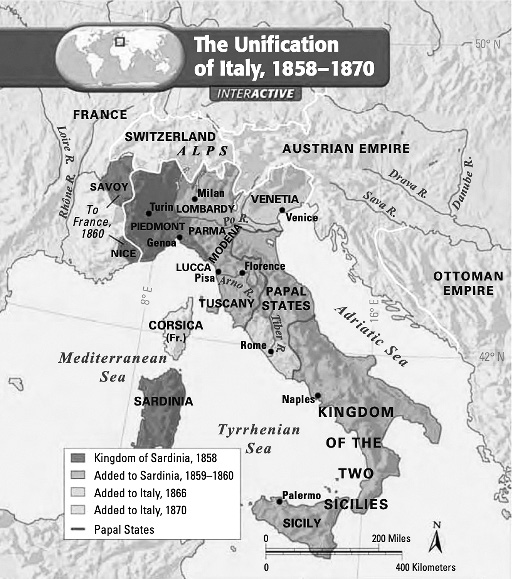
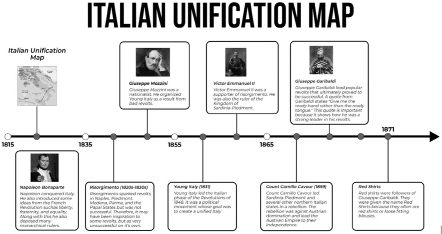
By 1850, Austria remained the dominant power on the Italian Peninsula. After the failure of the 1848 revolution, many Italians began to look to Piedmont, a northern Italian state, for leadership in unifying the country. The Kingdom of Piedmont, ruled by the Savoy royal family, included Piedmont, Sardinia, Nice, and Savoy. King Victor Emmanuel II became the ruler in 1849.
In 1852, Camillo di Cavour became the prime minister. A committed and pragmatic leader, Cavour focused on economic expansion to boost government revenues and strengthen the kingdom’s military.
Aware that Piedmont’s army was not strong enough to challenge Austria, Cavour sought an alliance with French Emperor Napoleon III. He provoked Austria into declaring war in 1859. The subsequent peace settlement resulted in Nice and Savoy being ceded to France in exchange for their alliance. Lombardy, previously under Austrian control, was now part of Piedmont, while Austria retained control over Venetia.
Nationalist Fervor
Cavour’s success inspired nationalists in other Italian states—such as Parma, Modena, and Tuscany—to overthrow their own governments and unite their territories with Piedmont.
• At the same time, a new figure emerged in southern Italy to lead the unification effort. Giuseppe Garibaldi, a devoted Italian patriot, assembled a volunteer force of
a thousand men. Known as the Red Shirts, they earned their name from the distinctive color of their uniforms.
Garibaldi’s Unification Drive:
A branch of the Bourbon dynasty ruled the Kingdom of the Two Sicilies, which included Sicily and Naples. In 1860, a revolt erupted in Sicily against the Bourbon king. Garibaldi and his volunteer forces landed on the island and, by July, had seized control of most of it. In August, Garibaldi crossed over to the mainland and launched a successful campaign up the Italian Peninsula. By early September, Naples and the entire Kingdom of the Two Sicilies had been conquered.
Garibaldi chose to hand over his territorial gains to Piedmont. On March 17, 1861, the unified Kingdom of Italy—now including Sicily and Naples—was officially declared under the rule of King Victor Emmanuel II.
However, Italian unification was still incomplete. Austria continued to hold Venetia in the north, and Rome remained under papal control, protected by French troops.
Unifying Rome: Austro-Prussian War
• Italy gained control of Venetia following the Austro- Prussian War of 1866. The new Italian state had allied with Prussia, and after Prussia’s victory, Italy was rewarded with Venetia.
• In 1870, during the Franco-Prussian War, French troops withdrew from Rome. This allowed the Italian army to move in and annex the city on September 20, 1870.
• With the annexation of Rome, it became the capital of the newly unified Italian state
German Unification
German Unification
Prussia: After the Frankfurt Assembly failed to unify Germany in 1848 and 1849, the German people began to look to Prussia for leadership in the unification effort. By the 19th century, Prussia had emerged as a strong and prosperous state with an authoritarian government. The Prussian king exercised tight control over both the government and the military, and the state was known for its emphasis on militarism, or dependence on military power.
Nationalism in Europe
In the 1860s, King William I sought to expand the Prussian army. When the Prussian legislature refused to approve new taxes to fund the proposed military reforms, William I appointed Count Otto von Bismarck as the new prime minister.
Count Otto von Bismarck
Count Otto von Bismarck is often considered the leading practitioner of realpolitik in the 19th century. Realpolitik, or the “politics of reality,” focused on practical matters rather than ideals or ethics. Bismarck was known for his unapologetic opposition to anyone who stood in his way. Upon his appointment, he ignored the legislative opposition to his military reforms, asserting that “Germany does not look to Prussia’s liberalism but to her power.” He collected taxes and strengthened the military, governing Prussia from 1862 to 1866 without parliamentary approval, all while pursuing an aggressive foreign policy.
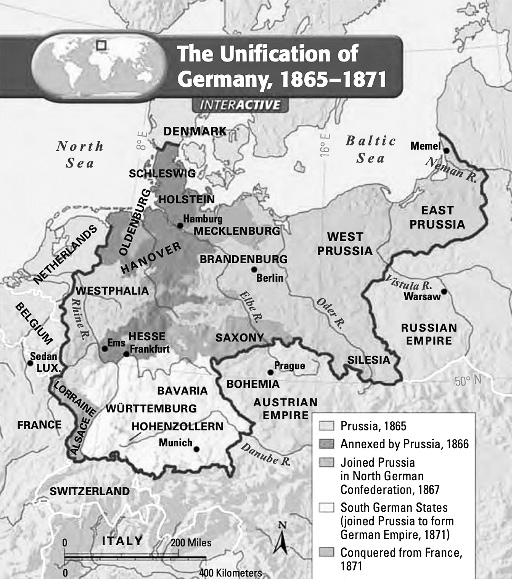
Unification Process: Bismarck’s journey to German unification began with the defeat of Denmark in 1864, with Austria’s assistance. Prussia gained control of the duchies of Schleswig and Holstein. In 1866, Bismarck stirred tensions with Austria, forcing them into war. The Austrians, unable to match the disciplined Prussian army, were decisively defeated by July 3. Prussia then united the northern German states into the North German Confederation. The southern German states, primarily Catholic, were wary of Prussia’s Protestant dominance but feared France more, and thus, they formed military alliances with Prussia.
War with France: By 1870, Prussia had established dominance over northern Germany, which began to concern France. Bismarck understood that a united Germany would pose a threat to French security. In 1870, a dispute over a relative of the Prussian king becoming the King of Spain gave Bismarck the opportunity to provoke France into war. He manipulated the situation, leading to France declaring war on July 19, 1870. This conflict, known as the Franco-Prussian War, saw French forces swiftly defeated by the superior Prussian army. The southern German states honored their alliances with Prussia, and Prussian armies advanced into France. On September 2, 1870, at Sedan, a French army and Napoleon III were captured. Paris surrendered on January 28, 1871, and a peace treaty was signed in May, with France paying a hefty indemnity and ceding the provinces of Alsace and Lorraine.
Unification Complete: Before the war’s end, the southern German states agreed to join the North German Confederation. On January 18, 1871, in the Hall of Mirrors at the Palace of Versailles, Prussian King William I was crowned Kaiser of the newly unified German Empire. The Prussian monarchy and military had accomplished German unity. With its industrial strength and military power, the new German state emerged as the most formidable force in Europe, embodying Prussia’s authoritarian and militaristic values.
Conclusion
Nationalism in Europe, as it evolved from the late 18th century to the 20th century, represents a complex and transformative force that profoundly reshaped the continent. Initially emerging as a response to the feudal monarchies and empires of the time, it was galvanized by the French Revolution’s ideals of self-determination and sovereignty. Throughout the 19th century, nationalism catalyzed the unification of fragmented states and the breakup of multi- ethnic empires, leading to the emergence of powerful nation- states like Germany and Italy.
While Nationalism played a crucial role in fostering a sense of unity and identity among diverse groups, it also sowed the seeds of conflict, as competing national aspirations often led to tensions and wars. The 20th century saw the destructive consequences of extreme nationalism, particularly in the form of two World Wars and the horrors of ethnic cleansing. Nevertheless, the post-war era witnessed a push towards European integration, with the European Union serving as a counterbalance to narrow nationalism.