The Course of the War
The Course of the War
Germany hoped to quickly defeat France with a rapid strike through Belgium, then shift its focus to Russia.
However, Russia launched attacks on Germany and Austria, forcing Germany to divert troops to the Eastern Front. This halted the German advance on France, leading to a prolonged stalemate in Europe.
Meanwhile, the war spread to various parts of the world, with battles fought in West Asia, Africa, and the Far East.
After the German advance was stopped, a new type of warfare emerged: trench warfare. Armies dug trenches and launched raids on each other, abandoning traditional open-field fighting.
On the Western Front, spanning eastern France and Belgium, both sides dug in and carried out continuous raids.
On the Eastern Front, Germany and Austria repelled Russian attacks, capturing parts of the Russian Empire, and also succeeded against Romania, Serbia, and Italy.
Outside of Europe, campaigns were fought against the Ottoman Empire in Palestine, Mesopotamia, and Arabia, as well as against Germany and Turkey in Iran.
Japan took control of German territories in East Asia, while Britain and France seized most of Germany’s African colonies.
On April 6, 1917, the United States declared war on Germany.
The German U-boats had sunk the British ship Lusitania in 1915, killing 1,153 passengers, including 128 Americans. This deepened American resentment towards Germany, as the public was generally sympathetic to Britain.
In 1917, Russia withdrew from the war after the October Revolution. The revolutionaries, led by Lenin, had opposed the war and sought to transform it into a revolutionary struggle to overthrow the autocracy.
Russia signed a peace treaty with Germany in March 1918, with harsh terms imposed on Russia. Despite the severity, the Russian government accepted these terms.
In response to Russia’s exit, the Entente powers intervened militarily, backing factions opposed to the revolution. This intervention led to a civil war in Russia, which lasted three years and ended with the defeat of both foreign forces and anti-revolutionary Russians.
Causes of World War 1
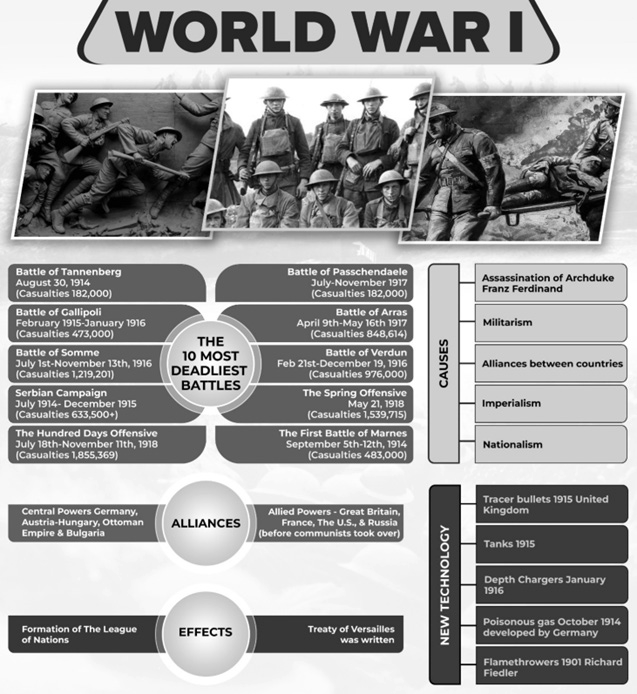
The rise of industrialization, colonialism, and imperialism fuelled intense rivalries among European nations as they competed for control over colonies in Asia and Africa. By the late 19th century, this competition became even more heated as colonies in these regions grew scarce. With no room for compromise, fuelled by mutual distrust and escalating hostilities, the stage was set for conflict. In 1914, war broke out in Europe, rapidly escalating to involve nations across the globe and their respective colonies. The scale of destruction caused by the war was unprecedented, earning it the title of World War I. This war didn’t emerge overnight; rather, it was the result of a complex web of factors and long-standing tensions that had been building for years, ultimately marking a dramatic turning point in world history.
Causes of the World War
The causes of the First World War can be traced to a combination of long-standing forces and developments that had been at work among the European nations for many years. Some of the key factors that contributed to the outbreak of the war include:
• The System of Secret Alliances
The system of secret alliances was one of the main causes that led to the outbreak of war.
In 1882, Germany, Austria, and Italy formed the Triple Alliance, agreeing to provide mutual military support against rival powers. In response, England, Russia, and France formed the Triple Entente in 1907.
This division of Europe into two opposing blocs heightened tensions and created a climate of hostility.
The countries in these alliances competed to produce increasingly deadly weapons, sparking an arms race. As mutual suspicion and hatred spread, the atmosphere of peace was shattered. Propaganda fueled the idea that, should war break out, all of Europe would inevitably be drawn into the conflict.
• Militarism
Militarism was another crucial factor that contributed to the outbreak of the war, closely tied to the system of secret alliances.
The concept of maintaining large armies began during the French Revolution and was later reinforced by Napoleon’s military reforms.
•
This system was further developed and expanded by Bismarck during the process of Germany’s unification.
• Following the Franco-Prussian War of 1870, all major European powers significantly increased their military and naval forces, leading to an arms race.
• Nationalism
• Nationalism played a significant role in causing the war, as a powerful wave of nationalist sentiment spread across Europe.
• This movement had its roots in the French Revolution, and the successful unification of Italy and Germany gave nationalism a new sense of strength, making it a dominant political force.
• Intense nationalism fuelled the rivalries between nations like Germany and Great Britain, further escalating tensions.
• It was this aggressive nationalism that drove European powers into disputes over their interests in regions like Asia, Africa, and the Balkans.
• In fact, much of the political unrest leading to the war can be traced back to the fervent spirit of nationalism that characterized the period.
• Urge to Imperialism
• By the late 19th century, Germany had made remarkable strides in economic and industrial growth, surpassing England and France in industrial production. To support its expanding economy, Germany, like Britain, needed colonies, making it a direct competitor in the imperial race.
• Alongside Germany, other major powers, including Japan, also harbored imperial ambitions. Italy, following its unification, aimed to seize Tripoli in North Africa, then under the Ottoman Empire. France sought to extend its control over Morocco, while Russia eyed Iran.
• In the Far East, Japan expanded its influence following its victory in the Russo-Japanese War of 1905.
• Austria focused its ambitions on the Ottoman Empire, and the United States, rapidly growing in power, prioritized maintaining its trade independence. The increasing expansion of any great power posed a serious threat to global peace..
• Newspapers, Press and the Public Opinion
• One of the underlying causes of the Great War was the role of newspapers in shaping public opinion across Europe.
• Newspapers often stirred nationalistic feelings by distorting or misrepresenting foreign events.
• On several occasions, when peaceful solutions to international issues were possible, the jingoistic tone of the press sabotaged diplomatic efforts.
• The popular press had a significant influence on national and international politics, sometimes escalating tensions.
• A notable example occurred in 1870 when Bismarck’s release of the Ems telegram inflamed extreme nationalist sentiment in Paris, leading to the Franco-Prussian War.
• This event demonstrates the harmful impact the press could have in escalating political tensions in Europe
Events Leading Up to the Outbreak of War
Events Leading Up to The Outbreak of War
• The Moroccan Crisis (1905-06)
This was an effort by Germany to expand its imperial influence and to challenge the recently established Anglo-French Entente Cordiale of 1904. Under this agreement, France recognized Britain’s control over Egypt in exchange for British support of a potential French claim over Morocco—one of the few remaining regions in Africa not yet under European colonial rule.
In response, Germany declared its intention to support the Sultan of Morocco in preserving his country's independence and called for an international conference to determine Morocco’s future.
A conference was held in Algeciras, southern Spain, in January 1906 to address the Moroccan crisis. The British feared that if Germany succeeded in its demands, it would effectively gain control over Morocco—marking a significant step toward German diplomatic dominance and advancing its Weltpolitik (world policy) agenda.
Having recently entered into the Entente Cordiale with France, Britain was determined to lead the opposition against Germany at the conference. Germany, however, underestimated the strength of the Entente, assuming that the long-standing rivalry between Britain and France would prevent real cooperation. To Germany’s surprise, Britain, along with Russia, Italy, and Spain, backed France’s demand to oversee Moroccan banking and police affairs.
It marked a significant diplomatic setback for Germany, which came to recognize that the emerging alliance between Britain and France was a powerful and unified front—especially as the crisis was soon followed by Anglo-French military discussions.
• The British agreement with Russia (1907)
The Germans saw Britain’s recent shift toward Russia as another unfriendly act. However, it made sense given that Russia had formed an alliance with France in 1894, which was now part of Britain’s “Entente Cordiale.”
For many years, Britain viewed Russia as a symbol of corruption, dominated by an aristocratic and undemocratic regime. Russia was also regarded as a major threat to British interests in the Far East and India.
However, this perception began to shift after Russia's defeat by Japan in the 1904–1905 war, which revealed its declining military strength.
The internal revolution of January 1905 further weakened Russia. In response, the Russian government aimed to ease tensions with Britain and attract British investment to support its industrial modernization.
In October 1905, Tsar Nicholas II introduced reforms, including freedom of speech and the creation of an elected parliament. These changes led Britain to adopt a more favorable view of the Russian regime.
As relations improved, Britain and Russia were able to resolve their longstanding disputes over Persia, Afghanistan, and Tibet. Although this was not a formal military alliance nor explicitly directed against Germany, the Germans interpreted it as a sign of a strengthening alignment between Britain, France, and Russia—one that they feared could eventually encircle them.
• The Bosnia Crisis (1908)
The crisis over Bosnia, a Turkish province, escalated tensions between Austria-Hungary and Serbia to the breaking point.
In 1878, the Congress of Berlin had made a complex decision that Bosnia should remain under Turkey’s sovereignty, but Austria-Hungary would handle its administration.
By 1908, a new government in Turkey, led by the Young Turks (a group of army officers), opposed Austria’s presence in Bosnia and aimed to reassert Turkish control over the region.
This situation gave Austria the opportunity to act first. They formally annexed Bosnia, which angered Serbia, as Bosnia had a large Serb population, and Serbia had long coveted the province.
Serbia appealed to Russia, hoping for support from their fellow Slavs. Russia called for a European conference, expecting to gain backing from France and Britain.
When it became clear that Germany would back Austria in the event of war, France hesitated, unwilling to get involved in a Balkan conflict.
The British, eager not to upset Germany, only protested Austria-Hungary’s actions. Meanwhile, Russia, still recovering from its defeat by Japan, was too cautious to provoke war without stronger allies. As a result, Serbia received no support, and no conference took place.
This outcome marked a victory for the Austro-German alliance.
• The Agadir Crisis (1911)
The crisis began with further developments in Morocco. French troops moved into Fez, the Moroccan capital, to suppress a rebellion against the Sultan. It appeared that France was on the brink of annexing Morocco.
In response, Germany sent the gunboat Panther to the Moroccan port of Agadir, aiming to pressure France into offering compensation, possibly the French Congo.
Britain became concerned that if Germany gained control of Agadir, it could establish a naval base that would threaten British trade routes.
Despite the tension, France remained resolute and made no significant concessions. Eventually, Germany withdrew the Panther, agreeing to recognize the French protectorate over Morocco in exchange for two strips of land in the French Congo.
While this was seen as a victory for the Entente powers, it sparked strong anti-British sentiment in Germany, particularly as Britain continued to pull ahead in the naval arms race..
• The First Balkan War (1912)
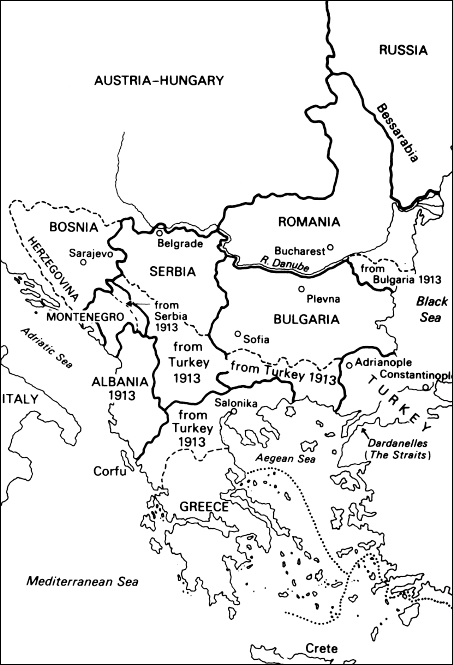
The war began when Serbia, Greece, Montenegro, and Bulgaria, collectively known as the Balkan League, launched a series of attacks on Turkey.
These countries, once part of the Ottoman Empire, saw Turkey’s weakening position as an opportunity to seize more land. They quickly captured most of the remaining Turkish territory in Europe.
In an effort to prevent the conflict from escalating, Sir Edward Grey, the British Foreign Secretary, along with the German government, organized a peace conference in London. The goal was to contain the war and show that Britain and Germany could still cooperate.
The peace settlement divided the former Turkish lands among the Balkan states, but the Serbs were dissatisfied
with their share. They desired Albania to gain access to the sea. However, the Austrians, supported by both Germany and Britain, insisted that Albania should become independent to prevent Serbia from growing stronger.
• The Second Balkan War (1913)
The Bulgarians were dissatisfied with their gains from the peace settlement and they blamed Serbia. They had been hoping for Macedonia, but most of it had been given to Serbia.
Bulgaria therefore attacked Serbia, but their plan misfired when Greece, Romania and Turkey rallied to support Serbia.
The Bulgarians were defeated, and by the Treaty of Bucharest (1913), they forfeited most of their gains from the first war.
It seemed that Anglo-German influence had prevented an escalation of the war by restraining the Austrians, who were itching to support Bulgaria and attack Serbia.
• The assassination of the Austrian Archduke Franz Ferdinand
The tragic event that took place in Sarajevo, the capital of
Bosnia, on June 28, 1914, served as the immediate trigger
for Austria-Hungary’s declaration of war on Serbia—a conflict that quickly escalated into the First World War.
On that day, Archduke Franz Ferdinand, heir to the Austro-Hungarian throne, and his wife visited Sarajevo and were assassinated by Gavrilo Princip, a Bosnian Serb nationalist. Vienna viewed the assassination as an act of provocation by Serbia.
Austria then issued an ultimatum with demands it knew Serbia would likely reject. When Serbia’s response was deemed unsatisfactory, Austria-Hungary declared war on July 28.
In support of Serbia, Russia ordered a general mobilization on July 29, determined not to abandon the Serbs again. In response, Germany demanded that Russia halt its mobilization (July 31). When Russia failed to do so, Germany declared war on Russia on August 1 and on France two days later, on August 3.
When German troops entered Belgium on their way to invade France, Britain (who in 1839 had promised to defend Belgian neutrality) demanded their withdrawal. When this demand was ignored, Britain entered the war (4 August). Austria-Hungary declared war on Russia on 6 August. Other countries joined later.
End of the War
End of the War
• Efforts to end the war were made throughout 1917. Some socialist parties called for an international conference to discuss peace, with a focus on ending the war without annexations and recognizing the right of peoples to self- determination.
• In January 1918, U.S. President Woodrow Wilson proposed his peace plan, known as the Fourteen Points.
These proposals included principles such as open diplomacy between countries, freedom of navigation, reduction of armaments, recognition of Belgium’s independence, the return of Alsace-Lorraine to France, the creation of independent nations in Europe, and the establishment of an international organization to safeguard the sovereignty of all states. Many of these ideas were later incorporated into the peace treaties that concluded the war.
• In July 1918, Britain, France, and the United States launched a major military offensive that led to the collapse of Germany and its allies.
• Bulgaria withdrew from the war in September, followed by Turkey’s surrender in October.
• Political unrest grew in Austria-Hungary and Germany. On November 3, the Emperor of Austria-Hungary abdicated.
• In Germany, a revolution erupted, resulting in the establishment of a republic. Kaiser Wilhelm II fled to the Netherlands. The new German government signed an armistice on November 11, 1918, officially ending the war.
The Conference of Paris, 1919
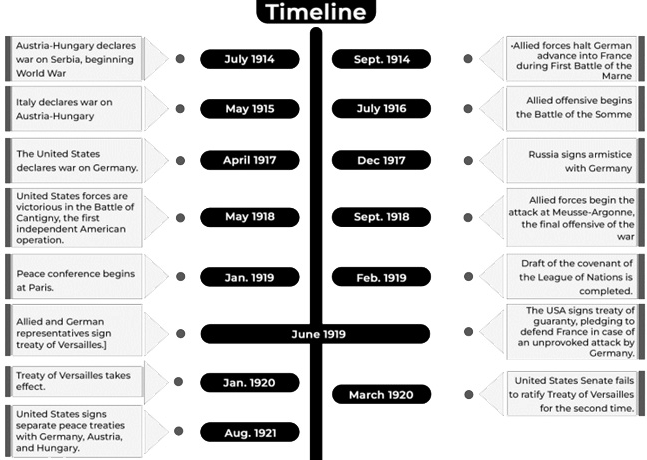
• The Paris Peace Conference formally opened on January 18, 1919, to establish the peace terms after World War I.
• This conference was more inclusive than the Congress of Vienna in 1815, as it was not dominated by monarchs. Most of the countries were represented by their Prime Ministers and Foreign Ministers, with two notable exceptions: President Woodrow Wilson and King Albert of Belgium.
• The composition of the conference was significant, as it included not only the ‘Allies’ but also the ‘Associated Powers’. These were nations that, although not always directly involved in the war’s early stages, had joined toward the end, hoping to influence the post-war settlement.
However, there were key groups missing from the discussions: neutral powers, the Russians (who were embroiled in civil war and external intervention), and the defeated countries—Germany, Austria-Hungary, Bulgaria, and Turkey—were not invited to participate.
• Despite these omissions, the Paris Peace Conference was the largest peace gathering ever held, even though its limitations were evident.
• The ‘Big Five’ the United States, Britain, France, Italy, and Japan had two representatives each at the conference. However, Japan quickly lost interest and withdrew, and by the end of April 1919, Italy followed suit.
• During the course of the conference, three treaties were signed with the former Central Powers, and two additional treaties were finalized in January 1920, after the official closure of the conference.
Peace Treaties
• The victorious powers, also known as the Allies, gathered for peace talks in Versailles, a suburb of Paris, from January to June 1919.
• Although 27 countries were represented, the terms of the peace treaties were largely determined by three nations: Britain, France, and the United States.
• The key figures shaping the treaty discussions were Woodrow Wilson, President of the U.S., Lloyd George, the British Prime Minister, and Georges Clemenceau, the French Prime Minister.
The defeated nations were not invited to the negotiations, and even Russia, which had been part of the Allied powers, was excluded from the conference. The treaties were thus imposed on the defeated countries without direct negotiations.
Treaty of Versailles
• The main treaty, the Treaty of Versailles, was signed with Germany on June 28, 1919, under duress. Germany’s new republican government had little choice but to sign, as they faced the threat of invasion.
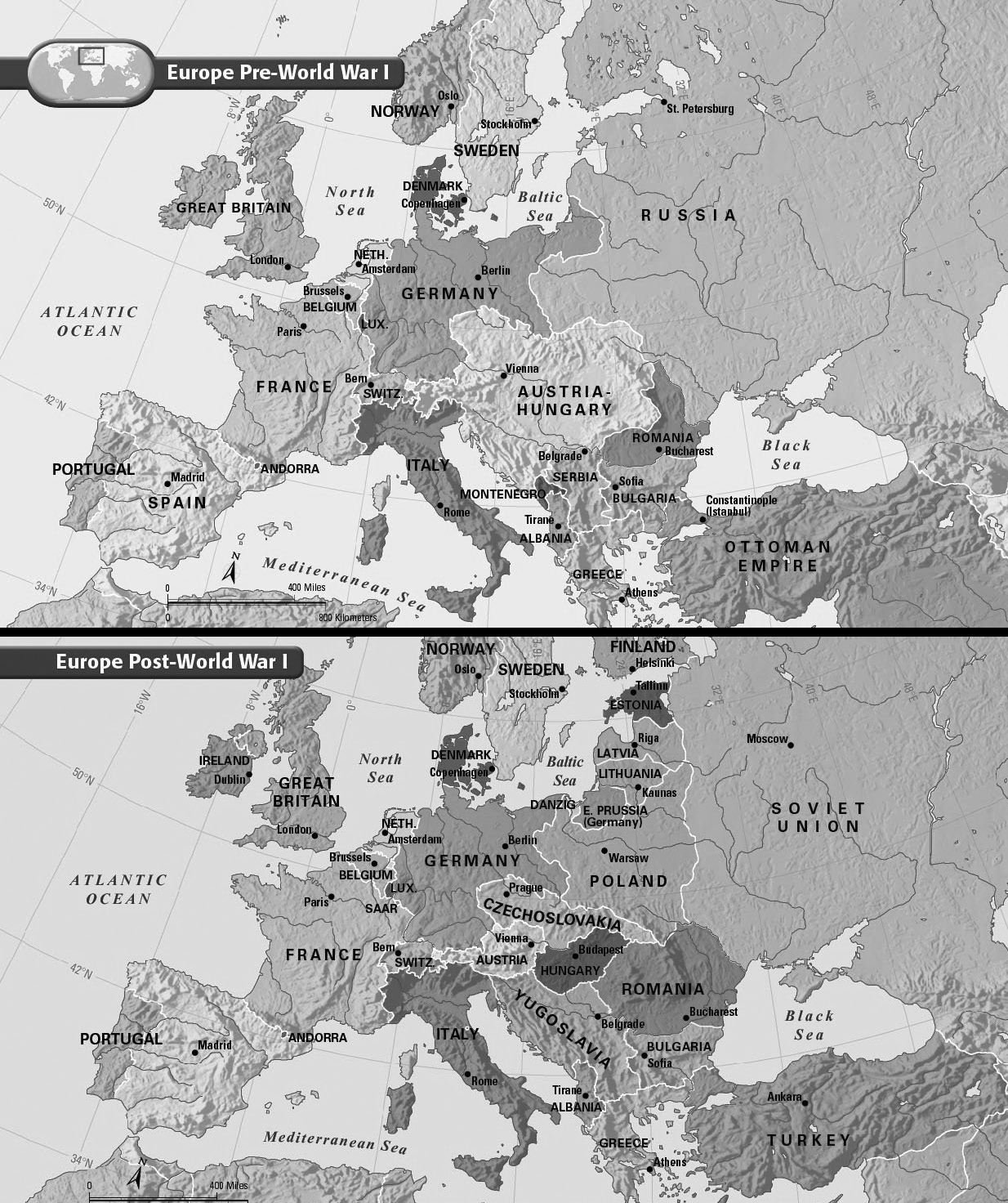
• The treaty declared Germany and its allies guilty of aggression and required Germany to make significant territorial and military concessions. Alsace-Lorraine was returned to France, and the Saar coal mines were ceded to France for 15 years under League of Nations administration.
• Germany also lost parts of its pre-war territory to Denmark, Belgium, Poland, and Czechoslovakia, and the Rhineland was demilitarized.
• Germany’s military was severely restricted, with its army limited to 100,000 troops, and it was banned from having an air force or submarines. The country also lost all of its colonies, which were taken over by the victorious powers.
• German colonies in Africa, including Togo, Cameroon, South-West Africa, and East Africa, were divided between Britain, France, Belgium, South Africa, and Portugal.
• In the Pacific, German territories and spheres of influence, including areas in China, were handed over to Japan. Despite being aligned with the Allies during the war, China’s territories under German control were not returned to China but were instead transferred to Japan.
• Germany was also required to pay reparations for the damages inflicted during the war.
Treaty of Saint-Germain
• Signed on September 10, 1919, the Treaty of Saint- Germain dissolved the Austro-Hungarian Empire and forced Austria to recognize the independence of many of its former territories. This included the newly formed nations of Czechoslovakia, Yugoslavia, and parts of Poland.
Treaty of Neuilly and Trianon
• Bulgaria signed the Treaty of Neuilly in November 1919, losing land to the newly formed Yugoslavia and losing all access to the Aegean Sea.
• Hungary, now an independent state after separating from Austria, faced significant territorial losses under the Treaty of Trianon, signed on June 4, 1920. Two-thirds of Hungary’s territory and 58% of its population were lost.
Treaty of Sevres
• The Treaty of Sevres, signed in August 1920, officially dismantled the Ottoman Empire.
• Britain was granted control of Palestine and Mesopotamia (modern-day Iraq), while France took Syria. These regions
were designated as ‘mandates’, meaning Britain and France would govern them under the guise of protecting local populations, but in reality, they were treated as colonies.
• Much of the remaining Ottoman territory was given to Greece and Italy, leaving Turkey as a small state.
• The Turkish nationalist movement, led by Mustafa Kemal, strongly opposed the Treaty of Sevres, sparking a nationalist uprising.
• As a result, the Treaty of Lausanne was signed in 1923. Turkey relinquished claims over Arab-majority territories and renounced the Islamic foundation of the state. A new Turkish Republic was established under Mustafa Kemal’s leadership.
Consequences of the War
Consequences of the War
Loss of Human Lives
The war caused extensive destruction, both in terms of
human lives and material resources, with millions of people losing their lives.
Russia suffered the greatest losses, with around 2 million casualties. Germany lost nearly 2 million, France and its colonies over 1.25 million, Austria nearly 1.25 million, and the British Empire about 1 million. The United States lost approximately 100,000 soldiers.
This level of casualties was unprecedented in European warfare. The massive loss of life significantly impacted the population structure, especially in terms of gender and age groups. Female casualties were considerably lower, creating an imbalance that led to numerous social challenges and related issues within society.
Social and Economic Changes
The war significantly advanced women’s emancipation, especially where the movement had already gained traction before 1914.
In 1918, women over 30 in Britain were granted the right to vote, largely due to the national effort required by the war. Civilian morale and industrial production became just as crucial as military efforts, highlighting women’s contribution to the war effort.
Women worked across various sectors, including factories, offices, hospitals, schools, and voluntary services, alongside men. Their active participation strengthened their claim for equality.
This period also led to easier access to jobs in industry and business, as old barriers, including class and wealth distinctions, were diminished. The shared hardships of war fostered a sense of unity, and the “fellowship of the trenches” weakened social divisions.
The economic strain of the war was staggering. Great Britain’s debt increased dramatically, and the total loss inflicted on all warring nations was estimated at around
$186 billion.
The war disrupted global trade, causing severe economic
dislocation. Europe’s industrial dominance was undermined, and when trade resumed, Europe found itself far behind other nations.
The United States saw substantial growth in its exports, while new industries emerged in South America and India.
Japan also entered the textile trade, flooding markets in China, India, and South America, shifting the global trade landscape.
When European leaders called for a return to the pre-war world of 1913, they failed to recognize that modern war had effectively marked the end of that era, much like the fall of empires in history.
In the post-war period, nationalism in the Balkans became increasingly intolerant of any solution that did not balance national economies. Countries with developing industries sought protection, while older industrial powers, like Britain, sought to safeguard their economies against new competition.
France’s economic recovery was aided by the return of Alsace and Lorraine and the cession of Saar coal mines for 15 years. However, many other economic challenges could not be solved through reparations alone.
Belgium suffered significant damage, with its railway system severely disrupted and most of its steel mills destroyed or damaged beyond repair..
Democratic Ideals
Despite its devastating impact, the war introduced democratic ideals and institutions to many peoples who were previously unfamiliar with them. The conflict had been declared as a fight to “make the world safer for democracy,” so naturally, the newly independent states were eager to establish democratic systems.
One after another, countries adopted new democratic constitutions. Germany led the way by creating the Weimar Republic, which featured one of the most comprehensive democratic constitutions ever drafted, inspired by the American, French, British, and Swiss models.
However, the major challenge for these new democracies was that they were imposed on societies where social structures had changed very little. The only unifying sentiment among the people was a widespread national resentment over their defeat and the harsh peace terms imposed by the Allies.
Similarly, democratic institutions in other European countries remained fragile due to their patchwork nature. Nevertheless, the war gave a significant boost to democratic movements worldwide.
The New International Machinery
The League of Nations was established as a global organization designed to replace the outdated system of “power politics.” It aimed to provide a structured
mechanism for peacefully resolving disputes and conducting arbitration, moving away from secret diplomacy, exclusive alliances, and the traditional balance-of-power approach.
The concept of the League was strongly promoted by President Woodrow Wilson, though it was later adjusted to accommodate British and French suggestions.
In one sense, the League was a sophisticated revival of the Concert of Europe, transforming it into a broader international collaboration. In another sense, it represented a new direction—members pledged to resolve conflicts peacefully and to collectively respond to acts of aggression.
The League was not a government in itself, but rather a collaborative platform available to all nations, designed to help maintain global peace.
Failure of the League
The League of Nations was significantly weakened from the outset by the absence of the United States, along with the exclusion of both Germany and Soviet Russia. Japan’s limited commitment further undermined its credibility. In effect, the League became little more than a support mechanism for the postwar settlement, with real participation limited to the British Commonwealth, France, and Italy. However, Italy soon undermined the
League’s authority through its aggressive expansionist policies under Fascist leader Benito Mussolini.
Ultimately, the League of Nations failed in its most critical mission: the preservation of global peace.
Successes of the League
Despite its overall shortcomings, the League of Nations did achieve success in resolving several minor disputes. In cases where states genuinely committed to the process of conciliation, the League's mechanisms proved effective.
Notably, it peacefully resolved the conflict between Sweden and Finland over the Åland Islands. It also intervened successfully on three occasions in the volatile Balkan region and settled a border dispute between Iraq and Turkey.
Two key subsidiary bodies of the League were the Permanent Court of International Justice and the International Labour Organization (ILO). The Court was established to handle legal disputes between states, while the ILO focused on labor issues. Both institutions later became integral parts of the United Nations system.
World War and India
World War and India
The First World War had a deep and lasting impact on Indian society and economy, with its effects varying across different sections of the population.
For the poorer classes, the war brought significant hardship. Increased taxation and war demands led to widespread poverty, with agricultural products and essential goods becoming scarce. This scarcity caused prices to skyrocket, making life even more difficult for the common people.
As desperation grew, many people became increasingly willing to support any movement that opposed the British government. This created a fertile ground for political unrest, and the war years saw a surge in nationalist agitation. This period eventually led to the launch of the Non-Cooperation Movement, spearheaded by Gandhi, which sought to challenge British rule.
On the other hand, the war proved to be beneficial for Indian industrialists. As Britain faced an economic crisis, it turned to Indian industries to meet the demands of the war. The jute industry, for example, saw significant growth during this period.
The war thus accelerated the industrial development of India. Indian industrialists capitalized on the opportunities created by the conflict, amassing wealth. Their newfound prosperity encouraged them to protect their interests, and many of them began to align themselves with the nationalist movement, recognizing the need to support India’s struggle for independence.
In this way, the war played a role in fostering a wave of nationalism across different sections of Indian society, contributing to the country’s growing economic independence, which would continue to develop in the years to come.
Conclusion
Conclusion
World War I, which ranged from 1914 to 1918, stands as a watershed moment in human history. It marked a brutal departure from the previous era and ushered in a new age of mechanized warfare, profoundly altering the political, social, and economic landscape of the world. The war’s immense human cost, with millions of lives lost and countless more scarred physically and emotionally, serves as a haunting reminder of the horrors of modern warfare.
World War I reshaped the global order, leading to the dismantling of empires, the redrawing of borders, and the creation of the League of Nations in an attempt to prevent future conflicts. It also had profound cultural and intellectual repercussions, contributing to the disillusionment of the Lost Generation and influencing art, literature, and philosophy. Moreover, the unresolved issues and punitive terms of the Treaty of Versailles sowed the seeds for the even more catastrophic World War II, underscoring the imperative of diplomacy and international cooperation. In conclusion, World War I represent a pivotal moment in history, serving as a stark reminder of the devastating consequences of unchecked nationalism, militarism, and conflict while highlighting the urgent need for lasting peace and diplomacy in the modern world