Correct Answer:
(B)
Dismantling barriers in international trade
Globalization is the word used to describe the growing interdependence of the world’s economies, culture, and population, brought about by cross-border trade in goods and services, technology, and flows of investment, people, and information. The process of globalization generally refers to increasing free trade between countries and dismantling barriers in international trade.
Ques:
2
Globalization of Indian Economy means :
Correct Answer:
(C)
Having minimum possible restrictions on economic relations with other countries.
Globalization generally means integrating economy of our nation with the world economy through trade, foreign direct investment, capital flows, migration, and the spread of technology. It refers to the free movement of people, goods, services and capital across boundaries. Hence, among the given options, globalization of Indian economy means having minimum possible restrictions on economic relations with other countries.
Ques:
3
Assertion (A) : The new EXIM policy is liberal, market-oriented and favours global trade.
Reason (R) : GATT has played a significant role in the liberalization of the economy.
Correct Answer:
(B)
Both A and R are individually true, but R is not the correct explanation of A
The EXIM Policy 2002-07 was more liberal, market-oriented and favourable to global trade than the previous trade policies. General Agreement on Trade and Tariff (GATT) and subsequently the World Trade Organization (WTO) came to existence and has played a significant role in the liberalization of the economy. Hence both statement and reason are correct but reason is not the correct explanation of statement.
Ques:
4
Given below are two statements, one labelled as Assertion (A) and the other labelled as Reason (R).
Assertion (A) : An important policy instrument of economic liberalization is reduction in import duties on capital goods.
Reason (R) : Reduction in import duties would help the local entrepreneurs to improve technology to face the global markets.
In the context of the above two statements, which one of the following is correct?
Correct Answer:
(A)
Both A and R are true and R is the correct explanation
Liberalization is the process of elimination of the control of the State over economic activities. It provides greater autonomy to the business in decision making and eliminates interference of the government. After India adopted new economic policy in 1991, there has been a drastic change in the economy. An important policy instrument of economic liberalization is the reduction in import duty on capital goods, which makes free flow of capital. Reduction in import duties on capital goods would help the local entrepreneurs to improve technology to face the global markets. Hence, both statements are correct and explain one of the instruments to liberalize the Indian economy.
Ques:
5
Consider the following statements about the recent Foreign Trade Policy :
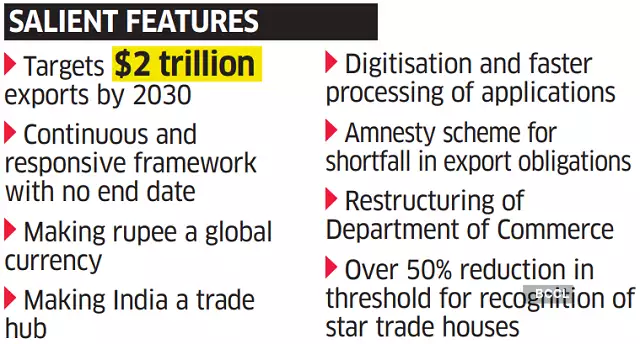
It’s major objective is to double the India's share of global merchandise trade by the end-year of the policy.
It emphasizes on economic development and not on employment generation.
Which of the above given statements is/are correct?
Correct Answer:
(A)
only 1
Ques:
6
What is called the twin deficits of 1990?
Correct Answer:
(D)
Deficit in trade balance and fiscal deficit
The "twin deficits" concept refers to a situation where a country experiences both a trade deficit (imports exceeding exports) and a fiscal deficit (government spending exceeding government revenue).
Ques:
7
What were the main causes of the depreciation of the Indian currency in 1990?
Correct Answer:
(C)
Deficits, the overvaluation of the rupee and investor confidence
The main factors contributing to the depreciation of the Indian rupee in 1990 were deficits, the overvaluation of the rupee, and investor confidence. Specifically, the country's large current account deficit, combined with high fiscal deficits and a gradual overvaluation of the rupee, created a situation where the currency's value was unsustainable. This was further exacerbated by a loss of investor confidence, which led to a flight of capital and a surge in demand for foreign currency, ultimately driving down the value of the rupee.
Ques:
8
How did the Reserve Bank of India handle the depreciation of the Indian currency during the 1990-1991 period?
Correct Answer:
(D)
Expanded international reserves and slowed the decline in value
anded international reserves and slowed the decline in value
Answer: d
Explanation:
During the 1991 Indian economic crisis, the Reserve Bank of India (RBI) attempted to stabilize the rupee's value by expanding international reserves and slowing its decline, according to the International Monetary Fund and IMF Working Papers. However, this strategy ultimately proved insufficient, and the rupee was devalued significantly.
Ques:
9
The primary goal of India’s structural reforms was:
Correct Answer:
(C)
Faster economic growth
A primary goal of India's structural reforms, particularly those initiated in 1991, was to achieve faster economic growth. These reforms, which included liberalization, privatization, and globalization (often referred to as LPG), aimed to create a more conducive environment for economic development and to attract foreign investment, ultimately leading to a surge in GDP growth.
Ques:
10
The Indian economic reform of 1991 saw significant changes in which sector?
Correct Answer:
(A)
Banking
The 1991 Indian economic reforms significantly impacted the banking sector, moving it from a highly controlled environment to one with greater market liberalization and competition. This included allowing commercial banks to determine interest rates, the freedom to import goods, and the removal of restrictions on industries. The reforms also led to the development of the stock market, with the establishment of institutions like SEBI to regulate it.