15th Finance Commission on Disaster Management
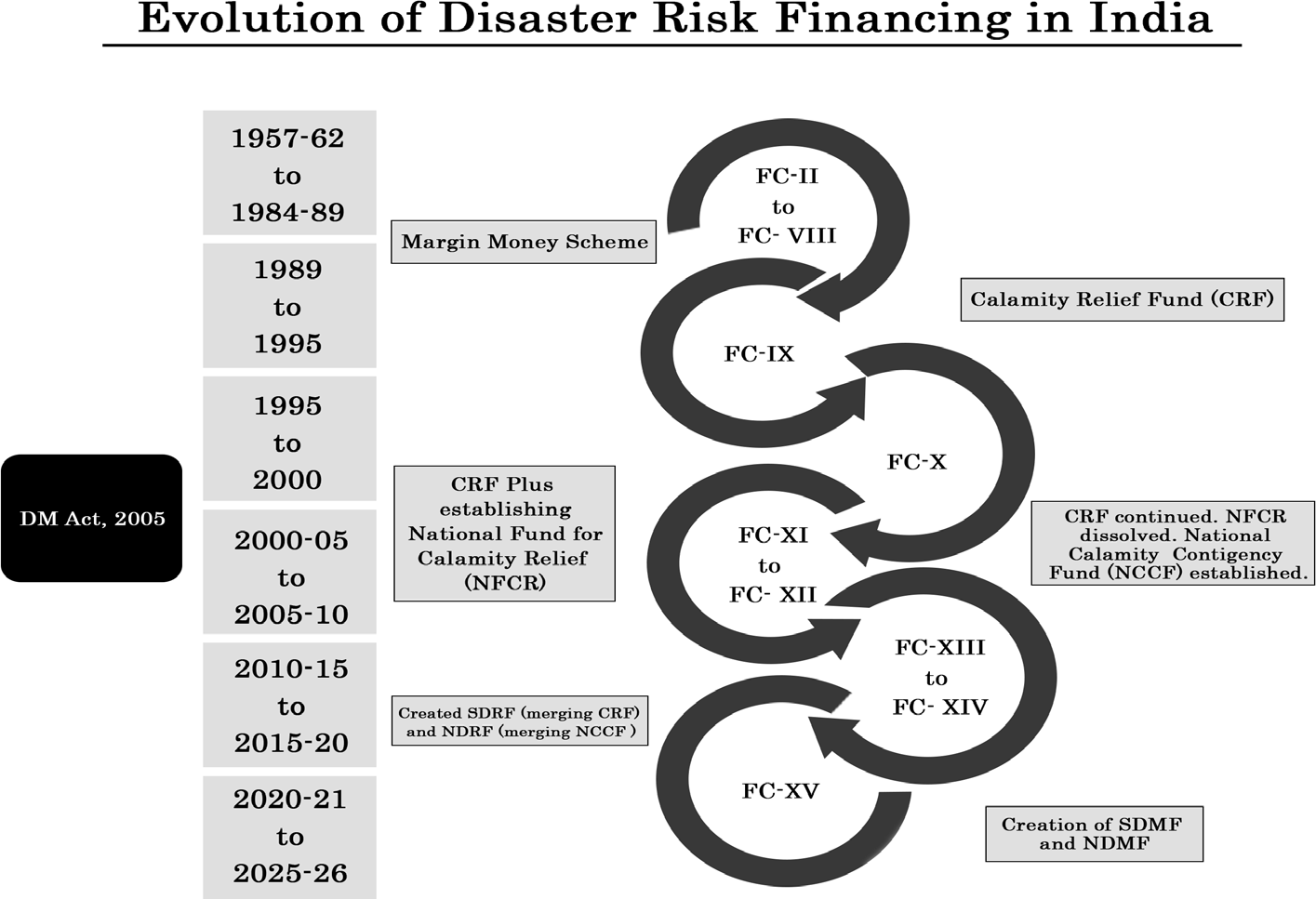
Fig: Evolution of Disaster Risk Financing in India
The contribution of states to the State Disaster Risk Fund (SDRF) remains at 25%, except for the Northeastern states, where it is set at 10%.
Establishment of Mitigation Funds at both the national and state levels, in accordance with the Disaster Management Act, 2005.
These funds should be utilized for local and community-based initiatives aimed at reducing disaster risks and promoting environmentally sustainable settlements and livelihood practices.
• Priority Areas for Funding:
• Allocating funds for the National Disaster Response Force (NDRF) to support the expansion and modernization of fire services and the resettlement of individuals displaced due to erosion.
• Providing financial support for the National Disaster Mitigation Fund (NDMF) to assist twelve drought- prone states, manage seismic and landslide risks in ten hilly states, mitigate urban flooding in seven major cities and implement erosion prevention measures.
• New Allocation Methodology:
• Previously, the Finance Commissions up to the 14th Finance Commission used an expenditure-based approach to allocate disaster management funds to states.
• The 15th Finance Commission introduced a new methodology based on:
• Capacity: Determined by past expenditure
• Risk Exposure: Assessed through area and population affected
• Hazard & Vulnerability: Measured using a disaster risk index
• National and State-Level Disaster Risk Management Funds:
• The National Disaster Risk Management Fund (NDRMF) and State Disaster Risk Management Fund (SDRMF) have been established at the national and state levels, respectively.
• NDRMF comprises both the NDRF and NDMF, while SDRMF includes SDRF and SDMF.
• From the total allocated disaster management grants at both levels, 20% is designated for mitigation efforts, while 80% is allocated for response activities.
• Changes in Funding Structure:
• The response fund is divided into three components:
• Response & Relief (40%) – 40% of NDRMF/ SDRMF is designated for immediate disaster response and relief efforts.
• Recovery & Reconstruction (30%) – Since most expenditures have historically been focused on response and relief, this allocation ensures resources are available for rebuilding assets and livelihoods.
• Preparedness & Capacity Building (10%)–
Recognizing the importance of disaster preparedness, this portion supports State Disaster Management Authorities (SDMAs), State Institutes of Disaster Management (SIDMs), training programs, capacity-building activities, and emergency response infrastructure.
• Cost Sharing Arrangement (Between Centre & States)
• Financial support from the National Disaster Response Fund (NDRF) and the National Disaster Mitigation Fund (NDMF) should be provided on a cost-sharing basis.
• The cost-sharing structure should follow a graded approach:
• States must contribute 10% for assistance amounts up to ₹250 crores.
• For assistance up to ₹500 crores, the state's contribution increases to 20%.
• For amounts exceeding ₹500 crores, states are required to contribute 25%.
• Implementing this cost-sharing model will help prevent excessive financial demands from states driven by competitive populism.
• Priorities related to preparedness, mitigation, and recovery through special initiatives
Four Priorities under NDMF
• Catalytic Assistance to develop district level drought mitigation plans (12 most drought prone States): Andhra Pradesh, Bihar, Gujarat, Jharkhand, Karnataka, Madhya Pradesh, Maharashtra, Odisha, Rajasthan, Tamil Nadu, Telangana, and Uttar Pradesh
• Reducing risk of Urban Flooding (7 most populous cities): Mumbai, Chennai & Kolkata, Bengaluru, Hyderabad, Ahmedabad, and Pune
• Managing Seismic & Landslide Risk (10 hill states): Himachal Pradesh, Uttarakhand and eight states in the North East
• Mitigation measures to prevent erosion to mitigate the risk of erosion. States would need to apply for these funds for undertaking erosion mitigation works.
Two Priorities under NDRF
• Resettlement of displaced people affected by erosion: To provide alternate settlements to people from recovery & reconstruction window of NDRF
• Expansion & modernisation of fire services: For strengthening fire services at state level, allocated through preparedness & capacity building head of NDRF. States contribution shall be 10% of amount sought.
• Empowering Panchayati Raj Institutions For Disaster Preparedness & Management
• Crucial/Critical to build capacities at the Panchayat Level
• PRIs have their own proximity to local community including weaker sections
• Hence, ability to enlist people’s participation on institutionalization basis
• Involvement would ensure quick response to disaster events (man-made or natural)
• Minimization on dependence on Government for rescue & relief
• It will be a Bottom-Up approach instead of top-down approach for disaster management
• PRIs can play a pro-active role in all stages of disaster management
• Relief, Recovery and Reconstruction and Mitigation
activities to be undertaken by the Panchayats
• State Governments should allocate some reasonable amount under the SDRF and SDMF to districts
• Alternate Source of Funding: Public Funds no matter howsoever large it will be inadequate for contingent situations hence mobilisation through alternate sources would be necessary. Some of the recommended sources include:
• Reconstruction Bonds
• In a Post Disaster situation States can issue reconstruction bonds
• Maturity of 3-5 years and with approval of Union Government
• Resources raised by bonds should largely be spent on construction of productive & social assets.
• Contingent Credit/ Stand-by facility (IFIs)
• The World Bank and ADB have been the vital sources of financial assistance post disasters.
• A long-term arrangement could be set-up to make lending operation shorter & easier.
• Activated if the cost of disasters exceeds a certain threshold.
• Costof borrowing, knowledge transfer and organisational help may be considered beforehand.
• Crowd Funding Platforms
• Way of raising funds from public through internet campaigns
• Playing an increasingly larger role in fundraising
• Government may set a platform with specified objectives and an assurance of transparency.
• Identifying the right time, setting up secure payment gateways and ensuring accountability.
• Union and State government should together prepare operational guidelines.
• Corporate Social Responsibility
• Tax exemptions to contributions to the NDRF and SDRF
• Enabling provision for the contribution of the private sector to disaster funding windows.
• Steps should be taken to improve & diversify private sector support for disaster management.
• Insurance & Risk Pooling
• Disaster relief through an Insurance intermediary earlier considered impractical.
•
Presently essential conditions for market-based risk management instruments exist in niche areas.
• Use of Insurance is most efficient for natural perils i.e. infrequent but with high potential impact.
XV FC has proposed four Insurance interventions
• National Insurance scheme for Disaster related deaths
• SynchronisingRelief assistance with Crop insurance
• Risk Pool for infrastructure protection & recovery
• Access to International Reinsurance for outlier hazard events
These will provide an additional layer of protection to people.
Will not replace the existing funding mechanism but will supplement them.
• Outcome Framework:
• Develop an Outcome Framework
• Link the State Allocations to Sendai Framework Indicators
• An annual report at the national level to record all the allocations, expenditures, key achievements and results against various indicators developed for the SFDRR.
• Dedicated capacity for managing NDRMF and SDRMF with emphasis on purpose of utilisation. Setting up an online system for release of fund allocations, expenditures and outstanding balance for each State.
• Two-stage assessment for NDRF allocation
• First assessment to ascertain humanitarian and relief needs
• Second assessment to cover damage, loss and recovery needs
• Post Disaster Needs Assessment (PDNA) may be used as a standard methodology for post disaster assessment.
• Setting up a Disaster Database as a special initiative: Database to include disaster assessments, fund allocation details, expenditures, preparedness and mitigation plans
• Disbursing assistance to women members of household: Cash assistance to be transferred to the families in a way that women members of the household also get access to money.