3D PRINTING
• 3D printing, also known as additive manufacturing, is a method of creating prototypes or functional models of products by layering materials such as plastic, resin, thermoplastic, metal, fibre, or ceramic.
• Compared to traditional subtractive techniques, 3D printing offers immense design flexibility, reduced waste and the ability to produce complex geometries.
• With a market share of more than 35%, the United States is the global leader in 3D printing. China controls almost half of the Asian market, followed by Japan (30%) and
South Korea (10%).
Process of 3D Printing
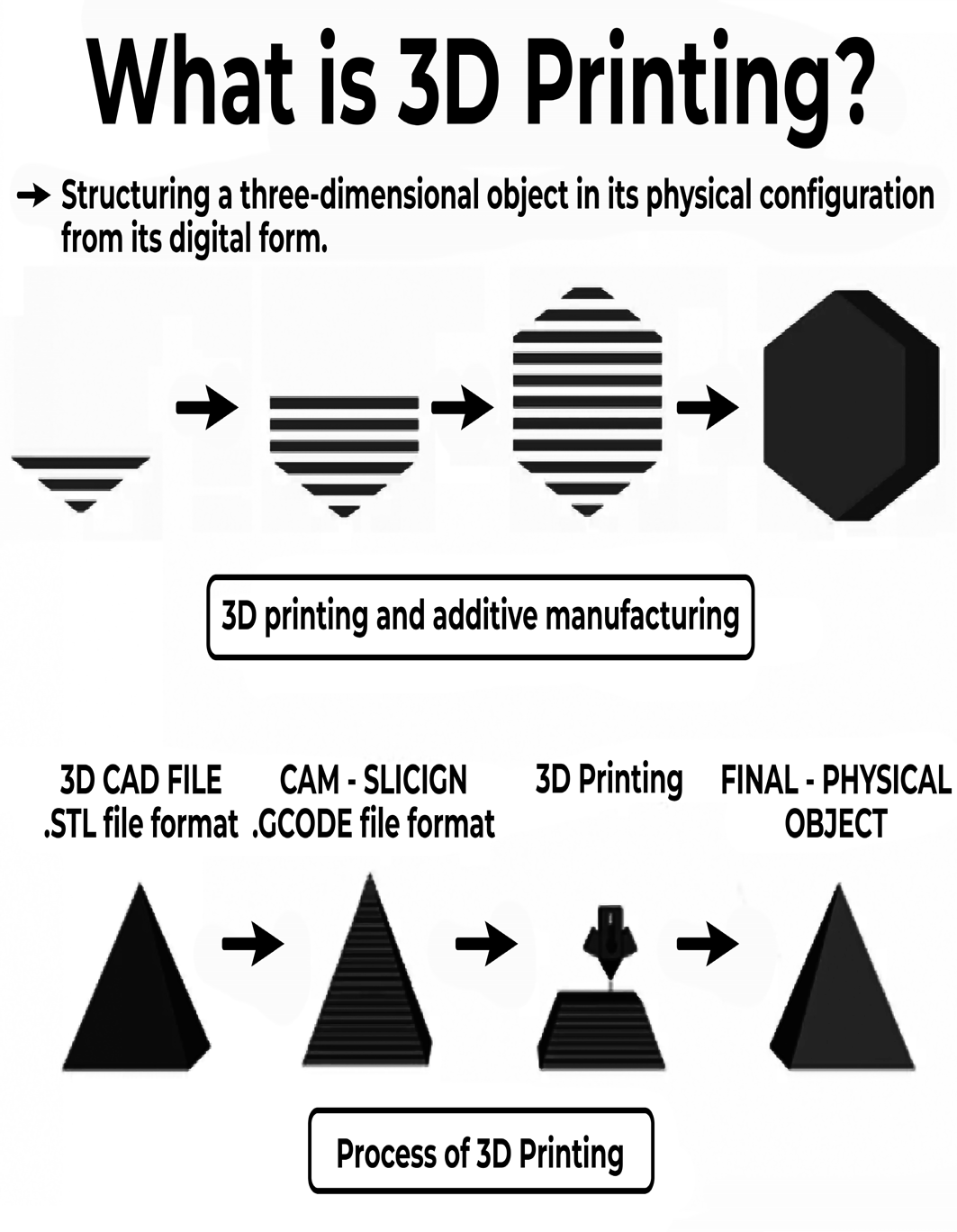
The process of 3D printing begins with the creation of avirtual model of the thing to be manufactured.
A 3D modelling application, such as CAD (Computer Aided Design), or 3D scanners can be used to create virtual designs.
After that, the 3D digital copy is loaded into a 3D modelling application. In order to print the model, it is next cut into hundreds or thousands of horizontal layers.
This prepared file is then sent to the 3D printer, which reads each slice in 2D format and then builds the item layer by layer, with no apparent layering and a 3-dimensional structure as a result.
Additive Manufacturing
Through the use of materials like metals and plastics,additive manufacturing creates three-dimensional objects from computer-aided designs.
The next step in digital manufacturing is additive manufacturing, which enables the fusion of electronics, computers, images and cutting-edge fields like pattern recognition and artificial intelligence. It also generates potential for intellectual property and exports.
With its application to digital processes, communication, photography, architecture and engineering, Additive Manufacturing (AM) has great promise to transform
India’s industrial production and manufacturing scene.
Potential of India
• Removing Huge Capital Expenses: Equipment is less expensive, inventory may be kept modest and space needs are minimal. As a result, retooling and adapting traditional small and medium-sized businesses to focus on high-tech manufacturing does not provide a significant obstacle when it comes to jump-starting manufacturing.
• Using India’s IT Power: As part of “Digital India,” there are ongoing plans to enhance connectivity and support a well-established software sector in India.
• This would promote industrial development outside of big cities and enable the establishment of additive manufacturing facilities in rural villages.
• Uniform Quality Standards: Since the complete system is constructed at once and assembly is not necessary, maintaining consistent product quality is much simpler.
National Strategy on Additive Manufacturing
• In addition to removing financial and technical obstacles, the National Strategy on Additive Manufacturing (AM) will work to establish a supportive ecosystem for design, development, and implementation. This will enable global leaders in AM to establish operations in India with associated ancillaries.
• The goal is to make sure that a sustainable ecosystem is built so that the AM industry can compete on a global scale, to promote AM transformation and drive the nation’s core competency development capabilities and to establish India as a hub for global AM innovation and research.
• Its objectives are to support the development of Indian IPR and guarantee end-user functional components made in AM for both home and international markets.
• By 2025, the MeitY plans to boost India’s share of additive manufacturing to 5% globally, which could add $1 billion to the country’s GDP.
• According to the plan, by 2025, India hopes to accomplish a number of goals, including 500 new goods, 50 machine, software, and material technologies unique to the country,
100 new additive manufacturing businesses, 500 new products, and at least 1 lakh new skilled employment.
The mission might be led by an apex body made up of subject matter experts and executives from regional and international businesses.
Applications of 3D Printing
Aerospace: To save weight and material requirements, parts for aircraft and spacecraft can be made using lightweight printing instead of typical manufacturing methods. Using direct metal laser sintering (DMLS), HAL and Wipro 3D printed an air blower component for the TEJAS aircraft. Weight reduction of 50% was attained in comparison to traditional manufacturing methods.
• Automotive: 3D printing is used by the automotive sector to create specialized parts and tools quickly through fast prototyping. Printed parts can save weight and enhance design. Mahindra manufactures about
200 3D-printed polymer components a year for car prototypes. Development and design verification have accelerated as a result.
• Healthcare: With personalized prosthetics, implants, anatomical models for surgical practice and medications, 3D printing is completely changing the healthcare industry.
• Yaantra, a medical tech firm, created a 3D printed skull implant that allowed doctors to precisely visualize the shape of tumors and eliminate uncertainty during operation.
Advantages of 3D Printing
• Customised Production: Easily customized products that meet specific demands instead of mass-produced items are produced thanks to 3D printing. Tool-less production and inexpensive personalization are made possible by it.
• Complex Geometries: It is possible to 3D print intricate forms and intricate interior structures like lattices and honeycombs that improve strength and functionality. Otherwise, it would be difficult to produce these.
• On-Demand Local Production: Global supply chains are not required, and transportation expenses, delays and carbon emissions are decreased with the use of distributed 3D printing and digital inventory. On-site printing of spare parts is possible.
• Material Savings: Waste is reduced via additive 3D printing, which deposits only the material needed. Recycled scrap can be made into feedstock, powder or filament.
Concerns and Challenges of 3D Printing Technology
• Limited scalability: Comparing production volumes to traditional manufacturing, they are still low. The dimensions of the printer limit the part size.
• High equipment costs: The cost of industrial-grade metal
• printer systems remains over ₹1 crore, which hinders their wider adoption by enterprises.
• Material constraints: restricted selection of printable 3-D objects. continues to be difficult for ceramics and multi- material parts.
• Process reliability: The final construction quality and material properties are frequently impacted by defects such as micro-porosity, inadequate filling and layer delamination.
• Standards: Interoperability and reliability are hampered by the absence of established design guidelines, data formats, quality benchmarks and material specifications.
Key Initiatives in India for 3D Printing
• Recognizing 3D printing’s immense potential for economic growth and self-reliance, the Government of India has devised targeted policies and initiatives:
• National Strategy for Additive Manufacturing: Developed in 2021 by the Ministry of Electronics and Information Technology, it establishes a strategic road map for promoting worldwide collaborations, production, talent development and research into 3D printing.
• Key goals:
• Enable 100 innovative 3D printing startups.
• Develop 50 India-centric technologies by 2025
• Train 5,000 skilled workers by 2024
• Samarth Udyog: The Ministry of Heavy Industries Industry 4.0 project seeks to improve manufacturing competitiveness through the use of 3D printing.
• Make in India 2.0: Indian government intends to establish itself as a global center for 3D printing as part of its Atmanirbhar Bharat agenda.
• Partnerships with Global Institutes: The government has established state-of-the-art 3D printing research centers in partnership with companies such as Applied Materials.
• Defence Initiatives: The benefits of 3D printing for component production have been acknowledged by the defense industry. BEL and DRDO are making active use of the technology.