Administrative Structure and Governance
• Centralized Administration: A robust bureaucratic system and efficient governance. The administration was structured with a detailed system of officials, categorized into two main groups: perundanam (upper) and sirudanam (lower).
• Revenue and Taxation: The land revenue system was efficiently structured and known as puravuvarithinaikkalam.
• All land was meticulously surveyed and categorized to determine revenue assessments. The residential area of the village was referred to as ur nattam.
• Certain lands, including those owned by temples, were exempt from taxation.
| TAX | MEANING |
| Nulayam | Tax on cotton thread |
| Achchu Tari | Tax on patterned loom |
| Teri irai/ tari kadmai | Loom Tax |
| Panjupeeli | Tax on cotton yarn |
| Parutti Kadamai | Tax cotton |
| Tari Pudavai | Tax on cloth |
KEY FEATURES OF CHOLA ADMINISTRATION
• Chola state was presided by a herditary monarch.
• Titles adopted by king:
• Peruman/Perumagan (big man)
• Ulagudaiyaperumal and Ulagudaiyanayanar (the lord of the world)
• Chakkaravarti (emperor)
• Tirubhuvana Chakravarti (emperor of 3 worlds)
• It was a practice at the time of coronation to add the suffix deva to the name of the crowned kings.
• The kings claimed themselves comrade of God (Thambiran thozhar).
• Chola kings granted estates of land called Brahmadeyams and Chaturvedimangalam to Brahmins to enhance and establish their prestige.
• Military Might: Well-organized standing army, naval prowess, and focused military strategies.
The royal military forces were known as Kaikkolaperumpadai, with specifically tasked with guarding the king, called Velaikkarar. a
The Cholas placed great emphasis on army training, and military camps, known as kadagams, were established for this purpose.
The Chola rulers also gave significant importance to their naval forces.
Provincial Administration
DIVISION DESCRIPTION
Chola Empire -Divided into Mandalams
Mandalams- Further divided into Valanadus and Nadus
Valanadus -Overseen by Periyanattar
Nadus-Administered by Nattar
Villages-Numerous autonomous villages within each Nadu
Town (Nagaram)-Administered by the Nagarattar council
Types of land: Chola inscriptions mention several categories of land-
➤ Vellanvagai- land of non-Brahmana peasant proprietors
➤Brahmadeya- land gifted to Brahmanas
➤ Shalabhoga- land for the maintenance of a school
➤ Devadana, Tirunamattukkani-land gifted to temples
➤ Pallichchhandam- land donated to Jaina institutions
Village Administration:
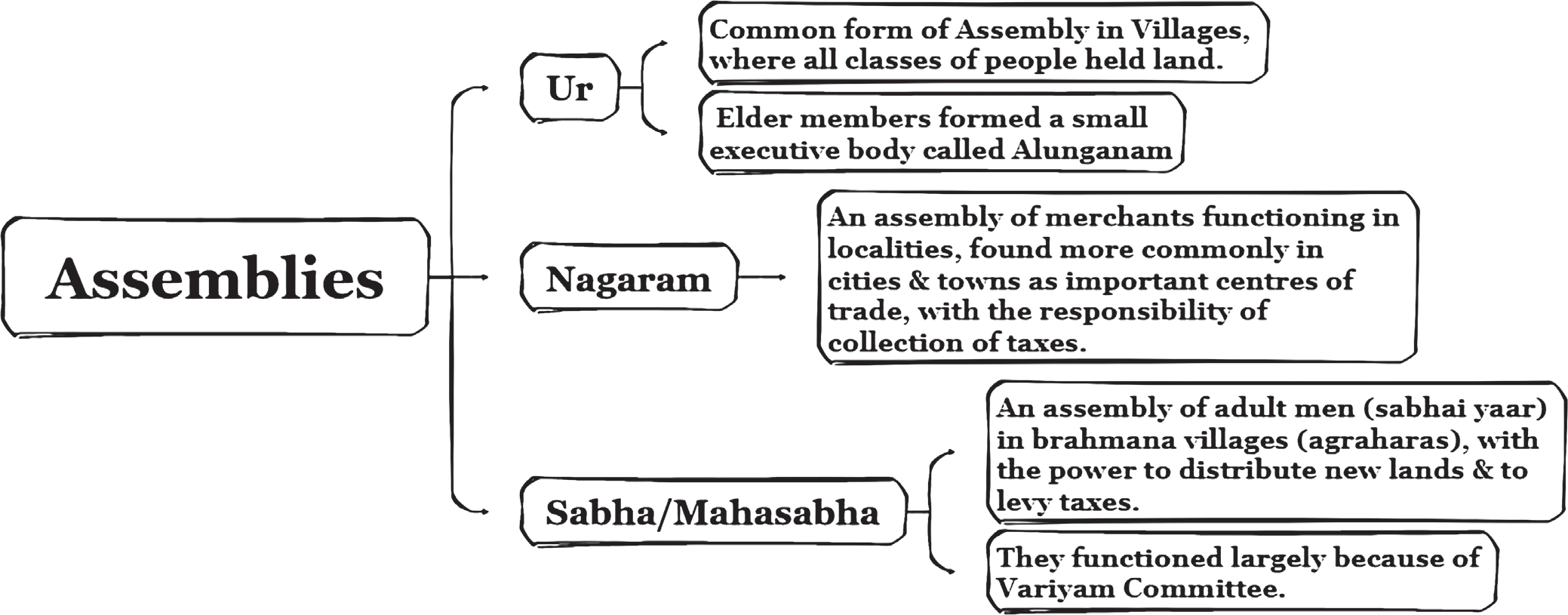
Two inscriptions from the reign of Parantaka I, discovered at Uttiramerur, offer insights into the organization and responsibilities of village councils. Villages were typically divided into wards, with each ward selecting its representatives for the Village Council. Members were nominated through the kudavolai system, and one individual from the nominated group was chosen to represent each ward for a one-year term.
WHAT WAS THE KUDAVOLAI SYSTEM?
The names of eligible candidates were inscribed on palm leaves and placed in a pot. A young boy or girl would draw thirty names for each ward. These individuals were then assigned to six different committees, or variyams, each responsible for a specific administrative function: samvatsaravariyam, erivariyam, thottavariyam, panchavariyam, ponvariya, and puravuvariya. The committee members, known as variyapperumakkal, would typically gather in a temple or beneath a tree to discuss matters and pass resolutions.