Introduction
The Revolutionary War (1775-83), also known as the American Revolution, began due to tensions between the British colonial government and the residents of 13 North American colonies. The conflict began with skirmishes in Lexington and Concord in April 1775, leading to a full-scale war for American independence. France joined the colonists in 1778, turning the civil war into an international conflict. French assistance helped force the British surrender at Yorktown, Virginia, in 1781, resulting in American independence, though fighting did not formally end until 1783.
The American Revolution was a key turning point in transforming America into a democratic and capitalist society. While similar democratic movements were unfolding in Western Europe during the late 18th and early 19th centuries, the American Revolution had a more profound impact on reshaping American politics and society. It helped lay the foundation for a more democratic system, making significant strides in political participation and social equality that surpassed the changes occurring in Europe at the time.
Background
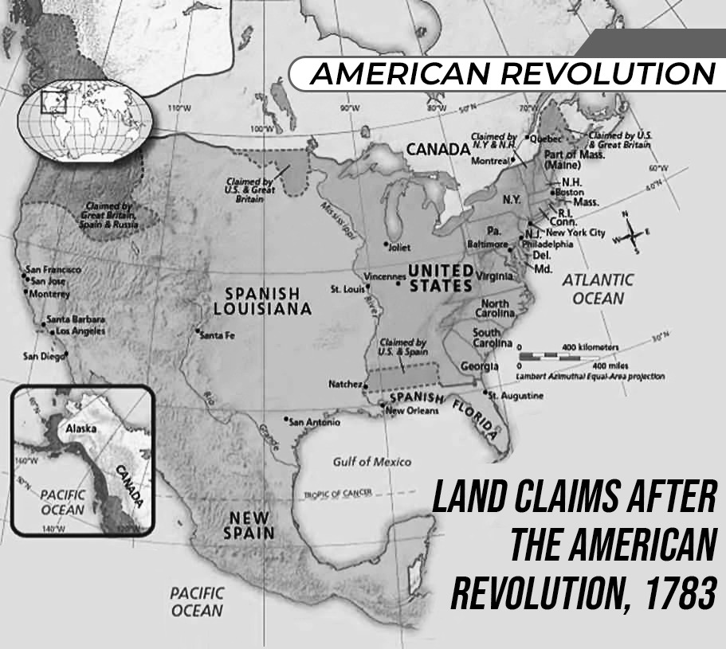
In North America, colonies were established by several European powers, including France, Holland, Spain, and England. By the 18th century, England had pushed France out of the eastern part of the continent and Canada, and had also taken control of New Netherlands from the Dutch, renaming it New York.
• By the mid-1700s, there were 13 English colonies along the Atlantic Coast. These colonies were home to landless peasants, people seeking religious freedom, traders, and entrepreneurs, but the majority of the population were independent farmers. Early industries began to take shape, focusing on products like wool, flax, and leather.
• In the northern colonies, fishing and shipbuilding thrived, while in the southern colonies, large plantations were established, resembling feudal estates, where tobacco and cotton were cultivated with the labor of enslaved Africans.
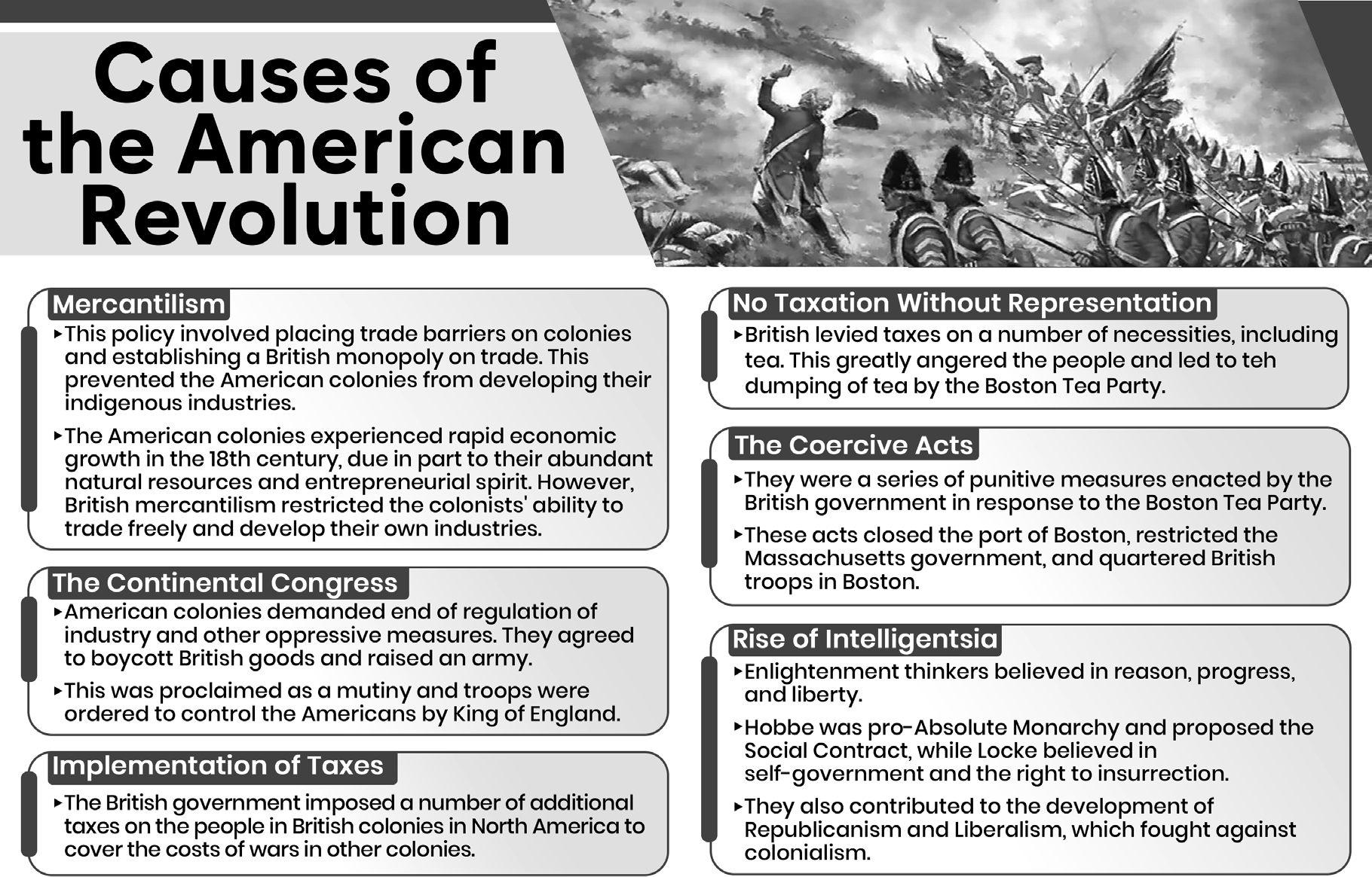
• Each colony had its own local assembly, elected by qualified voters, which made laws on local issues and levied taxes. However, by the 18th century, the colonists grew increasingly frustrated with the laws imposed by the English government. This discontent fostered the idea of independence, eventually leading to the Revolutionary War, where the colonists fought for and gained their freedom.
Seven Years Global War
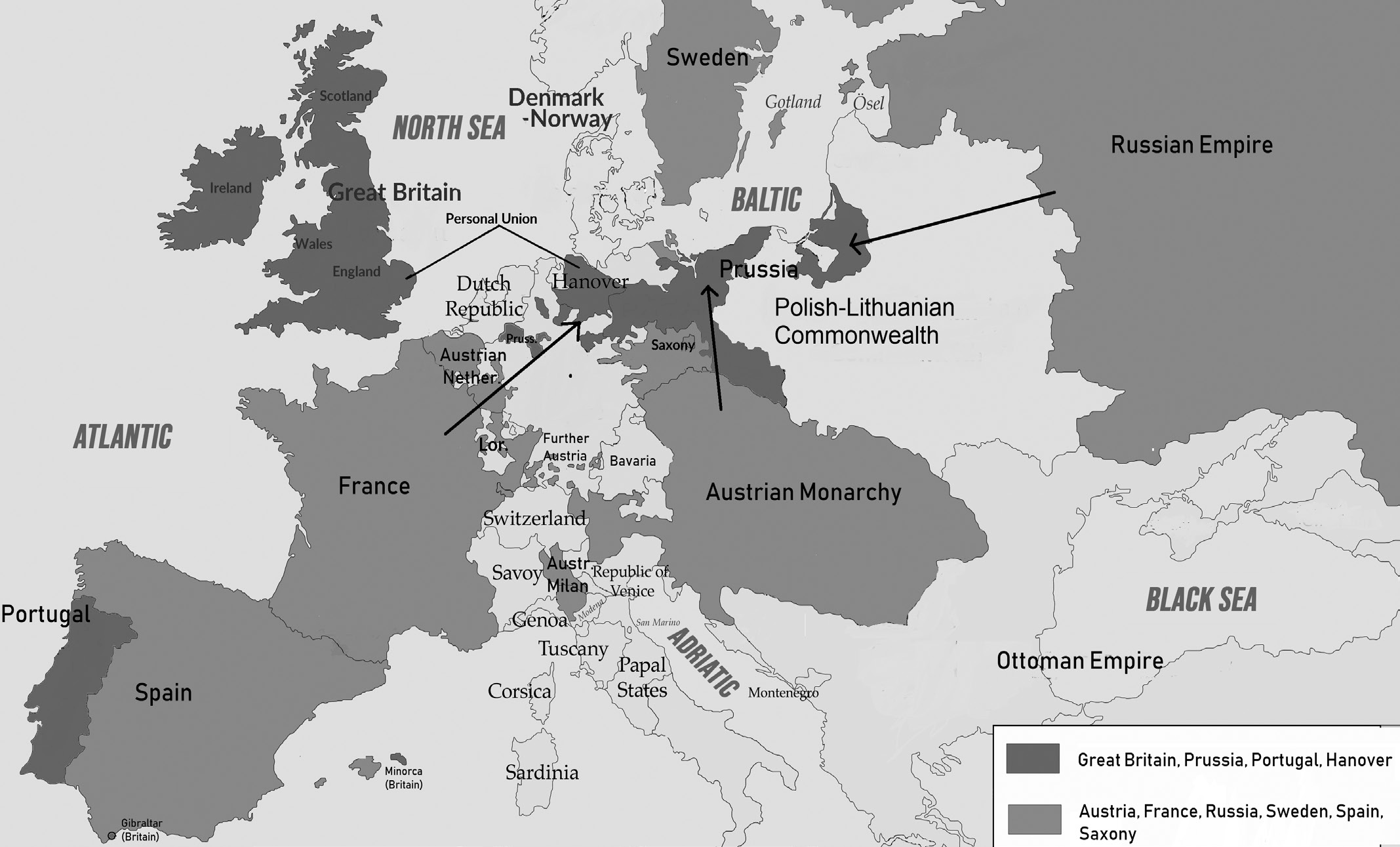
The Seven Years Global War, fought between France and Britain from 1754 to 1763, lasted for nine years and involved several other European nations, including Spain, Prussia, and Austria. Often referred to as the first “Global War,” it was waged across multiple continents, with battles taking place in North America, the Caribbean, India, the West Coast of Africa, and Europe.
Causes of the Seven Years’ War
• Hegemony over American Colonies - The struggle between Britain and France for control of the colonies served as the major driver of the conflict. The British held 13 colonies in North America along the Atlantic Ocean’s Eastern coast.
• British desire to expand westwards – The British desired to grow westward due to a lack of additional raw materials and a growing North American export market. But the west was under the domination of France. In order to avoid British predominance in international political and economic issues, the French were eager to hold onto Western North America.
• Control over Caribbean - Britain was undergoing the Industrial revolution (1750 onwards) at that time, which was making the British goods much more competitive in the world markets.
• In addition, Britain was growing as a dominating naval power, with its maritime trade revenues skyrocketing.
• As a result, France feared that a stronger Britain in North America would soon threaten France’s Caribbean holdings.
• They were right, and the British battled in the Caribbean against Spain and France, which controlled the lucrative sugar plantations in their Caribbean possessions.
• Control over African Resources - Senegal (West Africa) had abundant natural resources, particularly gum, and the British attacked the French commercial ports there.
• Control over India - In 1757, the Nawab of Bengal, Siraj- ud-Daula, clashed with the East India Company at the Battle of Plassey in India. The British emerged victorious, granting the East India Company exclusive trading rights in Bengal, while weakening the French presence in India. Additionally, the Battle of Wandiwash, fought between the French and British in 1760-1761, solidified British control over South Asia, leaving the French with only Pondicherry as their remaining foothold.
The Treaty of Paris 1763 was signed to conclude this war.
The Seven Year War had two effects on international politics: It decreased France’s hegemony while strengthening Britain’s colonial authority. Additionally, it laid the path for the French Revolution (1789) and the American Revolution (1765-83).
Causes of the American Revolution
The War of Independence
• A war broke out between the American colonies and England. In response, the French government decided to support the colonies with troops, supplies, and funding, aiming to weaken their long-time rival, England. Spain and Holland, both enemies of England, also joined the conflict on different fronts.
• At the same time, Britain faced internal troubles, with potential rebellion brewing in Ireland and some members of Parliament opposing the war with the colonies.
• The conflict came to an end in 1781 when British General Cornwallis—who would later become Governor-General of India—surrendered. Two years later, in 1783, the Treaty of Paris was signed, with Britain officially recognizing the independence of its 13 former colonies.
The American Constitution
• Each of the 13 colonies had its own army, borders, customs duties, and funds when the American Revolutionary War began
• Through a scheme for a national government, they came together in 1781 as states of the United States.
• The American Constitution set up a federal system under which powers were divided between a central or federal government and the state governments.
• The Declaration of Independence’s author, Thomas Jefferson fought to get a Bill of Rights inserted into the federal constitution. This was accomplished through the ten amendments, which provided the American people with several rights. The most notable of them are justice under the law, freedom of the press, and freedom of speech and religion.
• The United States of America became a nation with the adoption of the constitution. It was the first written republican constitution ever drafted that is still in effect.
Significance of the American Revolution
The American Revolution, spanning from 1775 to 1783, represents a pivotal moment in history that forged the foundations of a new nation and had far-reaching global implications. It was a remarkable and audacious struggle for independence, driven by a desire for self-governance and the rejection of British colonial rule. The revolutionary ideals of liberty, democracy, and the pursuit of happiness laid the groundwork for the United States Constitution and the democratic principles that continue to shape the nation’s identity today.
• Equality: The Declaration of Independence’s assertion of the equality of all men and their ‘inalienable rights’ had a powerful impact, resonating both within America and abroad. It helped inspire a broader recognition of equal rights, including acknowledging the rights of widows and daughters in matters of inheritance and property ownership.
• Impact on French Revolution: Lafayette, the French general who fought on the side of American revolutionaries, was soon to become a hero of the French Revolution. Thomas Paine also participated in the French Revolution.
• Inspiring Revolutions: Later in the 19th century, the American Revolution served as a model for many revolutionaries in Europe. It inspired the colonial outrage and independence movements in Central and South American Spain and Portugal.
• The Revolution in America represented an attack on aristocratic privileges, monarchical society and virtually all forms of dependence including slavery.
• Women’s Rights: After the Revolution the patriarchal control of men over their wives declined, the latter gaining the right to hold property separately and to make contracts and do business in the absence of their husbands. Widows got outright ownership of one-third of the estate rather than just the lifetime use which had been the customary practice earlier. The American Revolution not only ended feudal forms of land tenure but supported a more enlightened attitude towards the family.
• Republic: The establishment of a republic was the major accomplishment of the American Revolution. The new Republic of the USA was not free of biases. The Republic was not truly democratic as the women, the blacks and the Native Americans did not get the Right to Vote. Slavery was a stain on the idea of equality and wasn’t completely abolished until the American Civil War, which lasted from 1861 to 1865, between the Northern and Southern State.
• Liberal Democracy: A huge achievement was the growth of mass participation in politics and the emergence of the free market based on the ideals of economic development and political equality.
• After the Revolution, all the states abolished legal devices of primogeniture and entail which had tended to protect large estates and important families, although these practices had declined over time.
Reform in State: Election laws in all states favored men of property for many years. But progress towards democracy had begun. In some states, state religion was abolished, along with religious qualifications for holding public offices