APPLICATIONS OF NANOTECHNOLOGY
Energy storage, production, and conversion
• Novel hydrogen storage systems based on carbon nanotubes and other lightweight nanomaterials
• Photovoltaic cells and organic light-emitting devices
based on quantum dots
• Carbon nanotubes in composite film coatings for solar cells
• Nanocatalysts for hydrogen generation
• Hybrid protein-polymer biomimetic membranes
Agricultural productivity enhancement
• Nanoporous zeolites for slow-release and efficient dosage
of water and fertilisers for plants, and of nutrients and drugs for livestock
• Nanocapsules for herbicide delivery
• Nanosensors for soil quality and for plant health monitoring
• Nanomagnets for removal of soil contaminants
Water treatment and remediation
• Nanomembranes for water purification, desalination, and detoxification
• Nanosensors for the detection of contaminants and pathogens
• Nanoporouszeolites, nanopo rouspolymers, and attapulgite clays for water purification
Magnetic nanoparticles for water treatment and remediation
TiO2 nanoparticles for the catalytic degradation of water pollutants
Disease diagnosis and screening
Nanoliter systems (Lab-on-a-chip)
Nanosensor arrays based on carbon nanotubes
Quantum dots for disease diagnosis
Magnetic nanoparticles as Nanosensors
Antibody-dendrimer conjugates for diagnosis of HIV-1 and cancer
Nanowire and nanobelt nanosensors for disease diagnosis
Nanoparticles as medical image enhancers
Drug delivery systems
Nanocapsules, liposomes, dendrimers, buckyballs, nanobiomagnets, and attapulgite clays for slow and sustained drug release systems.
Food processing and storage
• Nanocomposites for plastic film coatings used in food packaging
• Antimicrobial nanoemulsionsfor applications in decontamination of food equipment, packaging, or food
• Nanotechnology-based antigen detecting biosensors for identification of pathogen contamination
Air pollution and remediation
• TiO2 nanoparticle-based photocatalytic degradation of air pollutants in self-cleaning systems
• Nanocatalysts for more efficient, cheaper, and better- controlled catalytic converters
• Nanosensors for detection of toxic materials and leaks
• Gas separation nanodevices
Construction
• Nanomolecular structures to make asphalt and concrete more robust to water seepage
• Heat-resistant nanomaterials to block ultraviolet and infrared radiation
• Nanomaterials for cheaper and durable housing, surfaces, coatings, glues, concrete, and heat and light exclusion
• Self-cleaning surfaces (e.g., windows, mirrors, toilets) with bioactive coatings
Health monitoring
• Nanotubes and nanoparticles for glucose, CO2, and cholesterol sensors and for in-situ monitoring of homeostasis
Vector and pest detection and control
• Nanosensors for pest detection
• Nanoparticles for new pesticides, insecticides, and insect repellents
Apart from the above, nanotechnology is being used in textiles, ICT, cosmetics and personal care products, electronics and home appliances, defence, etc., all across the world. All these applications of nanotechnology can be leveraged for social and economic development of the developing countries such as India.
Nano Urea Fertilizer
• Meaning: Nano urea is a liquid fertilizer developed by Indian Farmers Fertiliser Cooperative (IFFCO). It is an alternative to conventional urea.
• It is essentially urea in the form of a nanoparticle.
• Urea is a chemical nitrogen fertilizer, white in colour, which artificially provides nitrogen, a major nutrient required by plants.
• Aim: It aims to reduce farmers’ dependence on packaged urea.
• Fertiliser Control Order (FCO) 1985: It is based on existing rules that provisionally allow fertilizers to be used based on data from only two cropping seasons.
• The usual practice for recommending or rejecting a new fertilizer for commercial use required three seasons of independent assessment by the Indian Council of Agricultural Research (ICAR), but in the case of nano urea this was reduced to two.
• Central Public Sector Undertaking (CPSU): National Fertilizers Limited (NFL) and Rashtriya Chemicals and Fertilizers Limited (RCF) have signed Non-Disclosure Agreement & Memorandum of Understanding with IFFCO to transfer the technology of Nano Urea.
• India is the first country globally to start commercial production of Nano Urea Liquid and Nano Fertilizers.
• Import data: The country’s domestic urea production in 2023 is around 31.11 million tonnes. India’s urea imports in 2023 declined 21.3% year-on-year to 7.41 million tonnes on account of higher domestic production.
• The government will save foreign exchange of Rs 40,000 crore approximately per annum after replacing the conventional urea with the Nano Ureas.
Potential benefits
• It has a shelf life of a year and farmers need not be worried about “caking” when it comes in contact with moisture.
• Pricing: It comes in a half-litre bottle priced at Rs 240, and carries no burden of subsidy currently. By contrast, a farmer pays around Rs 300 for a 50-kg bag of heavily subsidised urea.
•
Efficiency: The conventional urea has an efficiency of about 25 percent; the efficiency of liquid nano urea can be as high as 85-90 per cent.
• Absorption: Liquid nano urea is sprayed directly on the leaves and gets absorbed by the plant. Fertilisers in nano form provide a targeted supply of nutrients to crops, as they are absorbed by the stomata, pores found on the epidermis of leaves.
• Lower subsidy Bill: It will reduce the country’s subsidy bill and it is aimed at reducing the unbalanced and indiscriminate use of conventional urea.
• Other benefits:
• Application of Nano Urea results in better crop productivity.
• This is regarded as an excellent alternative to chemical fertilisers because it promotes growth and reduces environmental pollution.
• Nano-fertilisers also reduce the crop cycle period and increase crop yield.
• The unique properties of nanoparticles, such as high absorption capacity, the increased surface to volume ratio and controlled-release kinetics to targeted sites, make them a potential plant growth enhancer.
Triboelectric Nanogenerators
• A triboelectric nanogenerator (TENG) is a self-powered device that makes use of mechanical energy in the form of vibrations present everywhere in different forms to generate electricity.
• Scientists from the Centre for Nano and Soft Matter Sciences (CNSMS) have fabricated a cost- effective, bio-compatible nanogenerator that can generate electricity from mechanical energy in the form of vibrations present everywhere.
• CNSMS is an autonomous institute under the Department of Science & Technology.
• The energy harvesting TENG works on the principle of creation of electrostatic charges (deficiency or excess of electrons which occurs on ungrounded or insulating surfaces)
• Applications include optoelectronics, self-powered devices, pacemakers and other biomedical applications
Nano Micelles
• Researchers also found that Nano micelles can be used for Cancer treatment
• Micelles are globe-like structures with a hydrophilic outer shell and a hydrophobic interior.
• This dual property makes them a perfect carrier for delivering drug molecules
• Advantages: Low toxicity, ability to minimize drug degradation, ability to permeate tissues easily for drug delivery, and lower adverse drug side effects.
• Hydrophilic and hydrophobic configuration matches with phospholipid bilayer thereby allowing targeted drug delivery
Gold Nano Particles
• Developed by National Centre for Polar and Ocean Research and the Goa University has successfully synthesized GNPs using psychrotolerant Antarctic bacteria.
•
GNPs are biocompatible, have high surface area, more stability, and are non-toxic
• GNPs are melted at much lower temperatures (300 C) than bulk gold (1064 C)
• Advantages of GNP
• Greater solar radiation absorbing ability: photovoltaic cells
• Unique optical properties: therapeutic imaging for better resolution
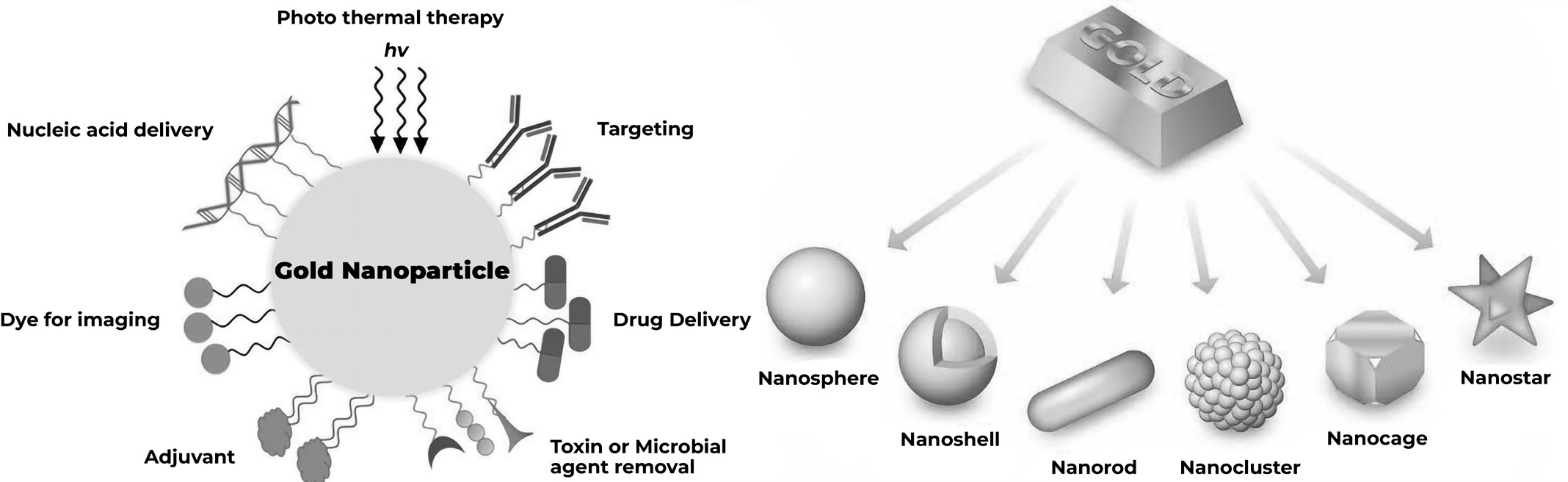
Applications o f gold nanoparticle and shapes.
Carbon Nanomaterials
• Graphene, carbon nanotubes (CNT) and fluorescent carbon quantum dots (CQDs) pertain to carbon materials family.
• They have attracted much attention in the scientific community and engineering due to their extraordinary physical, chemical, optical, mechanical, thermal properties.
• Graphene is the thinnest two-dimensional material comprised of a one-atom-thick planar sheet of sp2- bonded carbon atoms, while carbon nanotubes have a cylindrical nanostructure which also consisted of sp2- bonded carbon atoms.
• Graphene can be perceived as the basic structure of graphite, carbon nanotubes, and fullerene.
• Carbon nanotubes are tube-shaped carbon material and can be divided into two types: single-walled carbon nanotubes (SWCNTs) and multi-walled carbon nanotubes (MWCNTs).

P roperties and Applications of Carbon Nanoparticles
• Properties
• Carbon nanoparticles have extraordinary electrical conductivity, heat conductivity and mechanical
properties.
• They are composed of pure carbon, therefore, exhibiting high stability, good conductivity, low toxicity, environmental friendliness.
• Since a large part of the human body consists of carbon, it is generally thought as a biocompatible material.
• The good electrical conductivity, high surface area, and linear geometry make their surface highly accessible to the electrolyte.
•
Carbon-based nanomaterials also have strong anisotropic thermal conductivity.
• This property allows the carbon-based nanomaterials being used in advanced computing electronics where the temperature of uncooled chips can reach over 100℃.

Other Applications
• Sunscreens: Titanium dioxide and zinc oxide Nano particles help block UV radiations
• Non-flammable furniture: coating
• Fabrics and Body armour: lightweight, wettability: easy clean textiles
• Films on glasses, computers and camera displays
• Quantum dots and electrical effects: QLED TV
• Nano sensors: neutralize the effect of pollutants
• Wastewater treatments
• Nano membranes: desalinization
• Biofuel production: Nano-bioengineering of enzymes
• Solar panels: TENG
• Hydrogen economy and storage systems
• Nanotube scrubbers and electrostatic precipitators for better efficiency
• GNP: solar panels

• CNT: PV cell
• Graphene: production of green hydrogen
• Nano-herbicides and Nano-pesticides: targeted delivery and enhancement of productivity
• Nano-phosphorous fertilizer: Millet and cluster beans
• Silver Nano-particles: against phytopathogens
• Carbon Nanoparticles: seed germination
• Nickel / ferrite: Antifungals
• Zinc oxide/chitosan: Viral Diseases
• Precision farming: nano-sensors
• Antigen Antibody tests: ex: ELISA test
• Prosthetic Devices: nanocomposite materials
• Targeted drug delivery: nano-micelles
• Nano sensors: HIV and Cancer detection
• Nanohydrogel based eye drops
• Tank polymer and Camouflage
• Lightweight materials
• Precision guided missiles
• Quantum dots
• Graphene: used in flexible touch screens
• Optoelectronics
• CNT: replace silicon-based chips