Art, Literature and Religion
Gandhara Art
This area of sculpture developed during this era under the patronage of Sakas and Kushanas.
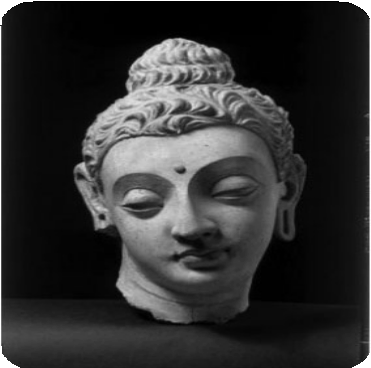


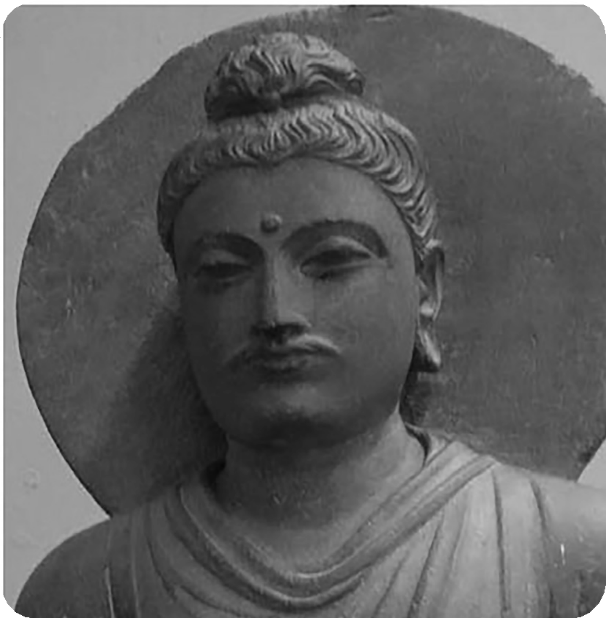
Originally inspired by Mathura Art and influenced by Greco-Roman traditions.
Vine scrolls, cherubs with garlands, tritons, and centaurs are of Roman influence.
Greek architectural influence: Sometimes Buddha is shown on Corinthian (capitals crowning columns or pilasters).
Sculptures were made of bluish-grey sandstone.
The human body is sculpted in a realistic manner in these sculptures, with considerable attention to realism and physical details, particularly in the depiction of muscles, mustaches, and other facial features.
The portrayal of the broad bold fold lines is a unique trait.
They generally consist of Buddha images and relief sculptures depicting scenes from Buddhist literature.
Buddha is shown in a spiritual state. The eyes were half-closed signifying meditation position.
In all the Buddha depicted in the Gandhara Art is shown making four types of hand gestures:
• Abahayamudra: Don’t fear
• Dhyanamudra: Meditation
• Dharmachakramudra: A preaching mudra
• Bhumisparshamudra: Touching the Earth
• Buddha is often seen under the protection of Greek god Hercules or Vajrapani.
• Artistic beauty: The Buddha’s face, resembling that of Apollo, exhibits natural realism, with wavy hair similar to the Hellenistic Greek style seen in Gandhara sculptures.
• Intellectual affinity: The halo and bun of Gandhara Buddha signify intellectual imbibitions of Buddha from Greek.
• These statues were majorly located in Taxila, and
Bamiyan regions.
Mathura Art also developed during this time.
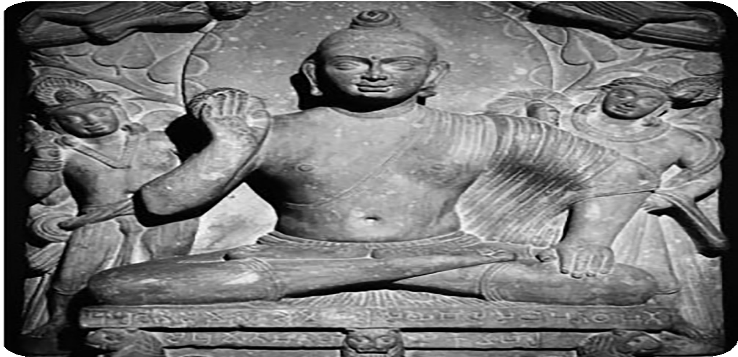
It was an indigenous art tradition.
• Spotted Red sandstone was used in Mathura art for depicting images of Buddha.
• The shoulders are broad, the chest expands, and the legs are planted firmly with feet split apart.
• Images were more sensuous and fleshier in the second century AD, with increasing rotundness.
• The shaved head, the protuberance on the top of the head indicated by a tiered spiral, a round smiling face, the right arm raised in abhaya-mudra (reassurance gesture),


the left arm akimbo or resting on the thigh, the drapery closely moulding the body and arranged in folds over the left arm, leaving the right shoulder bare, and the presence of the lion throne rather than the lotus throne.
• The halo around Buddha›s head was lavishly adorned.
• The Mathura school etched out both the sitting and standing postures of Buddha and Bodhisattvas.
• The Shravasti, Sarnath and Kaushambi Standing Buddhas are the best examples of Buddha images under this style.
• Vaishnava and Shaiva faiths can also be seen, but Buddhist ones predominate.
Religion:
• Mahayana tradition flourished during this time.
• Hinayana-the other sect of Buddhism was also called a small wheel.
• Kanishka organized the fourth council of Buddhism in Kashmir. In this council, Mahayana tradition flourished.
• Chaityas and Viharas were made.
• Kanishka gave patronage to Buddhist philosophers. Persons like Ashvaghosha, Parsva, Nagarjuna and Vasumitra were promoted by Kanishka.
Literature:
• ‘Buddha Charita’: Written by Ashvaghosha.
• ‘Sariputraprakarana’: It was the first play written in Sanskrit. This was also written by Ashvaghosha.
• Dramatist Bhasa also belonged to this period.
• ‘Manu smriti’ was written in this period.
• ‘Kamasutra’ of Vatsyayana also belonged to this period.
Pottery:
• Redware pottery was being used.
• Brick wells and burnt bricks usage was again a noted development