AURANGZEB’S REIGN (1657-1707)
Ascension and Initial Successes
Upon assuming the title Alamgir, meaning World Conqueror, Aurangzeb embarked on a series of successful military campaigns in the early years of his reign.
He swiftly suppressed minor revolts, establishing control over the empire.
However, challenges arose in the latter part of his rule, notably from revolts by the Jats, Satnamis, and Sikhs, prompted by his rigid religious policies.
Religious Policy and Conflict
Aurangzeb’s puritanical religious inclinations led him to impose the jizya tax on Hindus and exhibit intolerance towards other faiths.
Influenced by the Naqshbandi Sufi order, he implemented stringent measures that antagonized various religious communities.
The execution of the ninth Sikh Guru, Tegh Bahadur, following the rebellion of Prince Akbar, stands as a stark example of his religious rigidity.
Deccan Policy and Maratha Conflict
His Deccan policy aimed to counter the growing Maratha influence, quell Shia kingdoms like Golkonda and Bijapur, and suppress his son Akbar’s rebellious activities.
Aurangzeb’s annexation of Golconda and Bijapur
appeared victorious but led to political blunders.
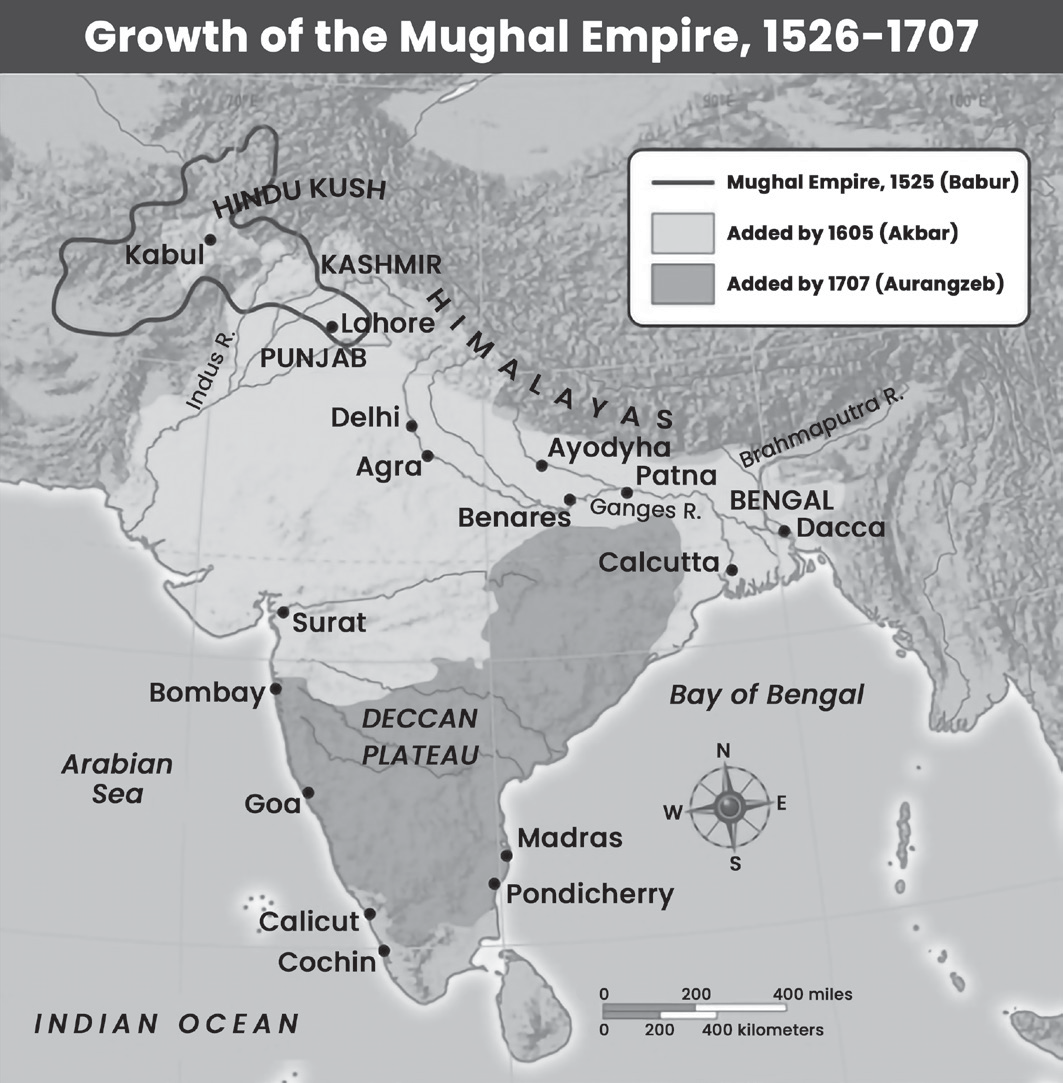
• The destruction of Deccan kingdoms removed the barrier between Mughals and Marathas, escalating direct confrontations.
MARATHA RESISTANCE AND LEGACY
• Shivaji, a formidable adversary, employed guerrilla warfare tactics against the Mughals.
• Though initially captured and taken to Delhi, Shivaji managed to escape and continued resisting Mughal forces.
• His death in 1680 didn’t deter Maratha resistance; his successors sustained the rebellion, challenging Aurangzeb until his demise in 1707.
End of an Era
• Aurangzeb’s death marked a significant shift in Indian history as the once-mighty Mughal Empire entered a period of decline.
• Weak successors after Aurangzeb struggled to maintain the empire, and within the next 150 years, the empire essentially ceased to exist.
Aurangzeb’s reign, despite early military triumphs, was marred by religious intolerance, conflict with diverse communities, and strategic errors that contributed to the empire’s eventual downfall.