BIMSTEC
The Bay of Bengal Initiative for Multi-Sectoral Technical and Economic Cooperation (BIMSTEC) is set to form an 'Eminent Persons Group' to provide future direction to the regional body.
About BIMSTEC

• Initially known as BIST-EC (Bangladesh-India-Sri Lanka- • Thailand Economic Cooperation), the organisation is now known as BIMSTEC and comprises seven Member States with the admission of Myanmar on 22 December 1997, and Bhutan and Nepal in February 2004.
Significance
• It connects not only South and Southeast Asia, but also the ecologies of the Great Himalayas and the Bay of Bengal.
• For India, BIMSTEC aligns with its ‘Act East’ policy for
• greater regional cooperation in southeast Asia.
• It could also be seen as aligning with India’s larger goal to gain trade and security prominence in the Indian Ocean region and to cater to the concept of the ‘IndoPacific’ region, a major focus of Quad countries.
• Another important factor for India in becoming a prominent leader in the Bay and maintaining peace and security, is China making inroads in the Indian Ocean Region over the years.
• Connectivity to North-East: About 45 million people, who live in landlocked Northeastern states, will have the opportunity to connect via the Bay of Bengal to Bangladesh, Myanmar and Thailand, opening up possibilities in terms of development.
Important Connectivity Projects:
• Kaladan Multimodal Project – links India and Myanmar.
• Asian Trilateral Highway - connecting India and Thailand through Myanmar.
• Bangladesh-Bhutan-India-Nepal (BBIN) Motor Vehicles Agreement - for seamless flow of passenger and cargo traffic.

Each country takes lead in specific areas. India is the Lead Country in four areas, viz Counter-Terrorism and Transnational Crime, Transport & Communication, Tourism, and Environment and Disaster Management.

India and BIMSTEC
• India is expected to face challenges from both within and outside, in terms of policy dilemmas.
• India is the largest contributor to the BIMSTEC secretariat's budget, and even provided an additional operational budget of 1 million USD at the Vth BIMSTEC Summit. India leads the Security Sector, which includes Counter Terrorism and Transnational Crime (CTTC), Disaster Management, and Energy.
• India would have to counter the impression that BIMSTEC is an India-dominated bloc. This is also a problem that it faced for a long time in SAARC. But today, many smaller neighbours are willing to engage with India to benefit from its economic rise.
• Nonetheless, for internal political reasons, the dominance issue may re-emerge and pose hurdles.
• To moderate such suspicions, India will need to show sensitivity to the concerns of smaller neighbours.
Challenges Associated with BIMSTEC
• Though largely devoid of bilateral tensions, as is the case in SAARC, BIMSTEC does not seem to have made much progress.
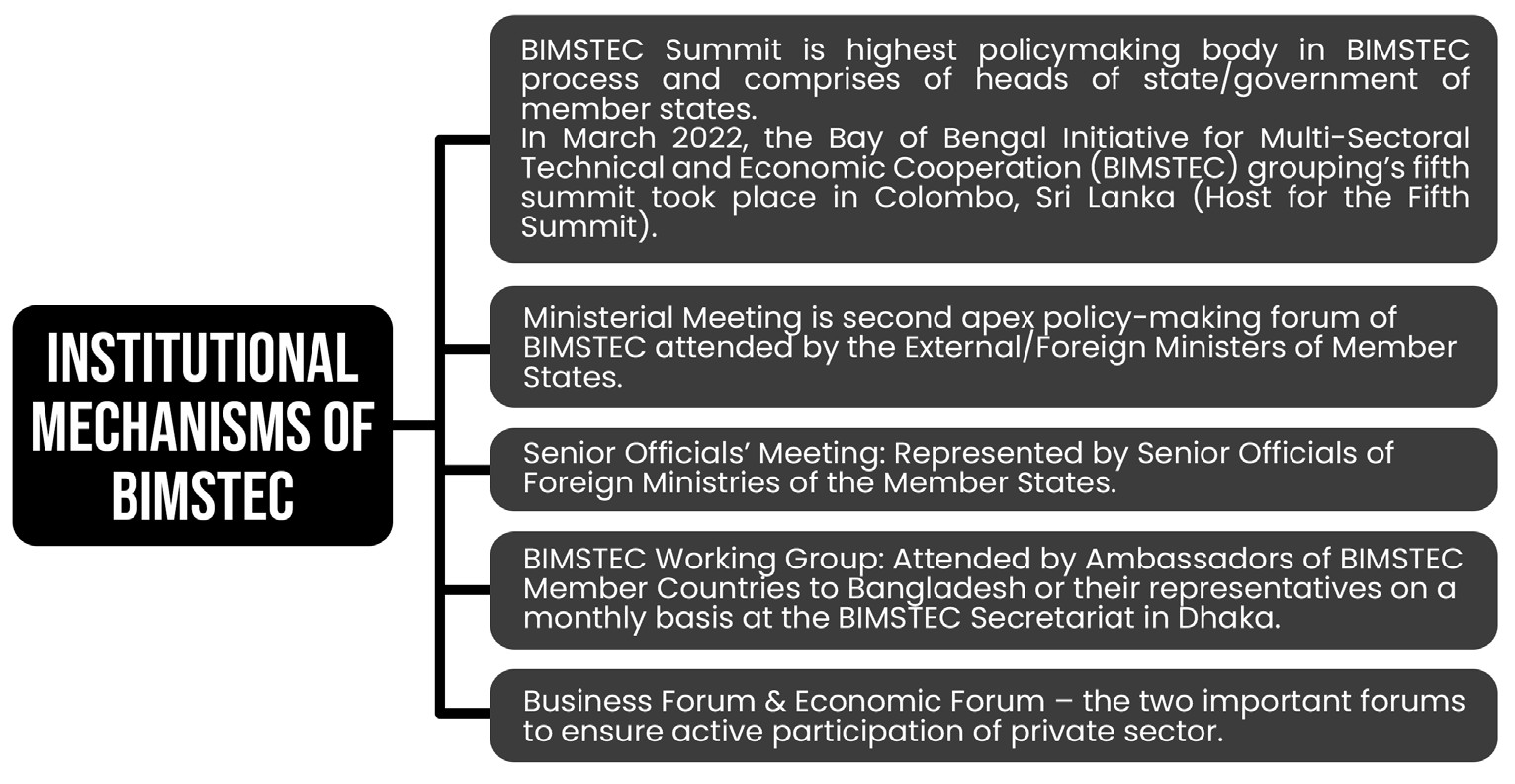
• Inconsistency in Meetings: BIMSTEC planned to hold summits every two years, ministerial meetings every year, but only five summits have taken place in 20 years upto 2022. Thailand is working towards hosting the VIth BIMSTEC Summit and related meetings in 2024.
BIMSTEC Summits that have taken place in the past -
Ist Summit - Bangkok (2004)
IInd Summit - New Delhi (2008)
IIIrd Summit - Naypyidaw (2014)
IVth Summit - Kathmandu (2018)
Vth Summit - Colombo (2022)
It seems that India has used BIMSTEC only when it fails to work through SAARC in the regional setting and other major members like Thailand and Myanmar are focused more towards ASEAN than BIMSTEC.
Broad Focus Areas: The focus of BIMSTEC is very wide, including 14 areas of cooperation like connectivity, public health, agriculture etc.. It is suggested that BIMSTEC should remain committed to small focus areas and cooperate in them efficiently.
Bilateral Issues between Member Nations: Bangladesh is facing one of the worst refugee crisis of Rohingyas from Myanmar who are fleeing prosecution in the state of Rakhine in Myanmar. There is a border conflict between Myanmar and Thailand.
BCIM: The formation of another sub-regional initiative, the Bangladesh-China-India-Myanmar (BCIM) Forum, with the proactive membership of China, has created more doubts about the exclusive potential of BIMSTEC.
Inadequate Focus on Economic Cooperation: A quick look at the unfinished tasks and new challenges gives an idea of the burden of responsibilities on the grouping.
Unfinished Projects: The general formulations of the Colombo Declaration (fifth BIMSTEC Summit) instil little confidence about prospects of early progress.
Despite talks for the need for expansion of connectivity,
much of the work is unfinished when it comes to finalising legal instruments for coastal shipping, road transport and intra-regional energy grid connection.
WAY FORWARD
BIMSTEC member countries should focus on deepening cooperation in various sectors such as trade, technology, energy, transport, tourism, fisheries, security, counterterrorism, disaster management, and energy.
The organization should work towards implementing existing agreements and exploring new avenues for collaboration.
BIMSTEC should work towards enhancing trade facilitation, reducing barriers, and promoting economic integration among member countries.
The organization should explore opportunities for a free trade agreement (FTA) to boost regional trade and investment