BIOTECHNOLOGY
It deals with techniques of using live organisms or enzymes to produce products and processes useful for humans. In a restricted sense, to those processes which use genetically modified organisms to achieve the same on a larger scale. European Federation of Biotechnology (EFB) definition is as follows: The integration of natural science and organisms, cells, parts thereof, and molecular analogues for products and services.
Biotechnology spectrum of colors
The field of biotechnology is categorized into subdisciplines based on their common applications and uses
Red biotechnology - use of organisms to make new medicines and stem cells to build whole organs and repair damaged human tissue.
White or Gray biotechnology - includes industrial procedures like creating new chemicals or biofuels for automobiles.
Green biotechnology - includes agricultural processes, such as producing pest-resistant crops, disease-resistant animals and environmentally friendly agricultural practices.
Gold biotechnology - also known as bioinformatics, is a cross between biological processes and informatics. It refers to the methods healthcare workers use to gather, store and analyze biological data to treat patients.
Blue biotechnology - includes processes in marine and aquatic environments, such as converting aquatic biomass into fuels and pharmaceuticals.
Yellow biotechnology - includes processes that aid food production, the most popular application being the fermentation of alcohol and cheese.
Violet biotechnology - ensures the practice of biotechnology is in compliance with laws and ethical standards governing each field.
Dark biotechnology - use of biotechnology for weapons or warfare
Principles of Biotechnology
• Genetic Engineering: Techniques to alter the chemistry of genetic material (DNA and RNA), to introduce these into host organisms and thus change the phenotype (refers to observable traits of an organism for ex. Eye colour) of the host organism.
Bioprocess Engineering: Maintenance of sterile (microbial contamination-free) ambience in chemical engineering processes to enable growth of only the desired microbe/eukaryotic cell in large quantities for the manufacture of biotechnological products like antibiotics, vaccines, enzymes, etc
Recombinant DNA Technology
It means the joining of two pieces of DNA usually not found together. Combining DNA from different sources and even different species comes under this technique. Let’s look at its definition:
Recombinant DNA is a technology through which molecules of DNA from two different species are inserted into a host organism to produce new genetic combinations that are of value to science, medicine, agriculture, and industry.
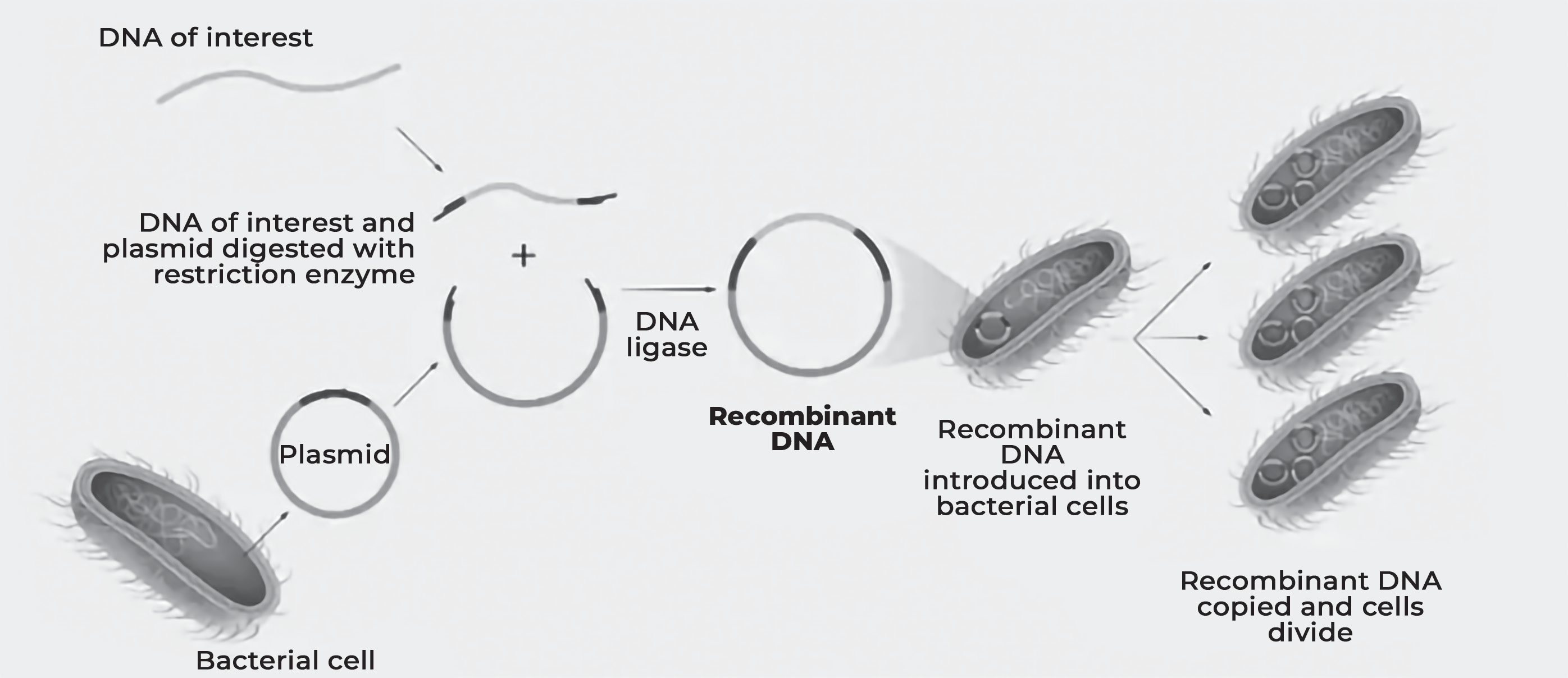
• Continuity of DNA – Structure of DNA is the same regardless of the species. Only the information differs. The A, T, C, G bases of the DNA are present in all organisms. The number and information stored within DNA varies between the species and not the structure of DNA molecule A plasmid can be used as vector to deliver an alien piece of DNA into the host organism.
• The linking of antibiotic resistance gene with the plasmid vector became possible with the enzyme DNA ligase
• This makes a new combination of circular autonomously replicating DNA (plasmid) created in vitro and is known as recombinant DNA.
• It could replicate using the new host’s DNA polymerase enzyme and make multiple copies
What are Plasmids?
Plasmid is an autonomously replicating, circular, extra chromosomal DNA present in the cytoplasm of various bacteria and protozoa. They typically have a small number of genes- some of which are usually associated with antibiotic resistance and these genes can be passed from one cell to others. This makes their use by scientists in RDT technologies very productive. When the plasmid with an inserted DNA fragment through RDT replicates itself, it also makes the copies of the inserted gene thus resulting in the success of RDT methods.
This is done by the help of two enzymes:
To cut the DNA- Restriction Endonuclease
To join the cut (paste) DNA to the target- DNA Ligase
Cohen and Boyer Experiment
The first instance of the construction of an artificial recombinant DNA molecule was linking a gene encoding antibiotic resistance with a native plasmid (autonomously replicating circular extra-chromosomal DNA) of Salmonella typhimurium by Stanley Cohen and Herbert Boyer in 1972. Salmonella typhi had the gene for antibiotic resistance but E. Coli did not. Boyer and Cohen first identified the location of the gene which was providing antibiotic resistance to Salmonella typhi and cut it using restriction enzymes. They then pasted this gene which was providing the resistance into the removed plasmid of the E. Coli using DNA Ligase technology. As a result of their experiment, E. Coli also developed antibiotic resistance. This was the first time Recombinant DNA technology was used.

Tools of RDT
• Restriction enzymes belong to a larger class of enzymes called nucleases. These are of two kinds; exonucleases and endonucleases.
• Exonucleases remove nucleotides from the ends of the DNA whereas, endonucleases make cuts at specific positions within the DNA.
• Each restriction endonuclease recognises a specific
palindromic nucleotide sequence in the DNA.
• When cut by the same restriction enzyme, the resultant DNA fragments have the same kind of ‘sticky-ends’ and, these can be joined together (end-to-end) using DNA ligases
• Separation and isolation of DNA fragments: Use of Agarose gel electrophoresis
Need of Vectors
• The likely fate of a piece of DNA, which is somehow transferred into an alien organism would not be able to multiply itself in the progeny cells of the organism.
• When it gets integrated into the genome of the recipient, it may multiply and be inherited along with the host DNA.
• This is because the alien piece of DNA has become part of a chromosome, which has the ability to replicate.
• One method we have discussed is to use the plasmids of the bacteria cells as the vector. Another method is infecting the bacteria with a virus, whose DNA has been modified to suit our purpose.
Viruses that infect bacteria are known as bacteriophages. By the same technology we insert the desired character into the viral DNA (using Restriction Endonuclease and DNA Ligase) and then infect the bacteria cells with the said virus.
Bacteriophages, because of their high number per cell, have very high copy numbers of their genome within the bacterial cells.
Copy number: It is the number of times a plasmid or a bacteriophage multiplies.
If we are able to link an alien piece of DNA with bacteriophage or plasmid DNA, we can multiply its numbers equal to the copy number of the plasmid or bacteriophage. Because they both create their own copies, these are also called as cloning vectors.
Thus, plasmids and bacteriophages become excellent candidates for the RDT technologies.
Steps of Recombinant DNA Technology (RDT)
Isolation of DNA pure form
We need pure form of DNA (removing the histones which help DNA to coil), so we break open the cell and release DNA using certain enzymes.
This can be achieved by treating the bacterial cells/ plant or animal tissue with enzymes such as lysozyme (bacteria), cellulase (plant cells), chitinase (fungus)
Cutting at specific places: Restriction Enzyme + gel
electrophoresis
Cut the source DNA and vector DNA with the same enzyme (Restriction Endonuclease)
Agarose gel electrophoresis: separates the DNA
fragments by size.
This checks progression of restriction enzyme work

Polymerase Chain Reaction (PCR): amplification of gene of interest
The DNA separation we get after gel electrophoresis is very minute and fragile. This creates a problem as the entire process cannot depend on minuteness of the DNA cut and fail as a result of mishandling.
So, we use a process called as Polymerase Chain Reaction (PCR) to create many copies of the extracted DNA fragment
COVID RT-PCR Tests
This term was used to test for COVID virus in the DNA of the humans. RT stands for ‘Reverse Transcriptase’ which means the reverse of transcription or the conversion of RNA to DNA. PCR is amplification of this DNA so produced. This is why when you got a RT-PCR COVID test done, a small nasal and mouth swab was enough. This small swab had your RNA which could be Reverse Transcripted to DNA and then the DNA could be run through the PCR to amplify its numbers so as to check for the COVID virus DNA.
Polymerase Chain Reaction (PCR)
Polymerase Chain Reaction (PCR), discoverd by Kary Mullis in 1983, is a crucial tool in genetic engineering, enabling, in vitro amplification of DNA sequences. It enables exponential copying of DNA through thermocycling and enzyme-mediated replication,
facilitating gene isolation, cloning, sequencing, and targeted mutagenesis. Refinements like real-time PCR, RT-PCR, and assembly PCR have expanded applications in recombinant DNA technology, synthetic biology, and genome editing. PCR has been instrumental in the rapid growth of genetic engineering in medicine, biotechnology, and life. PCR is based on thermal cycling, a DNA polymerase enzyme, and primers that initiate or limit DNA synthesis.
Key reagents include template DNA, primers, DNA polymerase enzyme, nucleotides (dNTPs), buffer, and magnesium ions. PCR equipment includes a thermal cycler machine with controllable heating, cooling, and holding. The cycling steps include initialization, denaturation, annealing, extension, and final elongation, with each cycle doubling the number of DNA copies. Even a single copy of the template can be amplified to 108 or more copies after 30-40 cycles, enabling detection and analysis.
Steps in Polymerase Chain Reaction
Although the notion of Polymerase Chain Reaction is straightforward, successful experiment design and optimization are essential. Significant steps consists of
Denaturation – The initial heating step converts the double-stranded DNA template into single strands, preparing primers for annealing. Higher denaturation temperatures (~98 C) result in full strand separation, particularly for GC-rich templates. Initial denaturation times range between 30 seconds and 3 minutes.
Annealing – The reaction temperature is set to 50-60°C for primer annealing to complementary sequences, which is typically 2-5 C lower than the primer melting point. Insufficient annealing affects yield, whereas excessive annealing enhances nonspecific binding and artifacts, which influence primer binding.
Extension – Raising the temperature to 72°C enables Taq polymerase to manufacture new strands by incorporating complementing dNTPs. Extension time is determined on the length of the amplicon and the polymerase used, with longer extensions (2-3 minutes) required for larger amplicons or slower polymerase.
Repeated Cycling – The primers are amplified in 25- 40 cycles, tailored for template amount and amplicon length, with excessive cycling avoided to reduce non- specific products and artifacts.
Final extension – The final extension step at 72 C ensures all single-stranded products are fully extended after repeated cycles, maximizing the final yield.
Optimisation - The Polymerase Chain Reaction is a straightforward process, but optimal conditions like annealing temperature, cycle number, and extension
time must be empirically determined for each target
and primer pair.
4.Ligation: Ligation is the process of connecting two nucleic acid fragments using an enzyme. It is an important laboratory method in the molecular cloning of DNA, in which DNA fragments are linked to form recombinant DNA molecules
5. Insertion into host: selectable marker Methods to get the alien DNA into the host cell of the target organism

• Recombinant Protein production
•
7. Downstream Processing- Using bioreactors to grow the product at a large scale. This is how the foreign gene product can be multiplied and extracted on a commercial basis making our lives easier. For instance, take the example of the human gene which produces insulin. This gene can be removed from Human DNA and inserted into the E. Coli using a suitable vector. After integration with the DNA of the E. Coli, this hormone can be produced at a large scale leading to the benefits.
Applications of Biotechnology
The applications of biotechnology include therapeutics, diagnostics, genetically modified crops for agriculture, processed food, bioremediation, waste treatment, and energy production.
Some of the applications of biotechnology are explained below
Genetic Engineering: A genetically engineered plant, also known as a genetically modified organism, or GMO is one that is grown via a new genetic modification (nGM) technique. The crops grown by this process use recombinant DNA (rDNA) technology which include techniques such as genome editing, RNA-directed DNA methylation, transgrafting, agroinfiltration, haploid induction, or others. The genetic engineering of plants is regulated by biosafety frameworks specific to a country. Some example of GMO crops include corn, potato, soybean, etc.
Micropropagation: It is an in-vitro method that uses vegetative propagation with controlled nutrition, temperature, and light intensity. This method helps in the development of disease-free plants, large-scale plant growth, and plants that are in danger of going extinct. For example, micropropagation is widely used in the cultivation of bananas.
Transgenic Technique: It is a method of modifying the genome in order to develop plants resistant to disease. In order to make disease-free variations, transgenic plants are created by either adding a new gene or deleting a gene from the original chromosomal DNA. For instance, transgenic techniques have been used to grow sugarcane and rice.
Transcriptomics: Transcriptome sequencing allows scientists to study the genome of plants. Transcriptomics uses transcriptome sequencing technology to grow plants that are microbe-and stress-resistant crops such as maize, tobacco, etc. Fortification of Plants: In order to alleviate malnourishment, fortification involves increasing the nutritional potential of crops. For instance, "protato" is a genetically modified fortified potato crop that offers higher protein content than a regular potato crop. Bioremediation: It is a method used to reduce the contamination of soil and water. This technique involves biological agents such as plants and fungi to reduce the number of heavy metals and toxins in soil and water.
Waste Management: Through the use of bacteria and living organisms is another application of biotechnology to decontaminate the environment safely.
Three critical research areas of biotechnology are:
Providing the best catalyst in the form of improved organism usually a microbe or pure enzyme
Creating optimal conditions through engineering for a catalyst to act
Downstream processing technologies to purify the protein/organic compound
Let us now learn how human beings have used biotechnology to improve the quality of human life, especially in the field of food production and health.
of millions of diabetes patients around the world. This is an example of how biotechnology can be used for human good.
Agriculture
Basic problem in agriculture since prehistoric times has been increasing the production and yield of food. This problem has been attempted and partly solved by various
technologies which can be broadly categorised as:
Agro-Chemical Based Agriculture- This is the method where various pesticides and chemicals are used in addition to using better varieties of seeds and other inputs to agriculture. Green Revolution is a prominent example of this method. While this method certainly produces the desired results it leads to the detriment of long-term sustainability of the system. Moreover, in developing countries, farmers find it difficult to procure expensive chemicals monopolised by Multinational Companies. This leads to the government subsidising it and diversion of disproportionate amount of time money and resources to funding the subsidy bill.
Organic Agriculture- It is the holistic production management system which promotes and enhances Agro-ecosystem health, including biodiversity, biological cycles, and soil biological activity. It emphasises the use of management practices in preference to the use of off-farm inputs, taking into account that regional conditions require locally adapted systems. This is accomplished by using, where possible, agronomic, biological, and mechanical methods, as opposed to using synthetic materials, to fulfil any specific function within the system. The problems of this system are widely known- this leads to a dramatic reduction of the yield which does not guarantee long term sustainability or fulfilment of food security (as recently seen in the case of Sri Lanka).
Genetic Engineering in Agriculture- We will discuss this method in detail here.
GENETICALLY MODIFIED ORGANISMS (GMO)
Plants, bacteria, fungi and animals whose genes have been altered by manipulation are called Genetically Modified Organisms (GMO). GM plants have been useful in many ways. Genetic modification has:
• made crops more tolerant to abiotic stresses (cold, drought, salt, heat)
• reduced reliance on chemical pesticides (pest-resistant crops)
• helped to reduce post-harvest losses
• increased efficiency of mineral usage by plants (this prevents early exhaustion of fertility of soil)
• enhanced nutritional value of food, e.g., Vitamin ‘A’
enriched rice
• has been used to create tailor-made plants to supply alternative resources to industries, in the form of starches, fuels and pharmaceuticals
Bacillus thuringiensis
Bt toxin is produced by a bacterium called Bacillus thuringiensis (Bt for short). Bt toxin gene has been cloned from the bacteria and been expressed in plants to provide resistance to insects without the need for insecticides; in effect to create a bio-pesticide. Examples are Bt cotton, Bt corn, rice, tomato, potato and soyabean etc
Since the bacterium ‘Bt’ had the gene of insecticide resistance, it must also have the gene that codes for specific proteins that kills the insects when they ingest it. So, that the gene must have been isolated and then incorporated into various crop.
If this toxin is being produced by Bt, why does it not affect the bacillus itself?
This happens because the toxin when it is produced by the bacillus it is in the form of a ‘Protoxin’. Protoxin = Pro + Toxin. Think back to Pro + Karyotic, Pro + Nucleus Transfer. What was the meaning of Pro? Pro means old. Thus, Prokaryotic cells are the old cells which do not have cell membrane. Pronucleus is the stage of where the nucleus of the male sperm and female ovum have not merged. And, Protoxin is before it is a toxin. That is, in the bacterium the toxin produced by Bt is not a toxin but it becomes a toxin when insects ingest it.
This technique is the word breakdown technique and is immensely helpful in understanding science and technology concepts and solving questions. We will keep using this technique throughout this book to help you understand and apply it yourself.
This toxin is coded by genes that are called as cry. There are a number of genes under this family of Cry such as Cry1Ac (control cotton bollworms), Cry2Ab (control cotton bollworms) and Cry1Ab (corn borer). Bollworms = Boll + Worms are insects which harm the cotton plant. Cotton plant has bolls of cotton. Corn Borer is a kind of drills into the corn plants. Thus, these are names of various insects which harm various plants and genes that control them.