Bronze Sculpture

B ronze Nataraja & Bronze Dancing Girl
Bronze casting was conducted on a large scale in practically all of the civilization’s main sites.
The technique used for Bronze Casting was Lost Wax Technique.
Lost Wax Technique

Lost Wax Technique
Bronze casting was widely practiced during the Indus Valley Civilization, especially at Harappa, using the “lost wax technique.”
This method continues to be practiced in regions like Himachal Pradesh, Odisha, Bihar, Madhya Pradesh, and West Bengal.
Each region applies a slightly different technique. First, the bee wax is melted over an open fire and strained through fine cloth into cold water.
The wax quickly solidifies and is then passed through a pharni, forming noodle-like wires.
These wax wires are shaped to form the entire image, which is then covered with a paste made of clay, sand, and materials like cow dung.
On one side, an opening is kept. When it becomes dry, the wax was heated and the molten wax was drained out through a tiny hole. The hollow mould thus created was filled with molten metal which took the original shape of the object.
Dancing Girl: This is one of the best- known artefacts from the Indus Valley. It’s a four-inch-high copper figure, found in Mohenjodaro.
It depicts a girl whose long hair is tied in a bun. Bangles cover her left arm, a bracelet and an amulet or bangle adorn her right arm, and a cowry shell necklace is seen around her neck.
Her right hand is on her hip and her left hand is clasped.
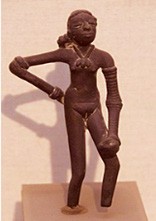
She is resting her weight on one leg in a very natural fashion, as in the contrapposto techniques of later sculptures.
The girl seems to be in what is called Tribhanga posture.
The jaunty manner and liveliness of the figure are remarkable. She is full of expression and bodily vigour and conveys a lot of information.