Buddhism:
• Among the heterodox sects, Buddhism was the most
popular. It went on to emerge as a powerful religion patronised by various rulers.
• Ashoka also adopted Buddhism as state policy.
• Dr. B.R. Ambedkar also followed this religion.
• Upasaka - Lay follower of Buddhism.
• Some important sites are:
• Tabo monastery and temple complex Spiti Valley,
• Lhotsava Lhakhang temple, Nako Kinnaur Valley,
• Alchi temple complex Ladakh.
Extent of Buddhism
It is widespread in Southeast Asia
Outside India, Buddhist influence reached Sri Lanka, Myanmar, Thailand, Cambodia, Laos, Vietnam, Central Asia, Tibet, China, Korea, Japan, and Mongolia.


Life of Buddha:
Gautam Buddha was born as Siddhartha in Sakya clan. His father was Suddhodana and Mother was Mahamaya. He was born in Lumbini near Kapilavastu.
He married Yashodhara and had a son named Rahul.
While he was riding Chariot with charioteer Channa, he saw an old man, sick man and a corpse and a poor person. After seeing this, he was overcome with remorse and left his royal life.
He Left home at the age of 29 and became a Parivarjaka (Renunciant and wanderer).
He discarded all the world’s belongings, and this is called
Mahabhiraskarmana or the Great Going Forth.
He attained enlightenment at the age of 35.
He delivered his first sermon in Sarnath near Varanasi. This is called as Dharmachakrapravartana.
He established Sangha and spread his ideas far and wide.

71
At the age of 80, he passed away in Kusinagara. This is known as Mahaparinirvana.
Prominent disciples were Sariputta, Maha-mogallanna,
Mahakaccayana and Ananda.
Eight important holy locations related to the life of Buddha are known as Astamahasthanas. Lumbini (Birth), Bodhgaya (Enlightenment), Sarnath (first Teaching), and Kushinagara (Death) are among the four pilgrimage sites associated with Gautama Buddha’s life, as are Sravasti (Kosala Kingdom capital), Sankasya, Rajgir, and Vaishali.
Buddha traveled to the kingdoms of Kosala and Magadha. Kapilvastu, Kosambi, Nalanda, Mathura, Varanasi, Saket
Buddhist Councils:
and Champapuri were among other places he visited during his lifetime.
| 5 Events of Buddha’s Life | |
| Event | Symbol |
| Birth | Lotus and Bull |
| Great Renunciation | Horse |
| Nirvan or Attainment of Knowledge | Bodhi Tree |
| First Sermon | Wheel(Dharma Chakra) |
| Parinirvan or Death | Stupa |

Decline of Buddhism
Buddhism in India started declining with onset of Bhakti movement.
Divisions into sects like ‘Mahayana’, ‘Vajrayana’, and ‘Hinayana’.
Adoption of Sanskrit language, thus their connection with the people started declining.
Lost royal patronage after Harshvardhana.
Shungas and Guptas gave patronage to Vedic religion.
Invasion of Huns.

Invasion of Arabs and Turks led Buddhist monks to flee from India and seek asylum in Nepal, Tibet and Ceylon.
Buddhist Sects:
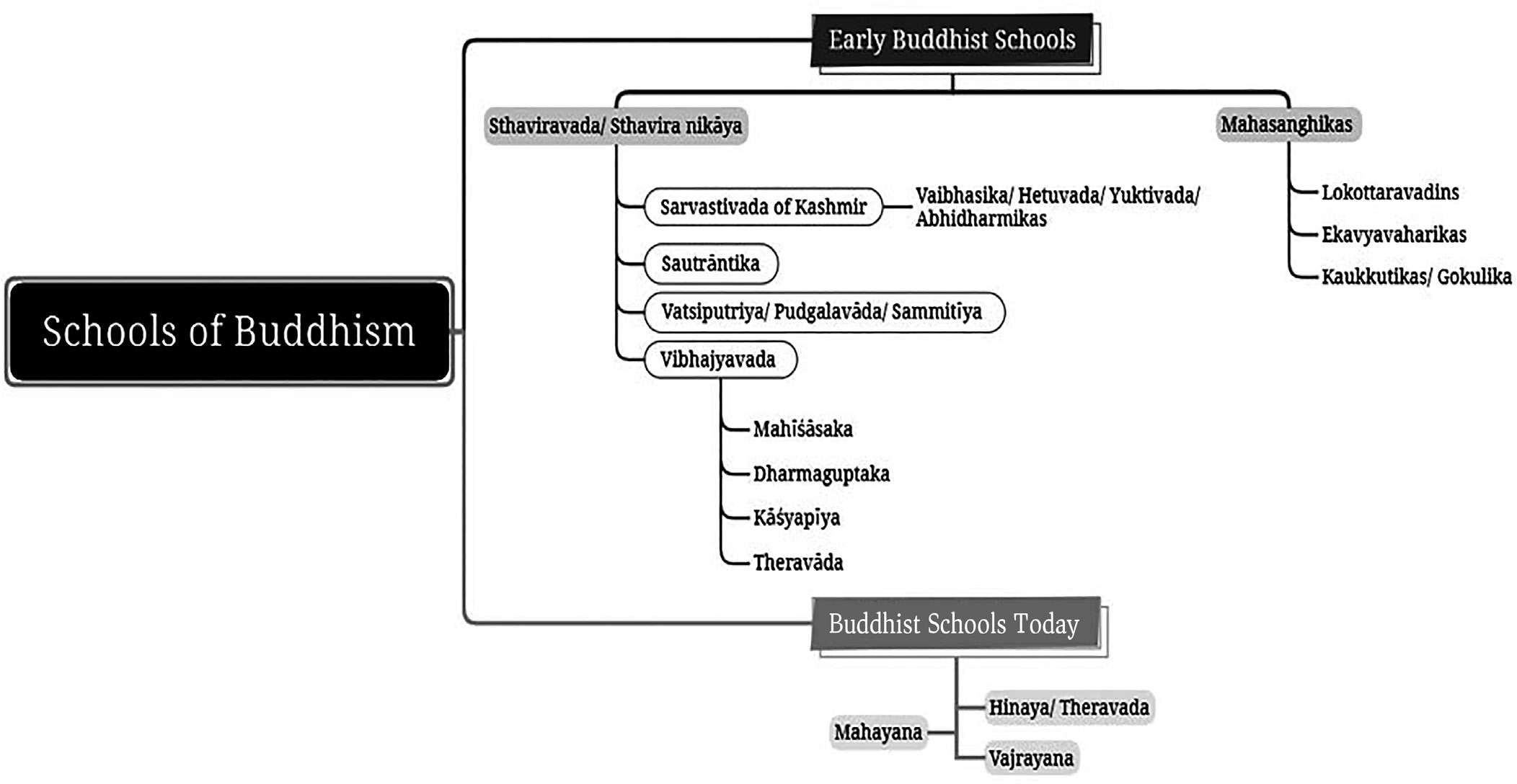
The early Buddhist schools refer to the various branches into which the Buddhist monastic saṅgha divided in the early history of Buddhism. These divisions initially arose from differences in Vinaya (monastic discipline) and later expanded due to doctrinal disagreements and the geographical separation of monastic communities.
Mahasanghikas:
From Sanskrit mahāsaṅgha meaning“great order of monks”, was an early Buddhist school formed during the second Buddhist Council of 383CE when it separated from Sthaviravada. The deification of Buddha by Mahasanghikas fostered the Mahayana Buddhism. Further subdivisions of the Mahasanghikas over the next seven centuries based upon the relative manner and degree to which they accepted the authority of these Mahāyāna texts, included:
• Lokottaravadins: Accepted the Mahāyāna sūtras as the words of the Buddha. They are described in the Mahavastu text written in Sansrikt part of Vinaya Pitaka.
• Ekavyavaharikas: They emphasized the transcendence of the Buddha, asserting that he was eternally enlightened and essentially non-physical.
• Kaukkutikas, also called Gokulika propounded the doctrine that all conditioned phenomena necessarily involve suffering, and that they are like an “inferno of ashes.”
Sthaviravada/ Sthavira nikāya
In Sanskrit means “Sect of the Elders”, was a minority who sought to add rules to the Vinaya which were rejected by Majority Mahasanghikas. The Sthaviras later divided into other schools such as:
•
Pudgalavāda
• Vibhajyavada
• Sarvastivada
• Sautantrika
Pudgalavāda/ Vatsiputriya/ Sammatiyas (from Sanskrit ‘Personalism’) in 3rd century BC- popular during Harsha’s reign. It asserted that while there is no ātman, there exists a pudgala (person) or sattva (being) which is neither a conditioned dharma nor an unconditioned dharma. They relied on the Bharaharasutta.
Vibhajyavada (from Sanskrit vibhajya, loosely meaning “dividing”, “analyzing” and vāda meaning “doctrine”, “teachings”). They were those who made distinctions as they rejected Sarvastivada and instead made a distinction between dhammas that “exist” and dhammas that do not exist. Essentially meaning that there was no future dhamma and past dhamma, to the extent that it had borne fruit, was also extinguished.
• Mahīśāsaka: held that everything exists, but only in the present and the Four Noble Truths were to be meditated upon simultaneously.
• Dharmaguptaka: split from Maisasakas and spread in China. Distinguished between disciples of Buddha and Buddha. They placed Buddha on a higher pedestal.
• Kāśyapīya: Believed that arhats (one who has achieved Nirvana) were fallible and imperfect. They held that arhats have not fully eliminated desires, that their “perfection” is incomplete, and that it is possible for them to relapse.
• Tāmraparnīya, later called Theravāda- Pali form of Sthaviravadins spread over Sri Lanka and Southeast
Asia.

73
Sarvastivada is a Sanskrit term meaning “the theory of all that exists”. It argued that all dharmas exist in the past, present and future. Sarvastivadins consider everything empirical to be impermanent, they maintain that the dharma factors are eternally existing realities. The dharmas are thought to function momentarily, producing the empirical phenomena of the world, which is illusory, but to exist outside the empirical world. It is also called:
• Vaibhasika: Vaibhasika or Abhidharmikas was formed during the council of Kashmir. They have orthodox adherence to the doctrines found in the ‘Great Commentary’ Mahāvibhāṣa or Abhidharma.
• Hetuvada comes from hetu – ‘cause’, which indicates
their emphasis on causation and conditionality.
• Yuktivada comes from yukti – ‘reason’ or even ‘logic’, which echoes their use of rational argument and syllogism.
Sautrantikas literally means “those who rely upon the sutras”. They maintained that the dharma factors are not eternal but momentary, and the only actually existing dharmas are the ones presently functioning. They hold the sutras, but not the Abhidharma commentaries (sastras), as authoritative.
Prominent Buddhist Sects Today:
With the exception of the Theravāda, none of these early schools survived beyond the late medieval period. The origins of specifically Mahāyāna doctrines may be discerned in the teachings of some of these early schools, in particular in the Mahāsānghika and the Sarvāstivāda.
• Hinayana meaning ‘Small Vehicle’ in Sanskrit, also called Sthaviravadin or Theravada.
• They did not believe in the divinity of the Buddha or Buddha’s reincarnation.
• It stressed individual salvation through self- discipline and mediation.
• They follow Arhat through the Eight-fold path.
• They favoured the Pali language.
• It was patronised by Ashoka.
• It became popular in Sri Lanka, Burma, Thailand and other south-east Asian countries.
• It encompasses eighteen schools. Important sub-sects include Sarvastivada and Theravada.
• Mahayana which means ‘Great Vehicle’ in Sanskrit.
• They believed in the divinity of the Buddha and believed that Buddha will be born again.
• They sought salvation of all through the grace of Buddha and Bodhisattva.
• The sect encouraged idol worship in Buddhism.
• They promoted Sanskrit language.
• It was promoted by Kanishka and Harsha.
• It spread to China and Japan.
• Importantsub-sects include Madhyamaka/ Sunyavada and Yogachara/Vijnanavada.
• “Paramita” or “Prajnanaparamitas” is a Sanskrit term, which means perfection of wisdom. In the Mahayana tradition, bodhisattva is described in terms of six paramitas:
• Dana paramita: to cultivate the attitude of giving;
• Sila paramita: refraining from harm;
• Kshanti paramita: the ability not to be perturbed by anything;
• Virya paramita: to find joy in what is virtuous, positive or wholesome;
• Dhyana paramita: not to be distracted and
• Prajna paramita: the perfect discrimination of phenomena.
• Vajrayana: By the end of Gupta period, Vajrayana sect emerged.
• Vajrayana (Sanskrit for “thunderbolt vehicle” or “diamond vehicle”), or Tantric Buddhism, said to have started in the Mahayana school.
• It is founded on a complicated intellectual and ceremonial framework that aims to lead to enlightenment.
• It entailed merging Brahmanical (Veda-based) rites with Buddhist concepts.
• The major goddess is Tara (a woman).
• It was popular in Bengal and Bihar. Vajrayana also reached Tibet.
• Vikramshila University was famous for Vajrayana teachings.
Bodhisattva
• Frequently associated with Mahayana Buddhism.
• Bodhisattva is a compassionate one on his way to enlightenment, who delays achieving his own salvation to help all sentient beings on their path to it.
• Major Bodhisattvas include Avalokitesvara, Manjusri, Samantabhadra, Ksitigarbha, Maitreya, Vajrapani, Sadaparibhuta and Akasagarbha.
• Vajrapani (Buddha’s Power): He is described as one of the 3 protective deities around Buddha, others are Manjusri and Avlokiteshwara. Vajrapani represents Buddha’s power while Buddha’s wisdom is symbolised by Manjushri, and Avalokiteshwara manifests as Buddha’s compassion.
• Avalokitesvara (Buddha’sCompassion): Avalokiteshwara means ‘one who can see all’. He represents infinite compassion and mercy. He is depicted as holding a lotus flower. He is depicted as female also. A cave wall painting of Avalokitesvara is devoted in Ajanta Caves as Padmapani.
• Manjusri (Buddha’s Wisdom): Literally means ‘Gentle Glory’. He represents Pragya or transcendental wisdom at a very early age. Manjusri is depicted as


a male bodhisattva wielding a flaming sword in his right hand.
• Maitreya (Buddha’s Activity): He is also known as Ajita Bodhisattva. It is believed that he will
come when people forget the right path. He is seen as the future Buddha, after Gautama Buddha. In Buddhism, he is respected as someone who will become fully enlightened and teach people the right way to live.

• Samantabhadra (Buddha’s Aspirations): Literal meaning is ‘Universal Worthy’ and he is associated with practice and meditation. He made ten vows to fulfil his journey of becoming a Buddha. His manifestation is ‘Action’ and he is a key figure in Flower Garland Sutra.
• Ksitigarbha (Buddha’s Merit): He is popular as a Buddhist monk in the mostly East Asia. While the name literally means Earth Womb, he is revered as the guardian of children and patron deity of deceased children. He carries a staff.
•
Akasagarbha (Buddha’s Blessings): He is boundless as space. He was the twin brother of Ksitigarbha. He manifests as a blessing.
• Sarvanivarana-Vishkambhin (Buddha’s Qualities): He is invoked to remove or eliminate all the obstacles to insure a successful meditation.
Buddhist Literature
• Buddhist texts were compiled in Pali.
• Tripitakas were written in Pali.


75
• ‘Vinaya Pitaka’ deals with monastic rules. It includes three books namely Suttavibhanga, Khandhaka and Parivara.
• ‘Sutta Pitaka’ deals with teachings of Buddha. It includes Nikayas which contained ‘Theragatha’ and ‘Therigatha’ (Hymns of the elder monks and nuns respectively) and Jataka poetic tales of previous births of Buddha.
• Five Nikayas are namely Digha Nikaya (long discourses), Anguttara Nikaya (numerical), Majjhima Nikaya (middle length), Khuddaka Nikaya (minor discourses) and Samyutta Nikaya (connected discourses of Buddha).
• ‘Abhidhama Pitaka’ expounds Buddhist philosophy. It includes seven books namely Dhammasangani, Dhatukatha, Kathavatthu, Patthana, Puggalapannatui, Vibhanga and Yamaka.