SHRAMANA TRADITIONS
Buddhism, Jainism and the Ajivikas sects trace their developments from the Shramana Traditions at end of the Later Vedic Period. A Shramana is one who strives for enlightenment. It started as a response to Later Vedic elaborate rituals and practices. Shramanas were against Brahmin dominance, complex Vedic rituals, Varna system of classification, backward status of women, shudras and indiscriminate animal sacrifice. This tradition was highly patronised by the Mauryan Rulers.
Journey from Siddhartha to Gautama Buddha
• Gautama Buddha was born in 563 BCE on the occasion of Vaishakhi Poornima at Lumbini, Nepal as Siddhartha Gautama in the Shakyan Kshatriya clan. His Father was Suddhodhana, King of Kapilavastu and his mother was Mahamaya, she was the princess of Kollia republic. He had a wife named Yashodhara and a son named Rahul. This janma event of Gautama Buddha’s life is symbolised by Lotus and Bull imageries.
• At the age of 29, he experienced pain from observing the outside world and renounced his home and life of comfort. His horse was known as ‘Kanthaka’ and his charioteer was known as ‘Channa’. This event is known as Mahabhinishkramana (renunciation). Siddhartha became a wandering ascetic (parivrajaka) and followed the Shramana tradition under the guidance of Alara Kalam (Early Sankhya philosopher).
• He wandered for years and finally reached a village uruvella on the banks of the river Niranjana. He sat under the Bodhi tree and meditated for 49 days before attaining Nibbana (extinguishment of the flame of desire). Thereafter, he was called as Buddha, the enlightened one.
• He gave his first sermon at Sarnath Deer Park near Varanasi. This event of Buddha’s life is known as ‘Dharmachakra Pravartana’ (turning of the wheel of law). He died in 483 BCE at the age of 80 years at Kushinagar, Uttar Pradesh. This event is known as Mahaparinirvana (final blowing out).
• Buddha is also known as Thathagat and Shakyamuni. His predecessor is known as Kassapa Buddha and his successor (future Buddha) would be known as Maitreya.
• His five disciples at Sarnath were Kaudinya, Bhadrika, Vashpa, Mahanaman and Ashvajit.
Philosophy and Tenets of Buddhism
• Buddha focused on the importance of metta (fellow feeling, brotherhood) and karuna (compassion).
• According to Buddha, the world is transient (anicca) and constantly changing. It is also soulless (anatta) as there is nothing permanent or eternal in it.
• Buddha emphasised on individual agency and righteous action as the means to escape the cycle of rebirth and attain nibbana.
• He gave the famous Chatwari Arya Satyani or the ‘four noble truths’:
• Life is full of sorrow Sabbam Dukham
• There are certain causes of sorrow Dukkha Samupadda
• Cessation of suffering can be done Dukkha Atikkama
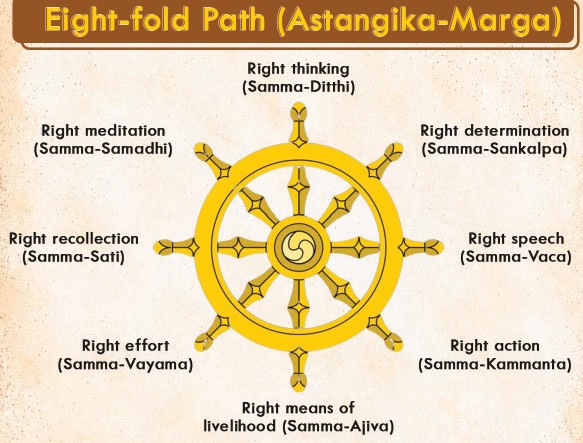
• Path Leading to the cessation of sorrow is the Ashtangika Marg or the 8-fold path Dukkha Nirodha
• He also highlighted the reasons for sorrow by giving the concept of dvadasa-nidana-chakra which has a list of 10 precepts generally ignored by people. When this chakra is not followed, it leads to sorrow or dukkha in the lives of the people.
• Ten Precepts
• Not to harm living beings
• Not to take what is not given
• Abstain from false speech
• Abstain from evil behaviour
• Abstain from alcoholic drinks
• Abstain from eating at forbidden times
• Abstain from dancing/singing/music/dramatic performance
• Abstainf romuse of jewellery/perfumes/ garlands
• Abstain from receiving gold/silver
• Abstain from use of broad or high bed
• Buddha suggested following the Madhyamka approach
– the middle path, avoiding the life of extremes; neither
pure ascetism nor pure worldliness.
• He rejected the authenticity of the Vedas. He also rejected the concept of soul or ‘atman’.
• Buddha gave the famous Tri-ratnas of Buddhism as:
• Buddha – The Enlightened One
• Dhamma- Doctrines
• Sangha- Commune order of monks
• Three Trainings or Trisiksha
• Morality (Sila)
• Meditation (Samadhi)
• Wisdom (Prajna)
• Metaphysical Thoughts of Buddhism
• Universe was created based on the Laws of Nature
• Rejected the authority of the Vedas
• Buddha was agnostic on the question of God. He neither confirmed nor deny the presence of God.
• Buddhism does believe in rebirth but based on karmic doctrine of ‘Pancha Skandha’
• Buddhism also does not believe in souls or atman but instead they believe in Doctrine of Momentariness or Kshanabhangavada and in Anicca (non-permanence)
Inclusion of Women and the Reasons for Decline
Buddha was initially against the idea of inclusion of women in the Sangha (Buddhist Monastic Order) and said that the religion would become corrupt within 1000 years if women were allowed to be members of the Sangha. On the insistence of his disciple Ananda, he relented and agreed to include women in the Monastic Order. The first women who was admitted into the Buddhist Sangha was Mahaprajapati Gautami.
The Decline of Buddhism happened due to
Corruption of the monks and luxurious lifestyles
Elitist attitude- gradual shift to Sanskrit language
Interference with the internal affairs of the rulers lead to stopping of state patronage to the religion
Frequent branching of Buddhism diluted it
Reform of Sanatana Dharma by assimilating various aspects of Buddhism on one hand and gradual reform of the sacrifice cult on the other.