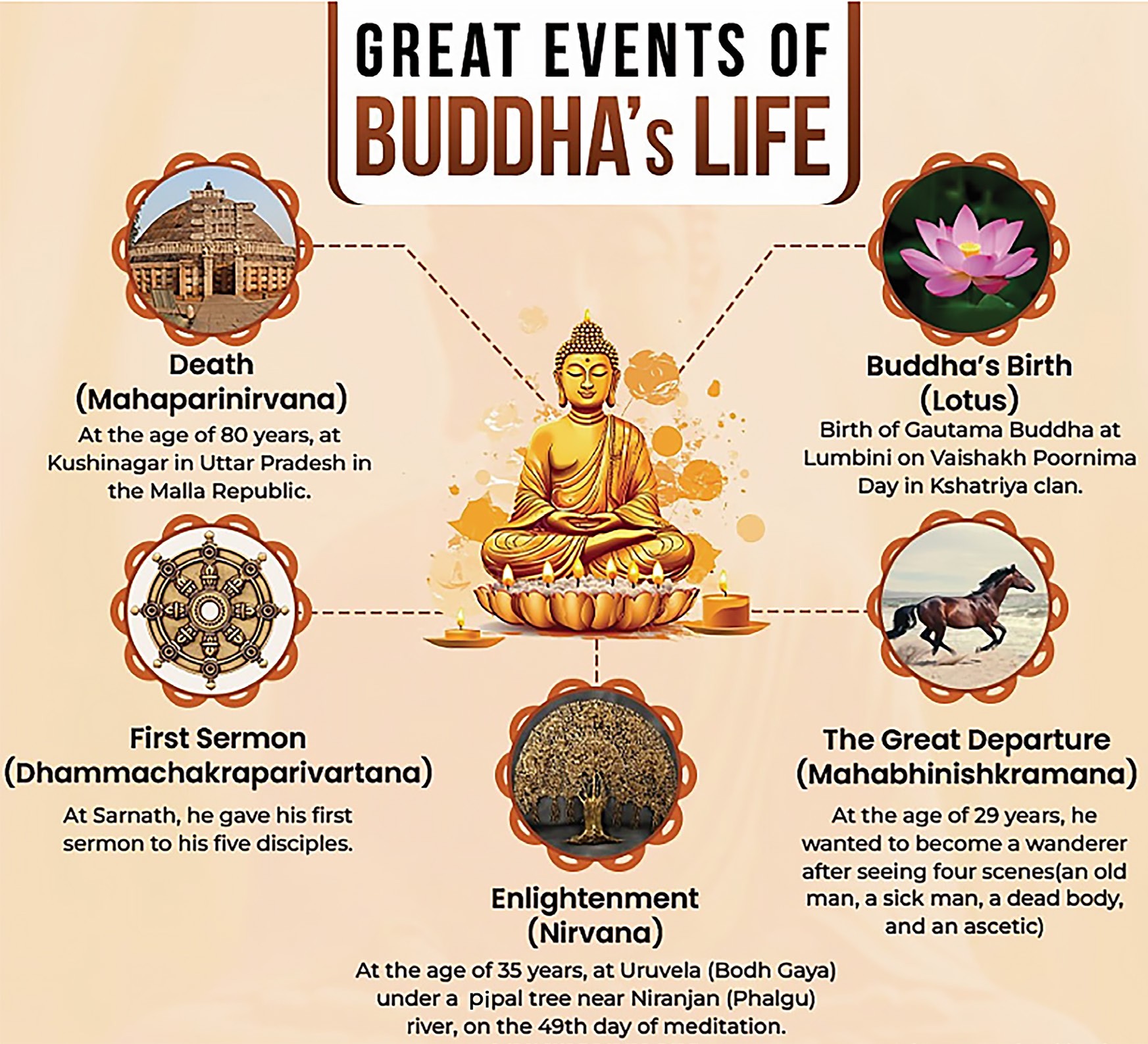
Important Events in the life of Buddha
Ksitigarbha (Buddha’s Merit): He is popular as a Buddhist monk in the mostly East Asia. While the name literally means Earth Womb, he is revered as the guardian of children and patron deity of deceased children. He carries a staff.
Akasagarbha (Buddha’s Blessings): He is boundless as space. He was the twin brother of Ksitigarbha. He manifests as a blessing.
Sarvanivarana-Vishkambhin (Buddha’s Qualities): He is invoked to remove or eliminate all the obstacles to insure a successful meditation.
Prominent Disciples of Buddha in the Ancient Period
• Sariputta: Chief Disciple and possessed knowledge of Dhamma
• Mahamoggallana
• Ananda: Chief disciple of Buddha
• Mahakasyapa: President of First Buddhist assembly=
• Purna Maitrayani-putra
•
Anuruddha: Master of right mindfulness
• Rahul: Son of Gautama Buddha
• Katyayan
• Upali: Possesed knowledge of Vinaya
• Ananthapindaka
• Subhuti
• Jivaka
Important Buddhist Scholars
• Moggaliputta Tissa: Launched Ashoka’s dhamma campaign
• Aryadeva: Mahayana Buddhist monk was a disciple of Nagarjuna and a Madhyamaka philosopher.
• Dignaga: His work laid the groundwork for the development of deductive logic in India and created the first system of Buddhist logic and epistemology (Pramana).
• Asvagosha: Wrote Buddhacharita and Sanskrit drama
Sariputra Prakran
• Nagarjuna: Founded madhyamik school of Mahayana Buddhism, gave theory of Sunyavad’ Emptiness’ and important work include ‘Mulamadhyamakakarika’
• Buddhagosh: Most important commentator of Theravada, important work is Visuddimagga.
• Dharmakirti: Teacher at Nalanda, called as ‘Kant of India’.
•
Propounded the Vijnanavada (mind alone) School of Thought
• Expanded on the work of Diganaga
• Laid the foundations of development of logic in India called as ‘Hetu Vidya’
• Vasubandhu: A proponent of Mahayana Buddhism in 4th-5th century AD from Gandhara and wrote from the perspectives of the Sarvastivada and Sautrantika schools.
• Padmasambhava: An 8th century monk and is contemplated as ‘Second Buddha’ across Tibet, Nepal, Bhutan and the Himalayan States of India.
• Atisa: A Buddhist Bengali religious leader and master, and is one of the major figures in the spread of 11th century Mahayana and Vajrayana Buddhism in Asia. He inspired Buddhist thought from Tibet to Sumatra.
• Dalai Lama: They are modern spiritual leaders of the
Yellow Hat School of Tibetan Buddhism.

Important Monasteries in India
| MONASTERY | LOCATION | FEATURES |
| Hemis Monastery | Hemis, Ladakh, India | Hemis Monastery, founded in the 11th century, is Ladakh’s largest and wealthiest monastery. It is a Tibetan Buddhist monastery a.k.a Gompa of the Drukpa Lineage (Dragon Order of Mahayana Buddhism). Reconstructed by Sengge Namgyal in 1672, it is believed that ancient Buddhist pupil Naropa achieved enlightenment here. The monastery hosts a famous Hemis Festival dedicated to Lord Padmasambhava. |
| Thiksey Monastery | Leh, Ladakh, India | It is a Gompa (monastery) affiliated with the Gelug sect of Tibetan Buddhism. It is located on top of a hill in Thiksey village, approximately 19 km east of Leh in Ladakh. The 49 feet statue of Maitreya Buddha that covers two storeys is the key attraction of this monastery. It resembles the Potala palace in Lhasa, Tibet. |
| Namdroling Nyingmapa Monastery | Coorg, Karnataka, India | It is the is the largest teaching center of the Nyingma lineage of Tibetan Buddhism in the world. The monastery was established by the 11th throneholder of the Palyul lineage, Drubwang Padma Norbu Rinpoche in 1963. It has a number of gold statues of Buddha as well as several domes all around the complex. |
| Tabo Monastery | SpitiValley,Himachal Pradesh, India | It was founded in 996 CE in the Tibetan year of the Fire Ape by the Tibetan Buddhist lotsawa (translator) Rinchen Zangpo (Mahauru Ramabhadra), on behalf of the king of western Himalayan Kingdom of Guge, Yeshe-O. The monastery, also known as the ‘Ajanta of the Himalayas’, is surrounded by caves and is primarily filled with paintings on walls and ceilings. |
| Tawang Monastery | Tawang,Arunachal Pradesh, India | It is India’s largest monastery and the world’s second largest after the Potala Palace in Lhasa, Tibet. Merak Lama Lodre Gyatso founded this monastery in 1680– 1681. It belongs to the Gelug school of Vajrayana Buddhism and had a religious relationship with the Drepung Monastery in Lhasa that lasted under British administration. |
| Namgyal Monastery | Dharamsala,Himachal Pradesh, India | It is the personal monastery of 14th Dalai Lama. It was created in either 1564/ 1565 by the third Dalai Lama, Gendun Gyatso. In 1571, Namgyal Monastery was renamed in honour of the female long-life deity Namgyalma. |
| Ghoom Monastery | Darjeeling, West Bengal, India | The Ghum Monastery, founded in 1850 by Lama Sharap Gyatso, is a Buddhist monastery of the Yellow Hat sect. The Tibetan culture has left its mark on this monastery. The primary feature of this monastery is a 15-foot-tall statue of Lord Buddha. This statue is made entirely of pure gold and exquisite stones. Two massive oil lamps are placed in front of this monument and stay blazing all year. |
| Dhankar Gompa (Monastery) | Lahaul and Spiti, Himachal Pradesh, India | It is a Buddhist temple located at a height of 3894 meters in India’s Lahaul and Spiti region. It is the world’s second highest monastery, after Ki Monastery, and has been a prominent center of Buddhist scholarship since the seventh century. |
| Enchey Monastery | Gangtok, Sikkim, India | The Enchey Monastery was founded in 1909 and is affiliated with the Nyingma order of Vajrayana Buddhism. Lama Drupthob Karpo, a well-known practitioner of tantric (adept) art in Buddhism, blessed the place. |
| Mindrolling Monastery | Dehradun, Uttarakhand, India | The Mindrolling Monastery is one of India’s most prominent Buddhist monasteries, with the World’s Biggest Stupa (185 feet) and the largest Buddha statue. Belonging to the Nyingma school in Tibet, this is a great center for learning Buddhist scriptures and traditional Tibetan medicine. |
| Rumtek Monastery | Gangtok, Sikkim, India | It is also known as the Dharmachakra center and is a gompa, which are Buddhist ecclesiastical fortresses of study, lineage, and sadhana. It was built under the direction of Changchub Dorje (12th Karmapa Lama in the mid-1700s). |
| Mulbekh Monastery | Kargil, Ladakh, India | Mulbekh Monastery, a Tibetan Buddhist monastery, is located on a crag 656 feet above the road, with a steep footpath leading to the monastery. It is believed to have been built around 800 years ago by Tibetan scholar Lotsawa Rinchen Zangpo’s students. The monastery features a 30-foot-tall statue of Maitreya Buddha, a blend of Buddhist and Shaivite influences, and ancient inscriptions and an edict from King Lde to abandon goat sacrifice. |
Important Hand Gestures in Buddhism
| MUDRA | POSTURE | MEANING |
| Dharmachakra Mudra | This gesture is also known as the "Teaching of the Wheel of Dharma," symbolizing one of the key moments in the Buddha’s life when he performed the Dharmachakra mudra during his first sermon in Sarnath after attaining enlightenment. The mudra is performed with both hands positioned at chest level, with the left hand facing inward and the right hand facing outward. | |
| Dhyan Mudra | This gesture is also referred to as Samadhi or Yoga mudra. It is performed by placing both hands on the lap, with the right hand resting on top of the left. The fingers are stretched, with the thumbs pointing upwards and the other fingers of both hands gently resting on one another. This mudra is commonly associated with Buddha Shakyamuni, Dhyani Buddha Amitabh, and the Medicine Buddha. | |
| Bhumisparsa Mudra | This gesture, known as "touching the Earth," symbolizes the Buddha's moment of awakening when he calls upon the Earth as a witness to his enlightenment. It is performed by raising the right hand above the right knee, with the palm facing inward, and extending it toward the ground while touching the lotus throne. | |
| Varada Mudra | This mudra symbolizes offering, welcome, charity, giving, compassion, and sincerity. It is performed with both hands: the right hand is extended forward with the palm facing outward and fingers spread, while the left hand is positioned near the navel with fingers extended. | |
| Karan Mudra | This gesture symbolizes the protection against evil. It is performed by raising the index and little fingers while folding the other fingers. It is believed to help alleviate sickness and dispel negative thoughts. |
| Vajra Mudra | This gesture represents the fiery thunderbolt, symbolizing the five elements: air, water, fire, earth, and metal. It is performed by enclosing the left forefinger with the right fist, with the tip of the right forefinger touching or curling around the tip of the left forefinger. | |
| Vitarka Mudra | This gesture represents the sharing and transmission of the Buddha's teachings. It is performed by bringing the tips of the thumb and index fingers together, while keeping the other fingers straight. It resembles the Abhaya and Varada Mudras, but with the thumbs touching the index fingers. | |
| Abhaya Mudra | It is a gesture of fearlessness or blessing that represents the protection, peace, benevolence and dispelling of fear. It is performed with the help of right hand by raising to shoulder height with a bent arm and the face of the palm will be facing outward with fingers upright whereas the left hand hanging down while standing. This gesture is characteristic of Buddha Shakyamuni and Dhyani Buddha Amoghasiddhi. | |
| Uttarabodhi Mudra | This gesture denotes the supreme enlightenment by connecting oneself with divine universal energy. It is performed with the help of both the hand, which placed at the heart and the index fingers touching and pointing upwards and the remaining fingers intertwined. | |
| Anjali Mudra | It is also called ‘Namaskara Mudra’ or ‘Hridayanjali Mudra’ that represents the gesture of greeting, prayer and adoration. It is performed by pressing the palms of the hands together in which the hands are held at the heart chakra with thumbs resting lightly against the sternum. |