Chalukyas:
• There are two Chalukya families: Chalukyas of Badami (Vatapi) and Chalukyas of Kalyani.
• The Chalukya dynasty emerged as a strong power with its founder Pulikesin I (c. 535- 566 A.D.) fortifying a hill near Badami.
• He declared independence from the Kadmabas. It is said that he conducted yagnas and performed the Ashvamedha sacrifice.
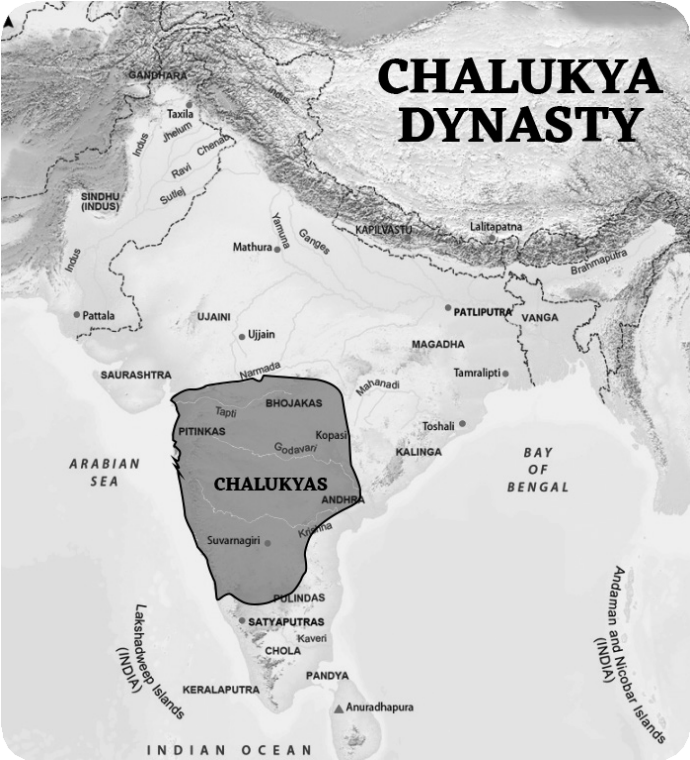
• The capital Badami was founded by Kirtivarman (566- 597 A.D.).
• Pulikesin I’s grandson Pulikesin II (609-642 A.D.), after defeating Mangalesha, proclaimed himself as king, an event that is described in the Aihole inscription.
• One of the most outstanding victories of Pulikesin II was the defeat of Harshavardhana’s army on the banks of the Narmada. This was mentioned by Ravi Kriti in Aihole Prashasti Inscription.
• The kings of Malwa, Kalinga, and eastern Deccan accepted his suzerainty.
• His victories over Kadambas of Banvasi, and Gangas of Talakad (Mysore) are also worthy of note. However, his attempt to attack Kanchipuram was thwarted by Mahendravarma Pallava.
• This led to a prolonged war between the Chalukyas and the Pallavas. Narasimha Varman I (630-668), the Pallava King, attacked and occupied Badami.
• Administration: The king was the head of the administration. In dynastic succession, primogeniture was not strictly followed.
• Generally, the elder was to be appointed as Yuvaraja while the king was in office.
• They became popular after Vakatakas.
• They were overthrown by Rashtrakutas.
• The Chalukya kings claimed to rule in accordance with dharma shastra and niti shastra. Pulakeshin I (543–566) was highly knowledgeable in Manu-sastra, Puranas, and Itihasas.
• Chalukya rulers adopted titles like Maharajan, Sathyasrayan, and Sri-Pritivi-Vallaban.
• Among the Chalukya kings, titles such as Bhattarakan and Maharajadhirajan gained widespread popularity. In the Pallava kingdom, kings adopted grand titles such as Dharma Maharajadhiraja, Dharma Maharaja, and Maharaja.
• Hirahadgalli Plates: It describes that Kings performed Agnistoma, Vajapeya and Ashvamedha sacrifices.
• The wild boar served as the royal emblem of the Chalukyas, symbolizing the Varaha avatar of Vishnu, in which he is believed to have saved the Goddess of the Earth.
• The bull, associated with Shiva, represented the Pallavas.
• Dantidurga of the Rashtrakuta dynasty defeated the last Chalukyan king, Kirti Varman II. However, the Chalukyas resurfaced after nearly two centuries around 972-73 AD, known as the Kalyani or Western Chalukyas. Tailapa II founded this revived empire, which had originally been a vassal state under the Rashtrakutas
| Chalukyas of Badami (543 - 753 A.D) | |
| Pulakeshin I (543-566 A.D.) | |
| Kirti Varman I (566-597 A.D.) | |
| Mangalesh (597-609 A.D.) | |
| Pulakeshin II (609-642 A.D.) | Hedefeated Harshavardhan andhalted his expansion towardsthe south. His conquest is mentioned in the Aihole inscription (634 A.D.) made by his court poet Ravikirti. He ruled from his capital of Badami (Vatapi), present- dayBijapur, Karnataka. |
| Vikramaditya I (655-680 A.D.) | |
| Vinayaditya (680-696 A.D.) | |
| Vijayaditya (696-733 A.D.) | |
| Vikramaditya II (733-746 A.D.) | |
| Kirti Varman II (746-753 A.D.) |
Provincvial Administration:
• Maha-sandhi-vigrahak: Higher official.
• Amatya and Samaharta: Revenue minister and Minister of Exchequer.
• Vishayam, Rastram, Nadu and Grama: Political divisions of the Chalukyan administration.
• Vishayapatis, Samantas, Gramophis and Mahatras: High officials in Chalukyan administration.
• Vishaya was divided into Pukti. Its head was Pogapati.
• Nala-Kavundas: Revenue officials of the village.
• Gramini/Karana: Village accountant.
• Mahajanam: Law and order official.
• Mahapurush: For maintaining order and peace, this official was appointed.
• Religion: Shaivism and Vaishnavism were popular.
• Kartikeyan, the war of God, was also famous.
• Ravikirti, a Jain scholar was present in the court of Pulkesin II.
• Languages used: Sanskrit, Prakrit and Kannada.
• In painting, Chalukyas adopted the Vakataka style.
Royal Women:
• The Chalukya dynasty of Jayasimhan I line appointed royal ladies as provincial governors. They also issued coins in some instances.
• Vijya Bhattariga, a Chalukya princess, issued inscriptions.
• While Pallava queens did not directly participate in the administration, they played a significant role in religious and cultural activities, such as constructing shrines, installing deity images, and making endowments to temples.
• An inscription in the Kailasanatha temple at Kanchipuram mentions the image of Queen Rangapataka, the wife of King Rajasimha.
Religion:
• The Chalukyas were patrons of both Shaivism and Vaishnavism, constructing temples dedicated to Lord Shiva and Lord Vishnu.
• They invited Brahmin groups from the Gangetic region to settle in their kingdom, where they performed regular pujas, festivals, and ceremonies in the temples
• Prominent Chalukya rulers, including Kirtivarman (566- 597 A.D.), Mangalesa (597-609 A.D.), and Pulikesin II (609-642 A.D.), conducted yagnas.
• They bore titles such as Parama-Vaishana and Parama- Maheswara.
• Kartikeyan, the war god, held a prominent position in Chalukya worship, and Shaiva monasteries became key centers for spreading Shaivism.
• The Chalukyas also supported heterodox sects, generously donating land to Jain centers.
• Ravikirti, the poet-laureate of Pulikesin II, was a noted Jain scholar.
Literature and Education:
Chalukyas used Sanskrit in pillar inscriptions such as in Aihole and Maha-kudam. A seventh-century inscription of a Chalukya king at Badami mentions Kannada as the local prakrit, meaning the people’s language, and Sanskrit as the language of culture.
A chieftain of Pulikesin II authored a grammar work
Saptavataram in Sanskrit.
Chalukyan Architecture:
Historically, in Deccan, Chalukyas introduced the technique of building temples using soft sandstones as medium.
Cave 1 is devoted to Shiva, and Caves 2 and 3 are dedicated to Vishnu, whereas cave 4 displays reliefs of Jain Tirthankaras.
Their temples are grouped into two: Excavated cave temples and Structural temples. Badami is known for both Structural and Excavated cave temples.
• Pattadakal and Aihole are popular for structural temples. The Chalukyans developed the Vesara style of temple architecture. This is a mixture of Dravida and Nagara-style architecture.


160 Emergence of New Kingdoms in Deccan


:

Image: Vastuchitra, Aihole
Lad Khan temple, Jaina temple of Megutti and temples in Badami and Aihole were important artistic contributions of Chalukya Kings.
Pattadakal has ten temples. The most celebrated of which are the Papanatha temple, the Virupaksha temple (built by the Queen Lok Mahadevi of Vikramaditya) and the Sangameshwara temple.
Built in 634 A.D., Aihole, the headquarters of the famous medieval Ayyavole merchants’ guild was an important commercial center.
About seventy temples are located in Aihole.
There are four caves in Badami. The largest cave temple built by Mangalesa is dedicated to Vishnu.
The reclining posture of Vishnu on the snake bed and Narasimha are exquisite examples of Chalukya art.
Pattadakal, a quiet village in Bagalkot district of Karnataka, is famous for its exquisite temples.
Pattadakal was a centre for performing royal rituals. The Virupaksha temple was built at the order of Queen Lohamahadevi to commemorate the conquest of Kanchipuram by her husband Vikramaditya II.
Paintings:
• Paintings are found in a cave temple dedicated to Vishnu in Badami.
• Chalukyas adopted the Vakataka style in painting.
• Many of the paintings are of incarnations of Vishnu. The most popular Chalukya painting is in the palace built by King Mangalesan (597-609 A.D.). It is a scene of a ball being watched by members of the royal family and others