Classification of Natural Hazards as per DesInventar Sendai
DesInventar Sendai is an upgraded version of a well- established and widely utilized software that incorporates all necessary indicators and data for tracking progress on Targets A to D of the Sendai Framework for Disaster Risk Reduction. These targets align with corresponding indicators from Sustainable Development Goals (SDGs) under Goals 1, 11, and 13.
The Disaster Information Management System within DesInventar categorizes disasters resulting from natural hazards into five primary groups and serves as a global tool for monitoring the Sendai Framework targets.
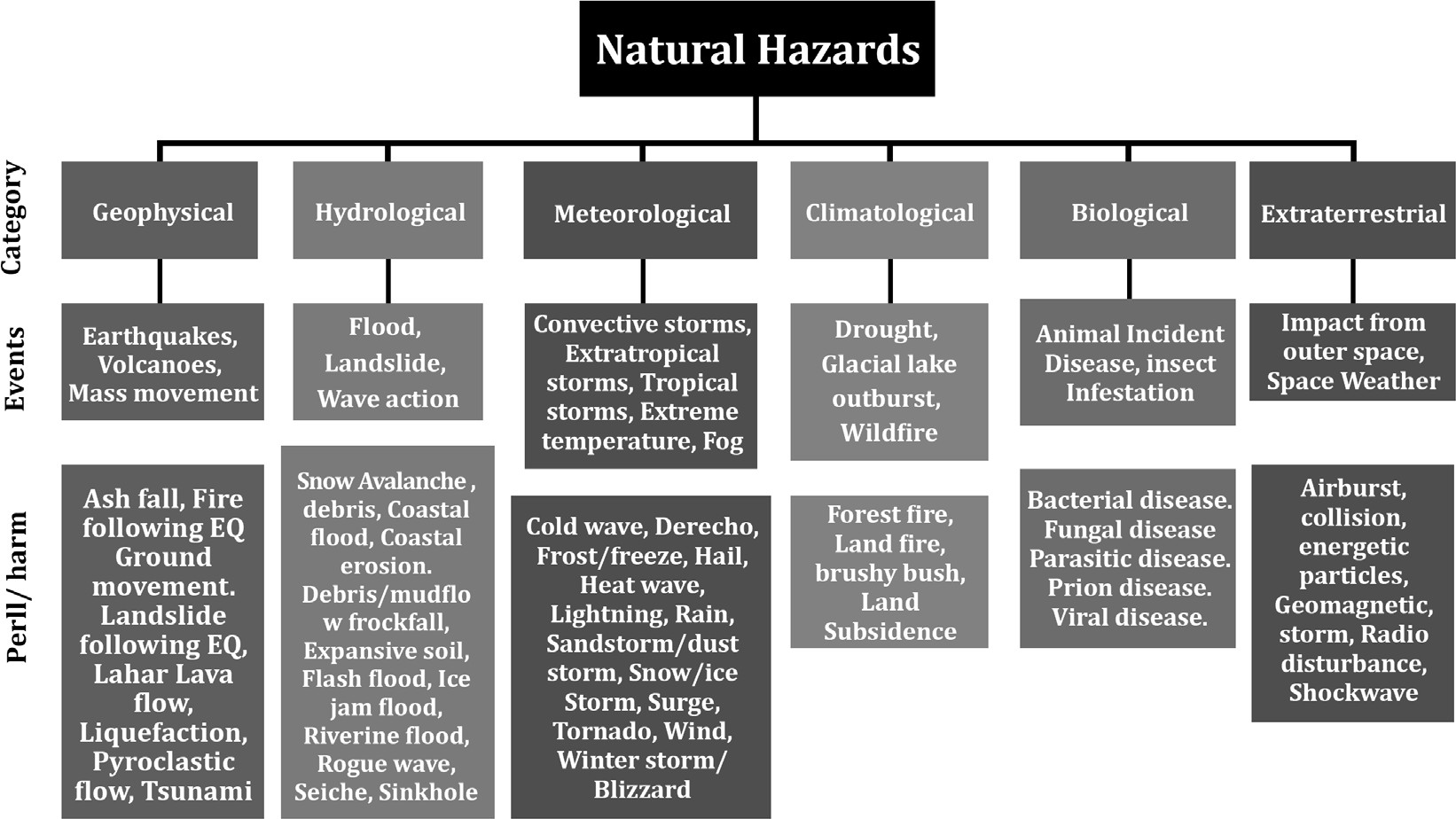
Figure: categories of natural hazards
Natural Processes or Natural Hazards: Natural processes, also known as natural hazards, serve as the primary triggers for natural disasters. These hazards are generally classified into six broad categories, each defined and described as follows:
Geophysical: Also referred to as geological hazards, these originate from the Earth's solid crust. Examples include earthquakes, volcanic eruptions, and dry mass movements.
Hydrological: This category pertains to hazards linked to the occurrence, movement, and distribution of freshwater and saltwater, both on and beneath the Earth's surface.
Floods, landslides, and wave action (including scour) are key events associated with this type of hazard.
Meteorological: These are short-duration events lasting from a few minutes to several days, caused by atmospheric conditions at micro- (<1 km) to meso-scale (2–2000 km) levels. Global climate change can amplify their effects.
Convective storms (e.g., tornadoes), extra-tropical storms (30°–60° latitude), tropical storms (within 30° latitude), fog, and sudden temperature extremes fall under this category.
Climatological: This hazard is linked to climate variability over extended periods, from intra-seasonal to multi-decade timescales, occurring at meso- to macro- scales (>2000 km).
It includes droughts, wildfires, glacial movements, and glacial lake outbursts.
Biological: These hazards originate from biological substances such as toxins, molds, or vectors carrying infectious diseases that pose risks to humans and other living organisms.
Examples include locust swarms, algal blooms, venomous wildlife infestations, and vector- borne diseases like plague, malaria, dengue, and COVID-19.
Extraterrestrial: This hazard arises from sources beyond Earth's atmosphere, including asteroid, meteorite, and comet residues, as well as human-made space debris that enter the atmosphere or impact the Earth's surface.
It may also result from solar flares and interplanetary disturbances, which can disrupt Earth's magnetosphere, thermosphere, or ionosphere