CONCEPT OF CULTURE
Culture encompasses every aspect of life. It shapes what people eat and wear, how they walk and talk, how they handle death and welcome new life. - Walter Rodney (Guyanese historian)
Culture represents a way of life, including the food you eat, the clothes you wear, the language you speak and the God you worship.
Art, music, literature, architecture, sculpture, philosophy, religion, and science are all integral parts of culture.
Culture also includes customs, traditions, festivals, daily living practices, and one's views on various life issues.
Culture consists of two main components: material and non-material.
Material culture includes tangible items like clothing, food, and household goods. Non-material culture refers to ideas, values, beliefs, and thoughts.
Culture differs from region to region and is shaped by the historical processes and its interaction with specific local, regional, or national customs and contexts.
For example, we differ in our ways of greeting others, our clothing, food habits, social and religious customs from that of West.
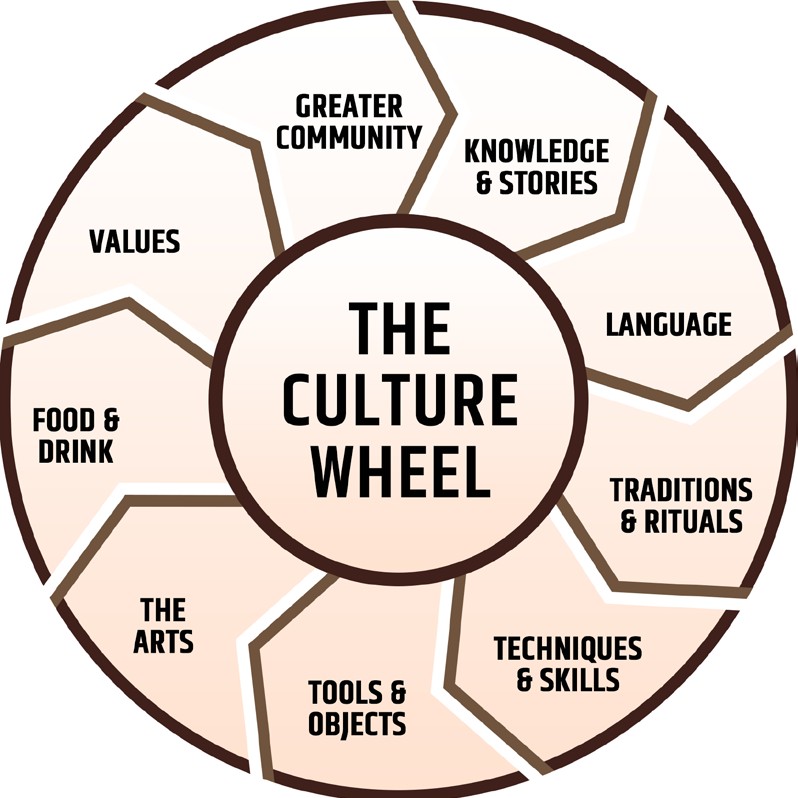
Cultu re Wheel
CULTURE AND CIVILIZATION
The word ‘culture’ and ‘civilization’ are often used synonymously. However, they have clearly defined meanings differentiating them.
| BASIS FOR COMPARISON | CULTURE | CIVILIZATION |
| Meaning | Culture is a term used to denote the manifestation of the manner in which we think, behave or act. | Civilization refers to the process through which a region or society, outstretches an advanced stage of human development and organization. |
| Represents | What we are? | What we possess? |
| Reflected in | Religion, art, dance, literature, customs, morals, music, philosophy, etc. | Law, administration, infrastructure, architecture, social arrangement, etc. |
| Expression | Higher level of inner refinement. | Higher level of general development. |
| Advancement/Changes | Yes | Advanced state of culture |
| Interdependency | Culture can grow and exist without civilization. | Civilization cannot grow and exist without culture. |
Culture and Heritage
The culture passed down from our ancestors is known as our cultural heritage. This heritage exists on various levels. All of humanity shares a collective culture, often referred to as human heritage. Similarly, each nation inherits its own culture, known as national cultural heritage.
Cultural heritage encompasses the cultural aspects and values passed down through generations. These are cherished, protected, and maintained by people, who take pride in their continuity.
Monuments like the Taj Mahal, Swami Narayan Temple in Gandhinagar and Delhi, the Red Fort of Agra, Qutb Minar in Delhi, Mysore Palace, the Jain Temple of Dilwara (Rajasthan), and Nizamuddin Aulia’s Dargah are all key elements of our cultural heritage deserving protection.
In addition to architectural landmarks, monuments, and material artifacts, intellectual achievements such as philosophy, scientific discoveries, and inventions are also part of our cultural heritage.
In the Indian context, the contributions of Baudhayan, Aryabhatta, and Bhaskaracharya in Mathematics, Astronomy, and Astrology; Kanad and Varahmihir in Physics; and Nagarjuna in Chemistry are significant treasures of Indian cultural heritage.
General Characteristics of Culture

Importance of Culture in Human Life
Culture brings us closer to truth through philosophy and religion.
It adds beauty to our lives through the Arts and nurtures our aesthetic sense.
Culture shapes us into ethical beings, fostering love, tolerance, and peace while connecting us with others.
It gives our lives a meaning, providing a guide for how to live. Humans create culture, and in turn, defines our humanity.
Culture serves as a tool for promoting social unity and inclusion.
It plays a key role in economic growth and competitiveness.
Promotion of culture can boost tourism industry.
It provides sources of entertainment and enjoyment.
It shapes our identities and offers us purpose and meaning in life.
Culture creates a sense of belonging.
It helps us build connections with others.
Culture allows us to express ourselves.
A country’s progress and development are measured using factors such as economic growth, citizen political freedom and the development of natural and human resources. Human resource development necessitates scientific, educational, and cultural advancement. As a result, art and culture define the bounds for each country or civilization.
Art is the visual expression and application of human ingenuity and imagination. Culture, on the other hand, is a way of life. It is a knowledge system that is shared by a huge number of individuals. It encompasses everything of a human being’s material and non-material accomplishments as a member of a social group.
Characteristics of Indian Culture
Indian culture refers to the amalgamation of social norms, moral values, age-old customs, belief systems, political frameworks, artifacts, and technologies that have either emerged from or are associated with the ethnically and linguistically diverse Indian subcontinent.
• Mixed Family Structure
• Indian culture promotes moral values as well as kind, simple and collectivistic attitudes. In India, the mixed family structure is a common institution. It happens when extended family members live together, such as parents, children, children’s spouses, and their offspring. The oldest male member of the family is often the head of the family and makes all key decisions.
• Arranged Marriage
• Arranged marriages have long been a norm in Indian society. Even today, a great majority of the Indian weddings are planned by parents or other elder family members. Weddings are the most extravagant family event, with lavish decorations, rituals, clothing, music, songs, food, and so on.
• Festivals
• India is a multi-cultural, multi-religious, and multi- ethnic civilisation where diverse religious festivals are celebrated. India’s three national holidays are Independence Day, Republic Day, and Gandhi Jayanti. Everyone in India celebrates festivals with zeal and excitement. Furthermore, many Indian states and regions have their unique customs and holidays. Famous religious festivals include Navratri, Durga Puja, Diwali, Holi, Janmashtami, Rakshabandhan, Maha Shivratri, Ugadi, Ganesh Chaturthi, Rath Yatra, Onam, Vasant Panchami, Dussehra, and others.
• Cuisines and Food
• Indian food is as varied as the country itself. Indian cuisines use a wide variety of food preparation methods, cooking techniques, and gourmet presentation. From appetisers through main course meals, snacks and desserts, Indian food is often complex.
• Clothing
• Traditional attire in India varies by area. Each state has its own distinct clothing style that is influenced
by local culture, geography, and climate. Draped garments for ladies, such as saris, and dhoti or lungis for men, are popular dress styles across the subcontinent.
• Literature and languages
• Languages and literature in India differ by location and state. The eighth schedule of the Indian Constitution contains 22 official languages, 15 of which are Indo-European. Sanskrit is the oldest language, and several ancient books and scriptures written in Sanskrit have been found. Hindi is the most widely spoken language in India. Other major languages include Tamil, Telugu, Kannada, Malayalam, Oriya, and several others are listed in the 8th Schedule. In addition, people also speak different local languages depending on the region they live in.
Conclusion
India is a country rich in culture and history that educates people to be kind, philanthropic, and tolerant.
Indian culture may be regarded as an old culture with a history that continues to this day. Stone age relics have been uncovered, such as Mehrgarh Culture and Burzahom demonstrating that cultural advancement happened in India at some point. Our forebears learnt a lot from their forefathers, and as time went, they added their own experiences to it. We continue to contribute new concepts and ideas to those that already exist as time passes, and culture is thus imparted and passed down from generation to generation.