Crisis/Disaster Prevention and Response Mechanism in India
• Over the centuries, local communities have developed their own indigenous strategies for survival. This vast repository of knowledge forms an integral part of the nation’s heritage.
• The Arthashastra, an ancient treatise on governance authored by Chanakya in the 4th century B.C., included a section on mitigation strategies to address famines. The application of modern crisis management techniques began in the late 1870s. Following Independence, relief efforts were implemented in regions affected by severe droughts.
• With the advent of the Green Revolution in the late 1960s, the need for famine relief measures declined. A comprehensive approach to drought management was introduced through the Drought Prone Areas Programme (DPAP).
• In 2005, disaster management legislation was formally established at the national level with the enactment of the Disaster Management Act, 2005.
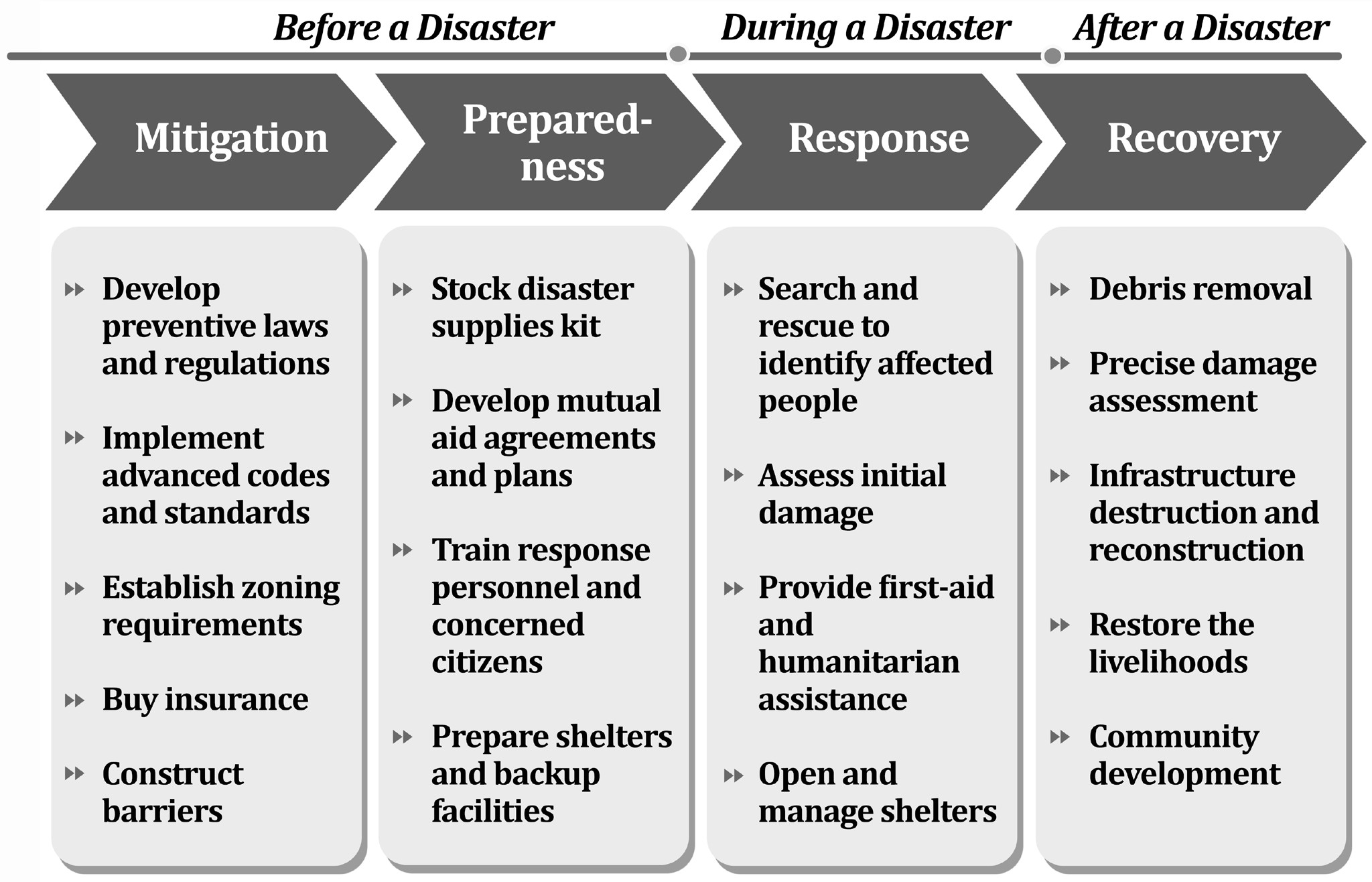
Figure: Practical Steps During Phases of Disaster Management
Disaster Prevention in India
• Following the Yokohama Strategy, India remains dedicated to disaster prevention policies. In 1994, the Ministry of Urban Development and Poverty Alleviation, Government of India, established an Expert Group to examine various aspects of natural hazard impacts, particularly concerning housing and infrastructure.
• The study emphasized the importance of identifying regions susceptible to natural disasters such as earthquakes, cyclones, and floods, which pose a threat to housing and infrastructure.
• A key objective was the development of a Vulnerability Atlas to map disaster-prone areas and assess the risk levels associated with different types of housing structures.
• Developing a strategic framework for establishing techno-legal regulations to ensure the enforcement of disaster-resistant construction and planning practices in human settlements vulnerable to natural hazards.
Disaster Response Mechanism
• In the event of a disaster, the community is typically the first to respond. In urban areas, response efforts are coordinated by agencies such as civic authorities, the fire department, and local law enforcement. However, panchayats currently lack the capacity to effectively respond to disasters.
• As a result, the district administration holds the primary responsibility for managing crisis situations, with the District Collector playing a key role.
• Within the Indian Constitution, "Disaster Management" is not explicitly listed under any of the three legislative lists. Matters not specifically mentioned in these lists fall under the Residuary Powers of the Union, as per Entry 97 of the Union List. While Parliament has the authority to legislate on this subject, in practice, the responsibility for disaster management primarily lies with State Governments.
State Governments act at the post disaster relief and rehabilitation stage.
Some states have established dedicated Disaster Management Departments.
A Cabinet Committee on Natural Calamities, led by the Chief Minister, oversees disaster situations and is responsible for making key policy decisions.
Each state has a Crisis Management Committee, chaired by the Chief Secretary, which monitors crisis situations daily during emergencies. This committee coordinates the efforts of various departments and provides decision-making support to the district administration.
Role of District Collector: The District Magistrate or Collector is responsible for overseeing disaster management within the district.
During a disaster, all state government departments, including police, fire services, public works, and irrigation, operate under the Collector’s leadership, except in metropolitan areas where municipal bodies play a key role. Additionally, the District Collector has the authority to request assistance from the Armed Forces if required.
• The Union Government primarily provides support by offering financial and physical resources, issuing early warnings, and coordinating efforts across various Union ministries, departments, and organizations.
• Previously, the Department of Agriculture was the nodal agency for disaster management. However, following the 2001 Gujarat earthquake, this responsibility was transferred to the Ministry of Home Affairs.
•
The Cabinet Committee on Security is responsible for handling matters related to nuclear, biological, and chemical emergencies.
• The National Crisis Management Committee (NCMC) is chaired by the Cabinet Secretary, the highest executive authority. The NCMC has the power to direct any ministry, department, or organization to take specific actions necessary to address a crisis situation.
• The allocation of funds for disaster management is determined based on the recommendations of the Finance Commission.
• Each state maintains a dedicated fund known as the Calamity Relief Fund (CRF) to manage disaster- related expenses.
• If the CRF is insufficient to meet the requirements, State Governments can request additional support from the National Calamity Contingency Fund (NCCF).
• Both CRF and NCCF are designated for relief and rehabilitation purposes. However, they do not cover mitigation or reconstruction activities, which must be financed separately by either the State or Union Government.
• Role of Army: They are highly effective in managing natural disaster relief due to their capability to coordinate operations in challenging conditions.
• Their rapid response, along with specialized skills and resources such as army engineers and medical professionals, enhances their efficiency.
• As a result, they play a crucial role in supporting civil administration during disasters.
• Their contributions include providing communication networks, conducting search and rescue operations, delivering healthcare and medical aid, ensuring transportation and power supply, distributing food
and essential goods, and assisting with public works
and engineering in the immediate aftermath of major disasters.
• The Essential Services Maintenance Acts (ESMA) ensure the uninterrupted provision of essential services during crises. The Code of Criminal Procedure (Cr.P.C) remains the primary legal framework for handling crises related to public order. A separate Disaster Management Act was enacted in 2005.
• The United Nations designated the 1990s as the International Decade for Natural Disaster Reduction (IDNDR). In 1999, the Government of India established a High-Powered Committee (HPC) on Disaster Management. Following the Gujarat earthquake in 2001, significant policy reforms were introduced to strengthen the disaster management system in the country, including:
• Shifting disaster management responsibilities from the Ministry of Agriculture to the Ministry of Home Affairs.
• However, the Ministry of Agriculture continues to oversee droughts, pest infestations, and hailstorms.
• State Governments were recommended to establishdedicated Disaster Management Departments.
• They were also advised to form a State Disaster Management Authority, chaired by the Chief Minister.
• At the district level, a District Disaster Management Committee was proposed under the leadership of the District Collector.
• A specialized force, known as the National Disaster Response Force (NDRF), was created with eight battalions, equipped with advanced technology and training to handle both natural and human-induced disasters. Additionally, a robust and fail-proof disaster communication network was developed.
• The National Institute of Disaster Management (NIDM) was established in Delhi to facilitate training and research in disaster management.
• Disaster management education was recommended for inclusion in school curricula, as well as in medical and nursing training programs.
• Disaster-resistant technologies were to be incorporated into engineering and architectural standards and specifications to enhance resilience against disasters.