INTRODUCTION


India is the land of cultural diversity and richness. The antiquity and uniqueness of Indian civilization are incomparable in the whole world. There are many institutions in India which are involved in conserving and promoting Indian culture.
The Archaeological Survey of India
It was created in 1861 by Alexander Cunningham, a British Army engineer with a particular interest in Indian archaeology. The Archaeological Survey of India, or ASI, is an affiliated agency of the Government of India’s Ministry of Culture.
ASI is headquartered at Mandi House, New Delhi. The laws of the Ancient Monuments and Archaeological Sites and Remains Act (AMASR Act) of 1958 govern all archaeological activity in the nation and established ASI as statutory entity. ASI protects and preserves over 3500 protected monuments and archaeological sites of national importance.
ASI publishes Epigraphia Indica, Ancient India and Indian Archaeology: A Review.
Archaeological Survey of India Activities:
All the archaeological study and excavation operations in India are carried out and regulated by the ASI.
It also protects and maintains historical sites and monuments.
Protected monuments, archaeological sites, and national remnants are maintained, conserved, and preserved.
It works to keep monuments and antiquarian relics safe from chemical attacks.
It conducts monument architectural surveys.
It carries out epigraphical and numismatic research.
It establishes on-site museums.
It provides archaeological education.
It publishes archaeology-related stuff.
It also organizes archaeological digs outside of India.
Horticultural activities are carried out at and around archaeological sites.
It oversees the Antiquities and Art Treasures Act of 1972, as well as the AMASR Act.
Anthropological Survey of India (ANSI)
It works under Ministry of Culture, which is involved with anthropological aspects such as conserving and studying skeletal remains. It was founded in 1945 at Varanasi but was shifted to Indian Museum Located at Calcutta in 1948. It is responsible for collecting, preserving, maintaining and documenting traditional artistic crafts of the people of India. It also studies the tribes and other communities from cultural as well as biological facets.
Indian National Trust for Art and Cultural Heritage (INTACH)
It is non-profit non-governmental organisation (NGO) registered under Societies Registration Act, 1860. It was founded in 1984 and is headquartered in New Delhi. It is largest membership organization committed to culture conservation with vision to promote the conservation of rich heritage of India.
It creates awareness about Indian heritage by organizing various awareness drives in educational institutions, workshops, etc.
INTACH presents the following awards;
• Anirudh Bhargava – INTACH Environmental Award
• INTACH Award for Best Practices in Heritage Conservation
• INTACH Heritage Award for excellence in Documentation of Unprotected Heritage
Indian Council of Historical Research (ICHR)
It is an autonomous body working under Ministry of Education. The ICHR is based in Delhi, with regional centres in Pune (Maharashtra), Bengaluru (Karnataka), and Guwahati (Assam). This institution works as a forum for historians to exchange different views among them. The body has provided financial assistance to historians and scholars through fellowships, grants, and symposia. The ICHR receives grants-in-aid from the Department of Higher Education, grants-in-aid from various Indian states, private donations, and the proceeds of revenues from the sale of publications of the ICHR.
Asiatic Society
It was founded by Sir William Jones. It is headquartered in Kolkata. It compiles old manuscripts of India. It maintains huge collection of Sanskrit manuscripts.

The main objectives of Asiatic Society are as follows;
• Organize, promote and initiate researchers in Science and Humanities in Asia.
• Establish, build construct, erect, run and maintain research institutions, museums, auditoriums, etc.
• Organizelectu res,meetings, symposia, seminars, discussions to accomplish its objectives.
National Galley of Modern Art (NGMA)
It is the most important art gallery working under the ambit of union Ministry of Culture. It was established in 1954 by Indian government with its headquarters at Jaipur House, New Delhi. It also has several branches in Bengaluru and Mumbai. It endeavours to preserve and acquire the works of Indian modern art starting from 1850s. It has collection of the works of artists like Thomas Daniell, Abanindranath Tagore, Raja Ravi Varma, Rabindranath Tagore and Amrita Sher-Gill, etc.
National Museum of India
It is one of the greatest museums in India. It is located in New Delhi. It was established in 1949 and works under union Ministry of Culture. It is based on the report of Maurice Gwyer Committee.
It stores art works having both Indian and foreign origin. The Museum is fully administered and funded by country’s Ministry of Tourism and Ministry of Culture.
Recent News:
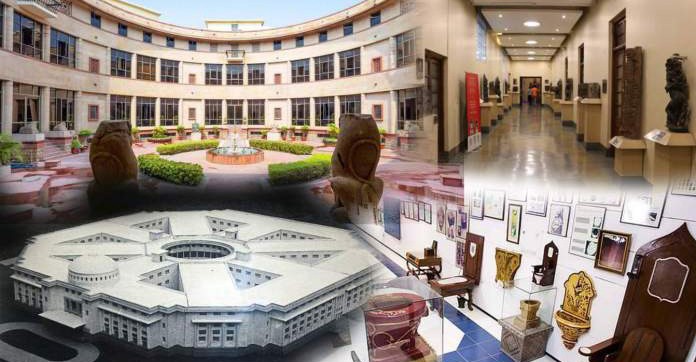
Yuge Yugeen Bharat National Museum will replace the existing National Museum, located on Janpath in Delhi.
Yuge Yugeen Bharat Museum
• The museum will have eight thematic segments to showcase India’s civilisational culture spanning over 5,000 years.
• The eight segments will include periods from ancient Indian knowledge, ancient to medieval, medieval, medieval to transition phase, modern India, colonial rule, the freedom struggle and the 100 years from 1947 onwards.
• The virtual walk-through of the museum gives a glimpse via digital experience into how the galleries and gardens will look once the project is completed.
• India’s ancient town planning systems, the Vedas, Upanishads, ancient medical knowledge, etc. Mauryan to Gupta Empires, Vijayanagara Empire, Mughal Empire, and the rule of several other dynasties are mentioned in the walkthrough.
National Council of Science Museums (NCSM)
It is an autonomous organization under the Ministry of Culture is involved in promoting a culture of Science in India through its network of Science Museums/ Centres and activities organised therein.
NCSM is the largest network of Science Museums/ Centres in the world under a single administrative umbrella. So far, NCSM has developed 45 Science centres in India. NCSM conceptualized and developed India’s first Science City at Kolkata which was inaugurated on July 1, 1997.
Indian Council for Cultural Relations (ICCR)
The Indian Council for Cultural Relations (ICCR) was founded under the Ministry of External Affairs auspices to carry out programs that promote Indian culture on a global scale. It was founded in 1950 by Maulana Abul Kalam Azad, who believed strongly in developing cultural contacts with different countries and civilizations.
The ICCR supports a variety of visual and performing arts programs that have a global reach. The programs are an essential part of establishing and building relationships with comparable national and international cultural organizations. ICCR’s main goal is to encourage international friendship, cultural interaction between nations, healthy competition and exchange, and, as a result, to integrate the modern and ancient aspects of Indian culture.
National Mission for Manuscripts (NMM)
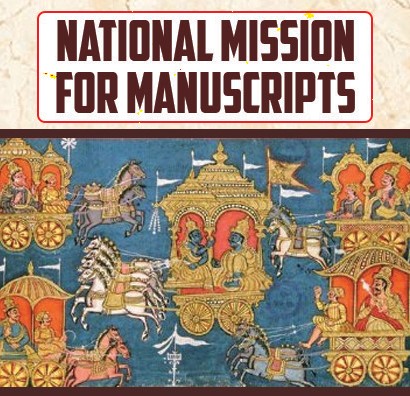
It was established in 2003 by union Ministry of Tourism and culture. It seeks to discover and preserve the manuscripts of India. India has more than 10 million manuscripts which is largest collection in the world. It identifies, documents, conserves and makes the manuscript heritage of India accessible to people.



National Archives of India (NAI)


It was established in March 1891 in Calcutta and is currently headquartered in New Delhi. It works under Department of Culture under the ambit of union Ministry of Culture. The institution emboldens scientific management, conservation and administration of various records throughout the country. It aims to enhance the feeling of patriotism and document cultural heritage. It works as a repository of series of documents and records from 1748 onwards.

Indira Gandhi National Centre for Arts (IGNCA)
It is a government funded autonomous institute under Ministry of Culture. It was established in 1985 and is located in New Delhi. It organizes national seminar, conferences, exhibitions and lecture series. It focuses on school and educational institutions and complements its research by cross-disciplinary landscapes studies.
Centre For Cultural Resources and Training (CCRT)
The Centre for Cultural Resources and Training (CCRT) was established by the Ministry of Culture to combine education and culture. CCRT has its headquarters in New Delhi and three Regional Centres in Udaipur in the west, Hyderabad in the south, and Guwahati in the north-east.
It conducts training programmes for educational administrators, in-service teachers, students and teacher educator throughout the country. It presents annual ‘CCRT Teachers’ Award. The award carries a citation, an angavastram, a plaque and a cash prize.
Directorate of Film Festivals
It was set up 1973 under the auspices of Union Ministry of Information and Broadcasting with the aim of promoting Indian films and cultural sensitivity. It is responsible aiding Indian participation in foreign festivals. It also manages foreign film festivals held in India. It confers National Film Awards and Dadasaheb Phalke Award. Also, it selects films for Indian Panorama.
Crafts Council of India (CCI)
The Crafts Council of India (CCI) was founded in 1964 by Kamaladevi Chattopadhyay. The CCI is a registered not for profit Society head-quartered in Chennai, Tamil Nadu.
CCI is engaged in partnerships with the Government of India and other activists to ensure a national awareness of the economic, social, cultural and environmental importance of artisans and their crafts. It also helps artisans with latest technology, design, entrepreneurial skills and marketing to make them self-reliant.
Lalit Kala Akademi
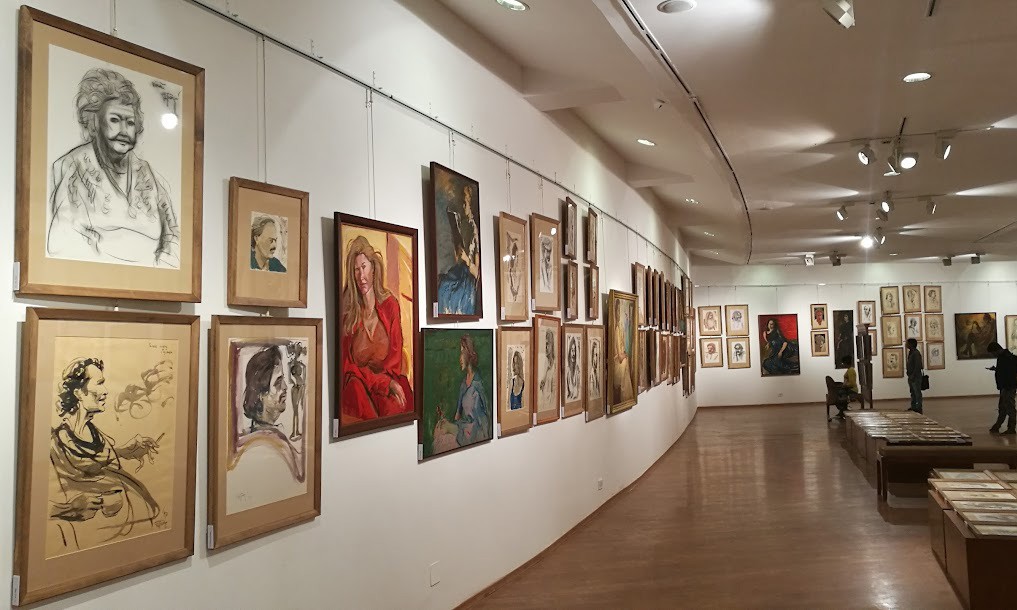
Maulana Abul Kalam Azad inaugurated the Lalit Kala Akademi in New Delhi on August 5th, 1954. It is an autonomous organization under the Ministry of Culture. It is headquartered at Ravindra Bhawan, New Delhi. They have regional centres in Chennai, Kolkata, Lucknow, Shimla, Shillong, and Bhubaneswar. It promotes study and research in creative fields such as painting, graphics and sculpture. It confers National Art Award.
Sangeet Natak Akademi (SNA)
The Sangeet Natak Akademi under the aegis of the Ministry of Culture was established on May 31, 1952, and it began operations the following year with the appointment of its first chairman, Dr. P. V. Rajamannar. Its main goal was to establish a setting for Indian music, theatre, and dances. It also promotes India’s vast intangible legacy, which was manifested in the forms of music, dance, and theatre. It also oversees several institutes that specialize in dance, music, or theatre. It established the National School of Drama (NSD) in 1959 to focus on dramatics in India. This institution has a library and museum for the purpose of promoting research in artistic arenas.
National School of Drama (NSD)
National School of Drama is premier theatre institute established by the Sangeet Natak Akademi in 1959. It became an independent school in 1975. It imparts training and propagates dramatics in the country. Before the National School of Drama, Bharatiya Natya Sangh (BNS) with assistance from UNESCO had established ‘Asian Theatre Institute’ (ATI) in New Delhi in 1958. ATI was overtaken by the Sangeet Natak Academi and merged with the newly formed National school of Drama in 1959.

Sahitya Akademi

Sahitya Akademi has been set up for the development of Indian literature and to set high literary standards to foster and co-ordinate literary activities in all the Indian languages and to promote through them cultural unity of the country. It is established by the government of India in 1954 at New Delhi. Sahitya Akademi is an autonomous body under the Ministry of Culture.
It preserves and promote literature in 24 Indian languages.
22 of these languages are enumerated in schedule 8 of Indian Constitution. English and Rajasthani are the other 2 languages.
It provides Sahitya Akademi Honorary Fellowship, Anand Fellowship and Premchand Fellowship.
All India Radio (AIR)
All India Radio, formally known as Akashvani since 1957, is India’s national public radio broadcaster and a branch of Prasar Bharati.


It was founded in 1936 and is the sister service of Doordarshan, an Indian television broadcaster owned by Prasar Bharati. All India Radio (AIR) is the country’s most well-known public service radio station. It is run by the Indian Government’s Ministry of Information and Broadcasting.
AIR reaches around 99.19 percent of the population in terms of demographics. AIR has worked to protect citizens’ rights by keeping them informed on all subjects of public interest since its foundation. The Prasar Bharati Act, which was revised in 1990, governs the content, goals, and objectives of AIR.
Indian Culture Abroad
Indian culture, with its diverse tapestry of traditions, spirituality, art, and cuisine, has transcended geographical boundaries to establish a global footprint. The widespread diaspora, increased globalization, and the universal appeal of its elements have all contributed to the dissemination of Indian culture far beyond its homeland. This journey of Indian culture abroad is a captivating narrative of preservation, adaptation, and influence. It is a tale of how ancient customs and contemporary innovations have left an indelible mark on the cultures they have encountered, enriching the global
mosaic of human heritage. In this exploration, we delve into the intricate threads that make up the fabric of Indian culture as it flourishes and evolves in foreign lands, fostering cross- cultural understanding and celebrating diversity.
• Diaspora Communities: The establishment of Indian communities abroad, both historically and in contemporary times. The role of these communities in preserving Indian culture through language, traditions, and religious practices. How these communities act as cultural bridges, connecting the homeland with the host country.
• Food and Cuisine: The proliferation of Indian restaurants and cuisine worldwide. The adaptation of Indian dishes to local tastes and ingredients. The growing popularity of Indian street food and spices in international cooking.
• Religion and Spirituality: The spread of Hinduism, Sikhism, Buddhism, and Jainism beyond India. The establishment of temples, gurudwaras, monasteries, and spiritual centers abroad. The influence of Indian spiritual practices, such as meditation and yoga, on wellness and mindfulness movements globally.
• Bollywood and Global Cinema: Bollywood, India’s vibrant film industry, has garnered a massive international following. Bollywood films blend Indian traditions, music, dance, and storytelling, creating a unique cinematic experience. Bollywood’s influence on international cinema, including Hollywood, has led to fusion films and the incorporation of Indian elements.
• Yoga and Wellness: Yoga, an ancient Indian practice, has become a global phenomenon. The adoption of yoga as a wellness and fitness regimen abroad. The fusion of yoga with local wellness practices in various countries.
• Fashion and Textiles: The influence of Indian textiles, fabrics, and traditional clothing on international fashion. The rise of Indian fashion designers and their contributions to global fashion weeks. The popularity of Indian jewelry and accessories in the global market.
• Music and Dance: The global appeal of Indian classical and contemporary music. The integration of Indian musical instruments and styles in Western music. Indian dance forms like Bharatanatyam, Kathak, and Bollywood dance gaining popularity worldwide.
• Art and Craft: The influence of Indian art, particularly traditional and contemporary Indian painting, sculpture, and handicrafts on the global art scene. The emergence of Indian artists on the international stage. Collaborations between Indian and international artists.
• Festivals and Celebrations: The celebration of Indian festivals like Diwali, Holi, and Navratri in various countries. The adaptation of Indian festival themes in international events and celebrations. The role of cultural organizations and Indian communities in preserving and sharing these traditions.

• Language and Literature: The global interest in learning Indian languages like Hindi, Sanskrit, and Bengali. The popularity of Indian literature and authors, including works translated into various languages. Indian storytelling traditions influencing global literature and storytelling techniques.
Conclusion:
Indian culture’s impact on art and culture abroad is a testament to its diversity, richness, and adaptability. The interconnected world has allowed for the fusion of Indian
elements with local cultures, creating a global cultural mosaic. The continued growth of Indian culture’s influence abroad reflects its enduring appeal and relevance on the international stage.
Indian culture abroad represents a multifaceted phenomenon, marked by preservation, adaptation, and far-reaching impact. The ongoing interplay between Indian culture and the cultures of host countries enriches the global cultural landscape. The diverse ways in which Indian culture is embraced and integrated abroad underscore its enduring appeal and relevance on the international stage.