Desert Locust Attack
Desert Locusts (Schistocerca gregaria) are considered the most destructive among locust species. When environmental conditions are favorable, even a small number of solitary locusts can rapidly increase in population, forming massive swarms that migrate across vast regions. These swarms pose a significant threat to agriculture across large areas of Africa, the Middle East, and Southwest Asia.
In the past century, there have been six major Desert Locust plagues, with one lasting nearly 13 years.
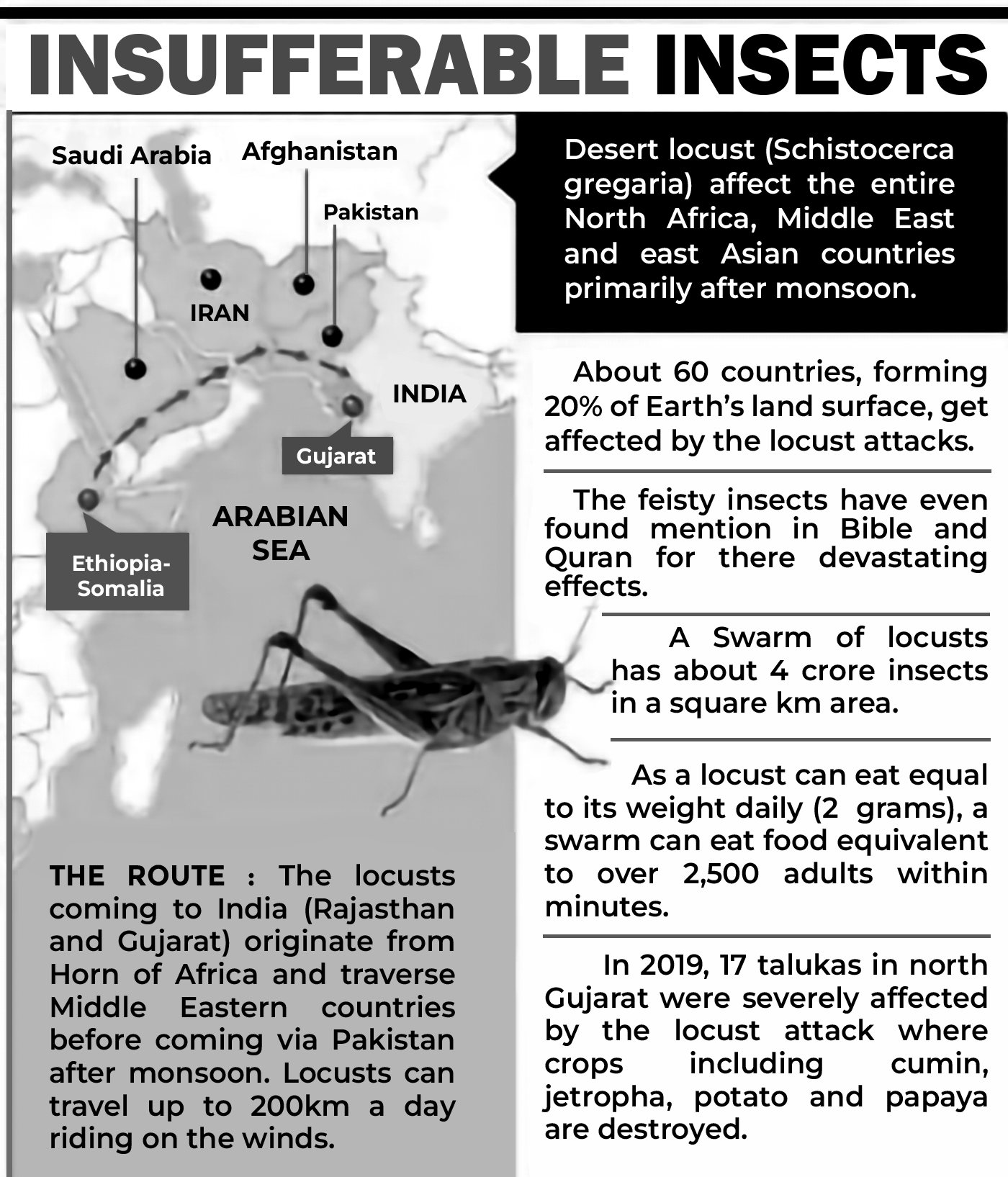
During 2019-20, locust attack was reported in some districts of Rajasthan and Gujarat. Rajasthan Government has reported that a total area of 1,79,584 hectares of 8 districts of the state was affected by locust attack during 2019-20.
According to the Food and Agricultural Organisation (FAO) of the United Nations, a swarm of locusts spread across an area of one square kilometre can eat as much food as 35,000 people in one day. Their appetite is voracious and one locust can consume food equal to its own weight – about two grams – on
a daily basis. And since a square kilometre swarm would contain about 40 million locusts, it can cause a significant amount of damage in a short period of time.
Figure: Locust Pest Attack
• Initial Desert Locust control efforts were largely curative but the trend in the twentieth century had been toward preventing such plagues from occurring. Affected countries have assumed ever more responsibility for monitoring locust breeding areas and treating infestations before they increase in size and number.
• Favourable conditions for desert locusts to breed consists of moist sand and green vegetation in arid areas. These favourable conditions were made available to the locusts in the desert region of Africa and Arabian Peninsula due to heavy rainfall that the region witnessed in 2019. They then migrated to India via Iran and Pakistan.
Heavy rainfall was caused by unusually warm waters in the western Indian Ocean in late 2019. And the unusually warm waters were caused by climate change or global warming.
These warm waters were caused by the phenomenon called the Indian Ocean Dipole — with warmer than usual waters to its west, and cooler waters to its east. Rising temperatures due to global warming amplified the dipole and made the western Indian Ocean particularly warm.
Strategy to Control Pest Attack
• International collaboration plays a crucial role in effectively managing locust infestations. A notable example is the coordinated effort between India and Pakistan during the 2020 locust attack. This approach has proven highly successful, as nations increasingly recognize that joint efforts are essential in combating Desert Locusts.
• Strategic interventions can be implemented at specific times or targeted areas. For instance, delaying control measures until locusts gather in a concentrated space enables a more efficient response, allowing a greater number of locusts to be controlled using a reduced amount of pesticides over a smaller area.
• The key challenge in the coming years will be to refine Desert Locust management strategies in a way that safeguards food security while also reducing negative environmental impacts.
Steps Taken to mitigate Locust Attack
• Central Government has established the Locust Warning Organisation (LWO) which tracks and monitors the Locust swarms and their breeding and migration patterns, to issue early warning.
• Spraying of pesticides like Malathion through vehicle- mounted sprayers,
• States notifying locust invasion as “mid-season adversity” under the Pradhan Mantri Fasal Bima Yojana (PMFBY) and announcing disaster relief packages.