Development vs Environment
Development activities often exacerbate the destructive impact of natural disasters. A notable example is the 1995 floods in Rohtak (Haryana), where large sections of the town remained waterlogged for months even after the floodwaters had receded. The primary cause of damage was not the flooding itself but rather persistent waterlogging, which resulted from the area's unique topography and inadequate land-use planning. In many cases, haphazard land-use decisions are made under immense pressure due to high demand for limited land resources, leading to poor urban planning and increased disaster vulnerability.
In Punjab, excessive use of chemical-based canal irrigation has led to widespread salinization, waterlogging, and groundwater contamination.
In other regions of India, large-scale infrastructure projects such as dams have resulted in the displacement of millions of people, while also submerging vast areas of forests and fertile lands. Additionally, these massive reservoirs may have contributed to or intensified seismic activity in earthquake-prone areas like Koyna, Maharashtra.
The country continues to witness recurring disasters— for instance, droughts in Odisha, desertification in Gujarat and Rajasthan, and environmental degradation in upstream regions of Uttar Pradesh and Bihar. Floods in the plains are becoming increasingly destructive, exacerbated by population pressures and ecological deterioration.
The unchecked deforestation, degradation of mountain ecosystems, over-extraction of groundwater, and changes in farming patterns have resulted in frequent floods and droughts. The destruction of forests prevents groundwater recharge and leads to runoff that worsens flooding. In the Himalayas, the increasing number of landslides in recent years can be directly linked to deforestation and the unregulated construction of roads under the guise of development. Additionally, man-made structures such as canals, dams, and embankments have significantly worsened the flooding situation across India.
The loss of mangroves and coral reefs has made coastal areas more susceptible to disasters such as cyclones and storm surges. The commercialization of coastal regions, especially for tourism, has led to unplanned development, increasing the likelihood of disasters. This vulnerability was starkly highlighted during the 2004 tsunami.
Environmental Risks in Delhi
Health Impacts: Every ninth school student in Delhi suffers from asthma due to severe air pollution. The city is ranked as the fourth most polluted in the world. Poor environmental conditions in informal settlements have resulted in frequent epidemics, such as the 1995 dengue outbreak, which claimed 423 lives.
Pollution Sources: Delhi's air pollution primarily originates from three sectors: transportation, domestic use, and industries. Vehicles contribute the most (72%), with rapid urbanization leading to a surge in vehicle ownership. The city’s population, currently around 13.8 million, is expected to rise to
22.42 million by 2021, mainly due to high migration rates driven by better job prospects. The number of registered vehicles has increased ninefold since 1970- 71, leading to heavy congestion and pollution.
Traffic and Safety Hazards: Delhi has one of the
highest road accident fatality rates in the world, reflecting the poor state of urban infrastructure and lack of risk management in urban planning.
Housing and Land Use Issues: The demand for housing has led to the conversion of fertile agricultural land into residential zones, negatively affecting farming employment and productivity. Meanwhile, large areas of cultivable wasteland remain unutilized, with plans for future industrialization.
Water Scarcity and Political Tensions: To meet its growing water needs, Delhi may need to tap into groundwater sources from Uttar Pradesh, including Meerut, which could create political tensions in the future.
Lack of Environmental Data and Management: Delhi lacks a centralized system for monitoring environmental quality, managing pollution, and assessing the effectiveness of urban policies. Without addressing these knowledge gaps, achieving a sustainable future for Delhi will remain a challenge.
• Safety Factor for Human Existence
• The quality of life of an individual is determined largely by socio-economic and the physical environment. From a different perspective, enhancing quality of life necessitates minimising frequency and intensity of disturbances to average human existence.
• The core issue therefore, is to reduce the vulnerability of the community through safety of social structures, the physical structures and the economic assets to avoid hazards in form of accidents, illnesses and other factors that could contribute to mortality.
• Need for Action
• Need is a paradigm shift in urban planning, development and management processes from sectoral manner to integrated manner.
• Safe City Concept, particularly due to its participatory approach, would try to bring about strategic integration of various urban sub-sectors and present an integrated development framework.
• National Commission on Urbanisation Working Group on Physical Planning in India, stated that, “it also provides for checking costs compared to the benefits of alternative packages of projects aiming at pragmatic goals and permits a much tighter and more efficient implementation control and evaluation of large-scale innovations”.
• Risk Reduction efforts need to be based upon as much in urban governance and management as in urban planning.
• Good urban governance includes the state, but transcends it by including the private sector and civil society. All three are critical for sustaining human development.
• Differences between modernist (or rationalist) and post-modernist (or subjective) approaches to planning
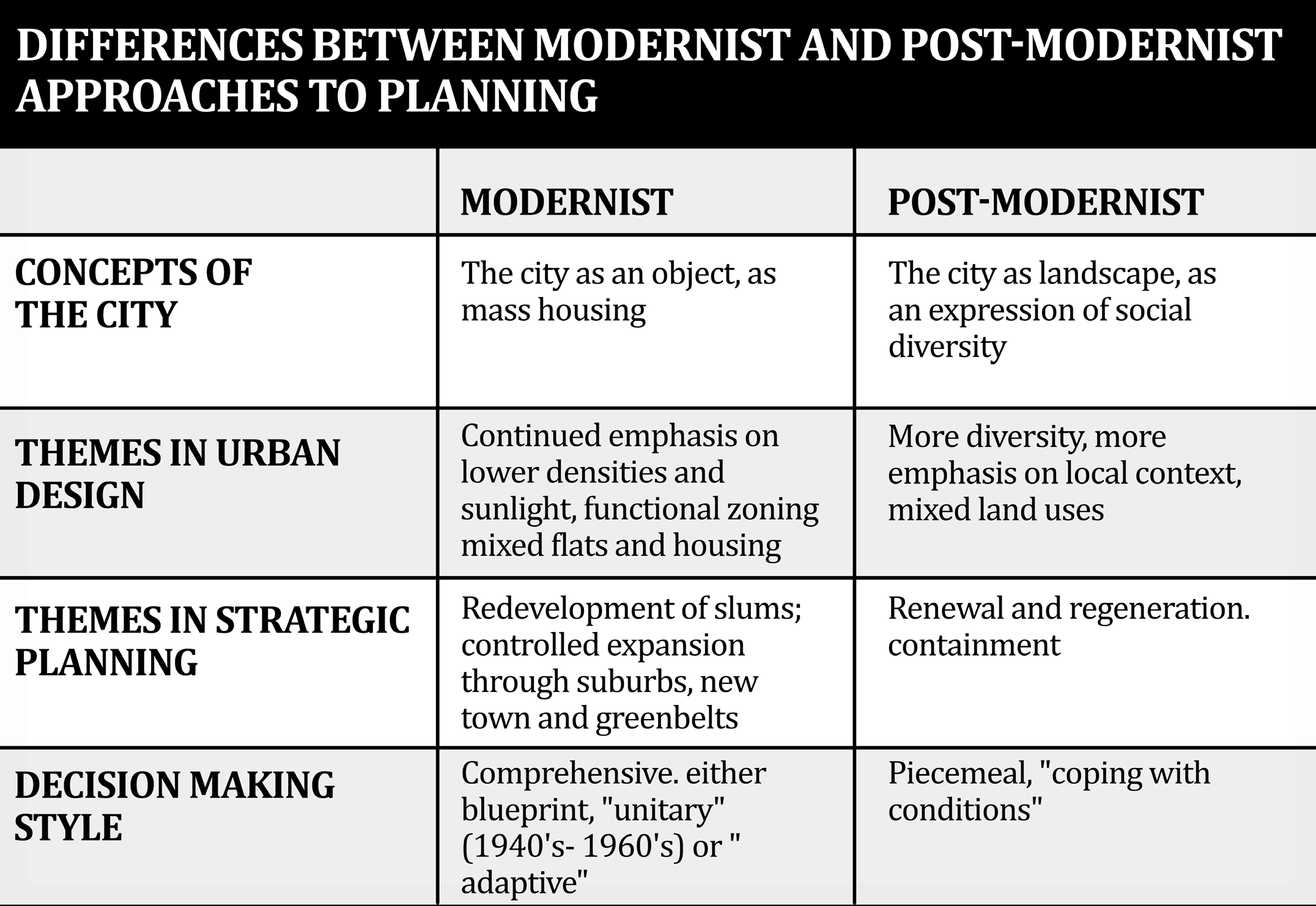
Figure: Modernist and Post-Modernist Approaches to Urban Planning
Conclusion
Thus, environmental concerns are therefore gaining importance in development, since environmental factors adversely impact the frequency and intensity of disastrous events. Sustainable development is being considered largely in terms of sustainable city growth. More than rural development, it is urban development that has to be stabilised/regulated through well-meaning/planned policies.
Urban populations are growing rapidly in the absence of well-planned and structured settlements and ever- increasing risk of natural as well as technological disasters. In such an alarming situation, the only viable way to a safer living is through preparedness to face disasters with concerted efforts on part of the government agencies, voluntary organisations, and most importantly, the community itself.