Disaster Management Act, 2005
• Objective and Scope: The Disaster Management Act of 2005 facilitates efficient disaster management and signifies a major shift in approach, emphasizing disaster mitigation, prevention, and preparedness. Recognized as the primary legislation governing disaster response for both natural and human-induced calamities, the Act establishes the National Disaster Management Authority at the central level, with corresponding structures replicated at the state and district levels.
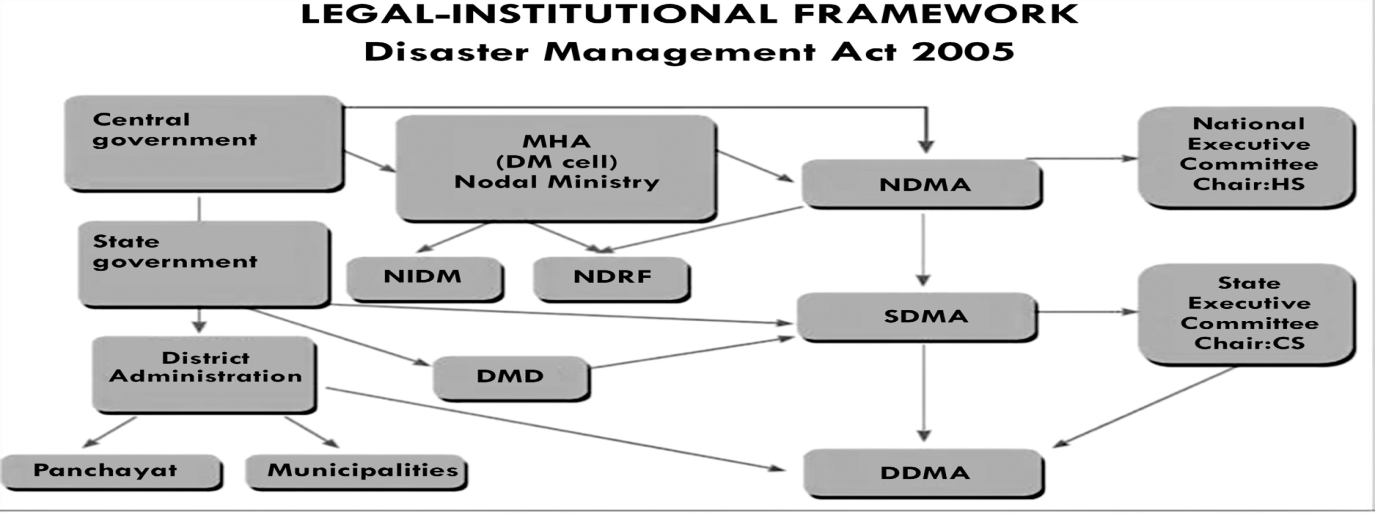
Figure: Legal Institutional Framework under Disaster Management Act 2005
Relevant Provisions of the Act:
Definitions
• A disaster refers to a catastrophic event, mishap, calamity, or severe occurrence in a specific area, resulting from natural or human-induced causes, accidents, or negligence. It leads to significant loss of life, human suffering, property destruction, and environmental damage beyond the affected community's capacity to cope.
• Disaster management is an ongoing and integrated process that involves planning, organizing, coordinating, and executing measures necessary for:
• Preventing potential disaster threats; (ii) Mitigating risks or reducing the severity and consequences of disasters; (iii) Strengthening capacity-building efforts; (iv) Preparing to handle disasters effectively;
• Ensuring a prompt response to disaster situations;
• Evaluating the magnitude and impact of disasters; (vii) Conducting evacuation, rescue, and relief operations; (viii) Facilitating rehabilitation and reconstruction efforts.
• The District Authority refers to the District Disaster Management Authority.
• The District Plan denotes the disaster management strategy formulated for a district.
• A Local Authority encompasses Panchayati Raj institutions, municipalities, district boards, cantonment boards, town planning authorities, Zila Parishads, or any other body responsible for delivering essential services within a designated local jurisdiction.
• Establishment of the National Disaster Management Authority (Section 3) The Central Government shall establish the National Disaster Management Authority, consisting of a Chairperson and up to nine additional members. The Prime Minister will serve as the ex-officio Chairperson of the Authority.
• Powers and Functions of the National Authority (Section 6) The National Authority is responsible for formulating policies, strategies, and guidelines related to disaster management. Its key functions include:
• Approving the National Plan.
• Endorsing plans prepared by Ministries and Government Departments in alignment with the National Plan.
• Establishing guidelines for State Authorities and Government Ministries/Departments to follow while formulating their respective disaster management plans.
• Overseeing the implementation and enforcement of disaster management policies and plans.
• Taking proactive measures to prevent disasters.
• Advisory Committee (Section 7): The National Authority shall establish an advisory committee comprising experts in disaster management at the national, state, or district levels. This committee will provide recommendations on various aspects of disaster management.
• National Executive Committee (Section 8): A National Executive Committee will be formed to support the National Authority in carrying out its responsibilities.
• Formation of Sub-Committees (Section 9): The National Executive Committee has the authority to establish one or more sub-committees to enhance the efficiency of its operations.
• Responsibilities of the National Executive Committee (Section 10): The National Executive Committee is tasked with implementing the policies set by the National Authority. It serves as the primary body for coordinating and overseeing disaster management efforts. Additionally, it is responsible for drafting the National Plan, which must receive approval from the National Authority. The committee also offers technical support to state governments, state disaster management authorities, and district authorities in developing their disaster management strategies.
• National Plan (Section 11): The National Executive Committee shall develop a comprehensive disaster management plan for the entire country, known as the National Plan.
• State Disaster Management Authorities (Section 14): Each state government shall establish a State Disaster Management Authority, consisting of a Chairperson and a maximum of nine members. The Chief Minister of the state shall serve as the ex-officio Chairperson.
• Advisory Committee (Section 17): The State Disaster Management Authority shall appoint an advisory committee composed of disaster management experts to provide guidance and recommendations.
• Functions of the State Authority (Section 18): The State Authority is responsible for formulating the state disaster management policy. It must approve disaster management plans prepared by various state government departments. Additionally, it establishes guidelines to be followed by state departments in disaster management initiatives.
•
Guidelines for Minimum Standards of Relief (Section 19): The State Authority shall establish guidelines to ensure a standard level of relief for individuals affected by disasters within the state.
• State Executive Committee (Sections 20 & 22): A State Executive Committee will be formed to assist the State Authority in fulfilling its responsibilities. The committee will be chaired by the Chief Secretary of the state (ex- officio) and will include four secretaries from different state government departments. It is responsible for executing the National and State Disaster Management Plans and serves as the primary body for coordinating and overseeing disaster management efforts in the state. Its key responsibilities include:
• Assessing the vulnerability of various regions within the state to different types of disasters and recommending appropriate measures.
• Establishing guidelines for the preparation of disaster management plans by state government departments and district authorities.
• Overseeing the implementation of disaster management plans at the state and district levels.
• Issuing directives to state departments, authorities, and agencies regarding disaster response measures.
• Advising, assisting, and coordinating efforts between different state government departments, district authorities, and other organizations involved in disaster management.
• Providing technical expertise and guidance to district and local authorities in carrying out their disaster management duties.
• Inspecting construction projects in local areas and ensuring compliance with approved safety standards. If necessary, it can instruct the District or Local Authority to take corrective action.
• State Disaster Management Plan (Section 23): Each state is required to develop a comprehensive disaster management plan, known as the State Disaster Management Plan, to address disaster preparedness, response, and mitigation
• District Disaster Management Authority (Section 25) District Disaster Management Authority is to be established for every district in the State. District Authority will consist of the Chairperson and other members (not exceeding seven). This includes the Collector or District Magistrate or Deputy Commissioner of the district (will act the Chairperson, ex officio), the elected representative of the local authority (Co-Chairperson, ex officio), Chief Executive Officer of the District Authority (ex officio), Superintendent of Police (ex officio), Chief Medical Officer of district (ex officio), other district level officers (not exceeding two). In Tribal Areas (referred to in the Sixth Schedule to the Constitution), Chief Executive Member of the district council of autonomous district will be the co-Chairperson (ex officio). In districts where zila
Parishad exists, Chairperson shall be the co-Chairperson of the District Authority. An officer, not below the rank of Additional Collector or Additional District Magistrate or Additional Deputy Commissioner will be appointed to be the Chief Executive Officer of the District Authority.
• Powers of Chairperson of District Authority (Section 26) Chairperson of the District Authority can in case of emergency exercise all the powers of the District Authority.
• Powers and functions of District Authority (Section 30) District Authority will act as the district planning, coordinating and implementing body for disaster management. It has the following functions
• Preparing a disaster management plan (including district response plan for the district).
• Coordinating and monitoring the implementation of the National Policy, State Policy, National Plan, State Plan and District Plan.
• Identification of districts vulnerable to disasters.
• Taking steps for the prevention and mitigation of disaster.
• Ensuring that the guidelines laid down by National Authority and State Authority are followed by all departments of Government at district level and the local authorities in the district.
• Giving directions to different authorities at district level and local authorities to take measures for prevention or mitigation of disasters.
• Laying down guidelines for prevention of disaster management plans by Government department at the district level and local authorities in the district.
• Monitoring implementation of disaster management plans prepared by the Government Department at the district level.
• Reviewing state of capabilities for responding to disasters.
• Reviewing preparedness measures to respond effectively to any disaster or threatening disaster situation.
• Organizing specialized training programmes for officers, employees and voluntary rescue workers in the district.
• Organizing community training and awareness programmes.
• Setting up, maintaining, reviewing and upgrading mechanism for early warning and dissemination of information to public.
• Prepare, review and update district level response plan.
• Coordinate response to any threatening disaster situation.
• Ensuring that Government Department at district levels and local authorities prepare their response plans.
• Examining construction in district and ensuring that it meets the necessary standards.
• Identifying buildings and places which can be used as relief centers.
•
Establishing stockpiles of relief and rescue material.
• Providing information to State Authority relating to different aspects of disaster management.
• Encouraging involvement of non-governmental organizations and voluntary social-welfare institutions in district for disaster management.
• District plan (Section 31) Every district will have a plan for disaster management. The plan will include the areas in the district which are vulnerable to different forms of disasters. The plan should list down the measures to be taken to prevent and mitigate disasters.
• Plans by different authorities at district level and their implementation (Section 32) Authorities at district level will prepare a disaster management plan.
• Powers and functions of District Authority in case of any disaster (Section 34) District Authority has the following powers and functions:--
Issue directives for the allocation and utilization of resources held by government departments and local authorities.
Regulate vehicular movement within the affected region.
Clear debris, conduct search operations, and facilitate rescue efforts.
Ensure the provision of shelter, food, clean drinking water, healthcare, and other essential services.
Set up an emergency communication network in the impacted area.
Arrange for the disposal of unclaimed deceased individuals.
Build temporary bridges or other required structures and remove hazardous constructions.
• State Government Responsibilities (Section 38): The state government must implement all measures outlined in the guidelines set by the National Authority, along with any additional necessary actions for disaster management.
• Disaster Management Plans for State Departments (Section 40): Every department within the state government is required to develop its own disaster management plan.
• Duties of Local Authorities (Section 41): Local authorities must take all essential steps for disaster management, including training their personnel, maintaining disaster- related resources, ensuring construction projects comply with disaster prevention standards, and carrying out relief, rehabilitation, and reconstruction activities in affected areas.
• National Institute of Disaster Management (Section 42): The Central Government will establish the National Institute of Disaster Management, which will focus on developing training programs, conducting research, maintaining disaster-related documentation, and assisting state governments and training institutes in policy development.
• National Disaster Response Force (Section 44): A specialized National Disaster Response Force will be set up to provide expert assistance during disasters.
• National Disaster Response Fund (Section 46): The Central Government will establish a fund dedicated to addressing disaster situations.
• National Disaster Mitigation Fund (Section 47): The Central Government will also create a fund exclusively for disaster mitigation projects.
• State-Level Disaster Funds (Section 48): State governments will establish various disaster response and mitigation funds at both the state and district levels, including the State Disaster Response Fund, District Disaster Response Fund, State Disaster Mitigation Fund, and District Disaster Mitigation Fund.
•
Offenses and Penalties (Chapter X):
• Obstruction of Officials (Section 51): Hindering any officer from carrying out duties under this Act is a punishable offense.
• False Claims (Section 52): Submitting fraudulent claims to obtain relief, aid, or other benefits is a punishable offense.
• Misuse of Relief Resources (Section 53): The misappropriation of funds or materials meant for disaster relief is punishable.
• False Disaster Alarms (Section 54): Spreading false information about a disaster or exaggerating its impact to incite panic is a punishable offense.
• Offenses by Government Departments (Section 55): If an offense is committed by a government department, the head of that department will be held accountable.
• Negligence by Officials (Section 56): Any government officer failing to fulfill duties assigned under this Act will face penalties.
• Offenses by Corporations (Section 58): If a company or corporate entity commits an offense, both the individuals responsible and the organization will be held liable.
• Non-Discrimination Clause (Section 61): No discrimination based on sex, caste, community, descent, or religion will be permitted when providing disaster relief and compensation.
• Jurisdiction Restriction (Section 71): Except for the Supreme Court or High Courts, no other court has jurisdiction over actions taken by the Central or State Government, National Authority, State Authority, or District Authority under this Act.