Disaster Management is essentially Disaster Risk Management, encompassing all activities, programs, and measures undertaken before, during, and after a disaster. The objective is to prevent disasters, minimize their impact, or recover from their consequences
Disaster management involves three critical phases:
1) Pre-Disaster Phase – Implementing measures to reduce human, material, and environmental losses and ensuring preparedness to minimize damage when a disaster occurs.
2) During Disaster Phase – Providing relief and support to affected individuals to alleviate suffering and address urgent needs.
3) Post-Disaster Phase – Facilitating rapid and sustainable recovery, ensuring that pre-existing vulnerabilities are not re-created.
• The Disaster Risk Management process follows a cyclical framework known as the Disaster Management Cycle, which consists of six key stages: Prevention, Mitigation, Preparedness, Response, Recovery, and Reconstruction.
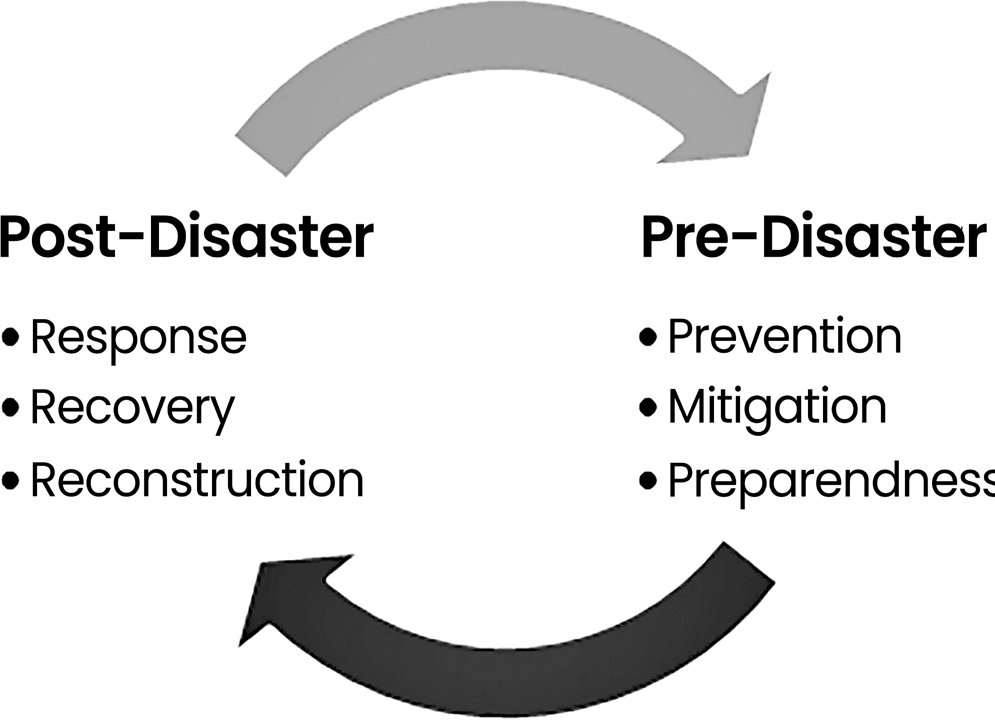
Figure: Pre and Post Disaster Management
• Disaster Risk
• Risk refers to the likelihood of an event occurring and its potential adverse effects. It represents the possibility of a disaster that may result in loss of lives, damage to property, and destruction of infrastructure.
•
The term "risk" has two distinct interpretations:
• 1) General Understanding – It emphasizes the probability or possibility of an occurrence, such as in "the risk of an accident".
• 2) Technical Perspective – It focuses on the potential consequences and losses related to a specific event, location, and time frame. It is important to note that perceptions of risk vary among individuals and communities based on their understanding and experiences.
• Risk is influenced by three key factors:
• The presence of a hazard (a situation posing a threat),
• The level of vulnerability (physical, socio-economic, and environmental capacity to cope),
• Exposure to risk-prone structures within a community.
The intersection of these three elements defines risk.

Figure: Identification of Risk
Disaster Risk refers to the potential losses in terms of lives, health, livelihoods, assets, and essential services that a particular community or society might experience within a defined future period.
The definition of disaster risk reflects the concept of disasters as the outcome of continuously present conditions of risk. Disaster risk comprises different types of potential losses which are often difficult to quantify.
Nevertheless, with knowledge of the prevailing hazards and the patterns of population and socio- economic development, disaster risks can be assessed and mapped, in broad terms at least.
A single disaster has a different impact on different people in the society. Poor people have less capacity to cope with the disaster in comparison to rich people. Because poor people have less strong houses constructed in low economic zones, situated in low lying areas with less economic power.
All are making them more vulnerable to any disaster. They are more exposed to nature and subject to risk. On the other hand, the reverse is the case with rich people. Therefore, risk is determined by hazard, vulnerability and exposure of the people to the disaster.
Exposure: People, property, systems or other elements present in hazard zones that are thereby subject to potential losses.
Measures of exposure can include the number of people or types of assets in an area. These can be combined with the specific vulnerability of the exposed elements to any particular hazard to estimate the quantitative risks associated with that hazard in the area of interest.
