DISEASES CAUSED BY BACTERIA
| Disease Name | Causative Organism | Symptoms/Organs Affected | Transmission | Vaccination |
| Diptheria | Corynebacterium diptheria | Respiratory Tract | Through respiratory droplets,likefrom coughing or sneezing | Toxoid Vaccine |
| Tuberculosis | Mycobacterium tuberculosis | Mainly Lungs | Droplet Infection, Drinking milk from infected cattle | BCG living attenuated bacteria.Certain Antibiotics like stretomycin also help |
| Pertusis (whooping cough) | Bordetella pertusis | Respiratory Tract | Droplet | Killed Vaccine |
| Gonorrhea | N. gonorrhea | ReproductiveTract, blindness in infants | Sexually Transmitted Disease and Vertically through the mothe | No vaccine but treatable through antibiotics |
| Syphillis | T. pallidum | ReproductiveTract, laterotherorgans including brain | STD | No vaccine but treatable through antibiotics |
| Tetanus | Clostridium tetani | Affects blood, becomes a toxin and then later causes lock jaw | Woundbreakson rusted iron | Toxoid vaccine |
| Cholera | Vibrio cholera | Gastro-intestinal tract: causes diarrhoea | Oro-faecal:through water/objects/vector etc. | Antibiotics |
| Typhoid | Salmonella typhi | GI tract then other organs | Oro-faecal:through water/objects/vector etc. | Ty21a and Vi capsular polysaccharide vaccine |
| Bacterial Dysentary | Shigella | GI tract | Oro-faecal:through water/objects/vector etc. | None, but it is treatable |
| Haemophilus Influenza type B (Hidisease | H. influenzae | Lungs:causes pneumonia Brain: Meningitis | Respiratory Droplets | Vaccine is available and is covered in the National Schedule |
Tuberculosis
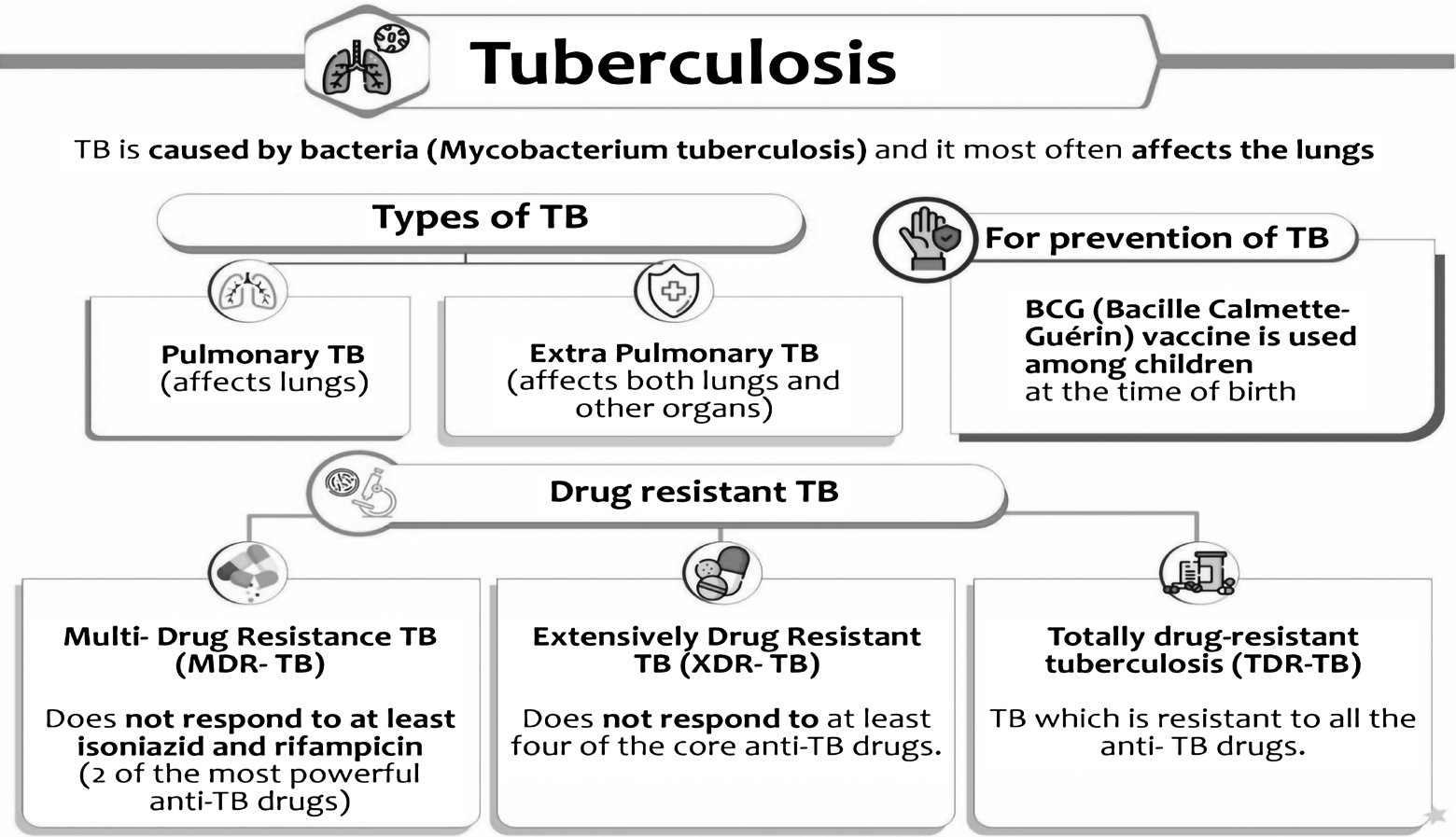
Tuberculosis (TB) is an infectious disease that most often affects the lungs and is caused by a type of bacteria. It spreads through the air when infected people cough, sneeze or spit.
Tuberculosis is preventable and curable.
About a quarter of the global population is estimated to have been infected with TB bacteria. About 5–10% of people infected with TB will eventually get symptoms and develop TB disease.
Those who are infected but not (yet) ill with the disease cannot transmit it. TB disease is usually treated with antibiotics and can be fatal without treatment.
In certain countries, the Bacilli Calmette-Guerin (BCG) vaccine is given to babies or small children to prevent TB. The vaccine prevents TB outside of the lungs but not in the lungs.
Multidrug-resistant TB
Drug resistance emerges when TB medicines are used inappropriately, through incorrect prescription by health care providers, poor quality drugs, or patients stopping treatment prematurely.
• Multidrug-resistant tuberculosis (MDR-TB) is a form of TB caused by bacteria that do not respond to isoniazid and rifampicin, the 2 most effective first-line TB drugs. MDR-TB is treatable and curable by using second-line drugs. However, second-line treatment options require extensive medicines that are expensive and toxic.
• In some cases, more extensive drug resistance can develop. TB caused by bacteria that do not respond to the most effective second-line TB drugs can leave patients with very limited treatment options.
• MDR-TB remains a public health crisis and a health security threat. Only about 2 in 5 people with drug resistant TB accessed treatment in 2022.
• In accordance with WHO guidelines, detection of MDR/ RR-TB requires bacteriological confirmation of TB and testing for drug resistance using rapid molecular tests or culture methods.
India and TB
India has a disproportionate amount of TB cases. Till now, India’s plans to deal with TB was to prevent its spread and control the causes behind the diseases. Now, with the launch of the TB Mukt Bharat Abhiyaan, the focus is on the eradication of the disease. Let’s look at an overview of India’s strategies with respect to TB:
• National Strategic Plan (2017-25) to address the TB epidemic in India- having measurable, attainable realistic and time-bound goals and was an update to the 2015 document. The WHO has also released a set of guidelines to support the NSP. It aims to eliminate TB in India by 2025.
• Nikshay Portal: National TB information system and a National Data Repository
• Nikshay Poshan Yojana: Provides Direct Benefits Transfer (DBT) to all TB patients towards nutritional support, by Ministry of Health and Family Welfare. It is financed by Government of India and the World Bank.
• TB Mukt Bharat Abhiyaan: Prime Minister’s initiative to eradicate TB by 2025
• Patho detect kit: Indigenous TB kit
Global Plans
Moscow Declaration, 2017
WHO end TB strategy: incidence reduction by 80%, reduce TB deaths by 90% and eliminate catastrophic costs
Find all, Treat all, End TB: Partnership between WHO, Stop TB partnership and Global Fund to end TB
BPaL: 6-month oral regimen for TB using 3 drugs, Bedaquilline, Pretomanid, Linezolid
Reduced time of treatment: 18 months to 6 months. Made by TB alliance, a Not-for-profit organisation
Pentavalent Vaccine
The Government of India has decided to introduce pentavalent vaccine in the national immunization programme in selected states. Pentavalent vaccine provides protection to a child from 5 life-threatening diseases – Diphtheria, Pertussis, Tetanus, Hepatitis B and Hib. DPT (Diphtheria + Pertussis + Tetanus) and Hep B are already part of routine immunization in India; Hib vaccine is a new addition. Together, the combination is called Pentavalent. Hib vaccine can prevent serious diseases caused by Haemophilus influenzae type b like pneumonia, meningitis, bacteraemia, epiglottitis, septic arthritis etc. Giving pentavalent vaccine reduces the number of pricks to a child, and provides protection from all five diseases.