EARTH’S MAGNETIC FIELD
Earth’s magnetic field (and the surface magnetic field) is approximately a magnetic dipole, with the magnetic field S pole near the Earth’s geographic north pole (see Magnetic North Pole) and the other magnetic field N pole near the Earth’s geographic south pole (see Magnetic South Pole). This makes the compass usable for navigation. The cause of the field can be explained by dynamo theory. A magnetic field extends infinitely, though it weakens with distance from its source. The Earth’s magnetic field, also called the geomagnetic field, which effectively extends several tens of thousands of kilometres into space, forms the Earth’s magnetosphere. A paleomagnetic study of Australian red dacite and pillow basalt has estimated the magnetic field to be at least 3.5 billion years old.
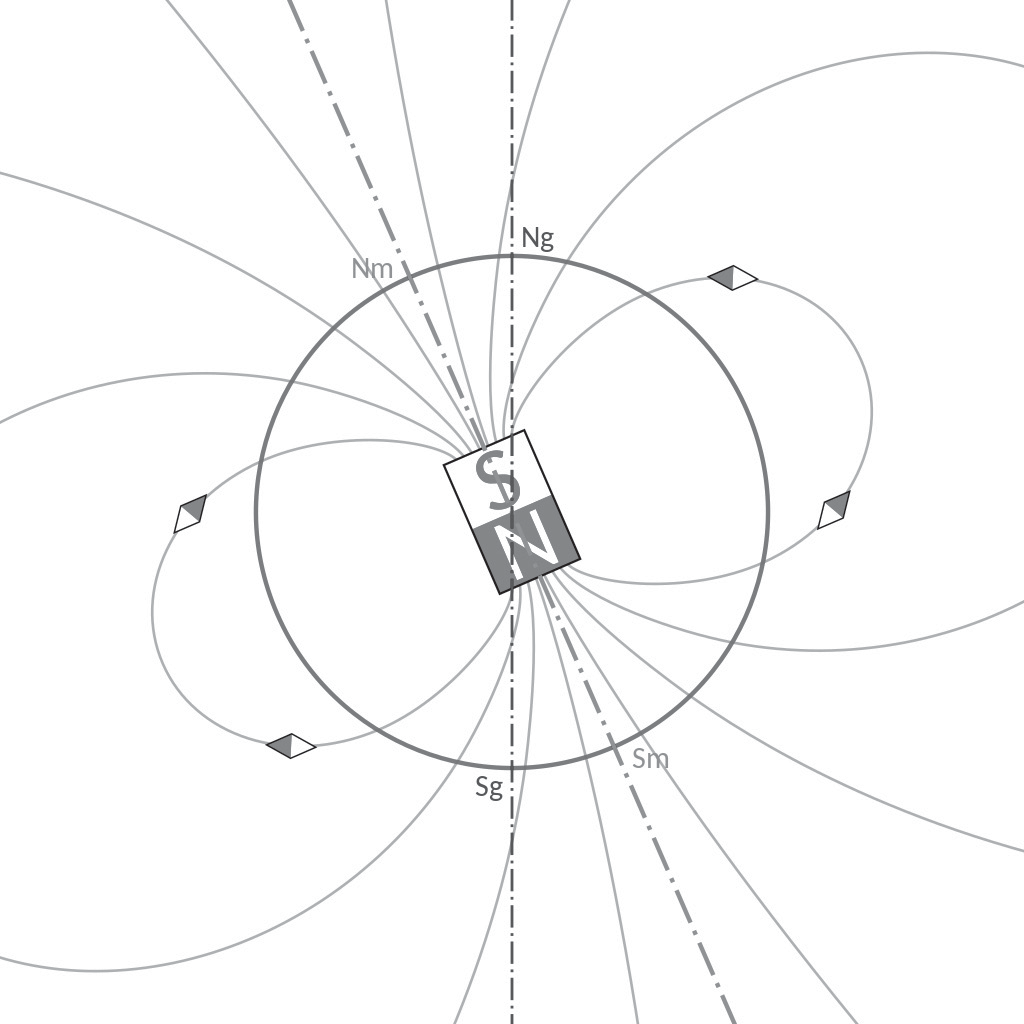
Fig: The variation between magnetic north and “true” north.
Importance of earth’s magnetic field
1. Earth’s magnetic field shields it from the solar wind, which is a flow of charged particles from the Sun. The magnetic field acts like a barrier, deflecting and redirecting most of these charged particles away from Earth.
2. A portion of the charged particles from the solar wind gets caught and held within the Van Allen radiation belts.
3. A small number of particles from the solar wind travel to Earth’s upper atmosphere and ionosphere in the auroral zones.
4. The solar wind becomes visible on Earth when it is strong enough to create phenomena like auroras and geomagnetic storms. These bright auroras heat up the ionosphere, causing it to expand into the magnetosphere and allowing some atmospheric matter to escape into space.
5. Geomagnetic storms occur when the pressure of plasmas inside the magnetosphere becomes high enough to stretch and distort Earth’s magnetic field.
6. The solar wind shapes Earth’s magnetosphere, and changes in its speed, density, and direction affect our local space environment. This can cause fluctuations in ionizing radiation, radio interference, and the position of the magnetopause. These changes can impact satellites and are known as space weather.
7. The gas from Earth’s atmosphere gets trapped in magnetic bubbles and is carried away by solar winds.
8. Changes in the strength of Earth’s magnetic field have been linked to changes in rainfall patterns in tropical regions.
Magnetic poles and magnetic dipole
Often, a magnetic (dip) pole is viewed as a point on the Earth’s surface where the magnetic field is entirely vertical. Another way of saying this is that the inclination of the Earth’s field is 90 at the North Magnetic Pole and -90 at the South Magnetic Pole. At a magnetic pole, a compass held in the horizontal plane points randomly, while otherwise it points nearly to the North Magnetic Pole or away from the South Magnetic Pole, though local deviations exist. The two poles wander independently of each other and are not at directly opposite positions on the globe. Magnetic dip pole can migrate rapidly, observation of up to 40 km per year have been made for the North Magnetic Pole.
The Earth’s magnetic field can be closely approximated by the field of a magnetic dipole positioned near the centre of the Earth. A dipole’s orientation is defined by an axis. The two positions where the axis of the dipole that best fits the geomagnetic field intersect the Earth’s surface are called the North and South geomagnetic poles. For best fit the dipole representing the geomagnetic field should be placed about 500 km off the centre of the Earth. This causes the inner radiation belt to skim lower in Southern Atlantic ocean, where the surface field is the weakest, creating what is called the South Atlantic Anomaly.
If the Earth’s magnetic field were perfectly dipolar, the geomagnetic and magnetic dip poles would coincide. However, significant non-dipolar terms in an accurate description of the geomagnetic field cause the position of the two pole types to be in different places. Magnetic poles are located where the magnetic lines of attraction enter Earth.
The Magnetic North Pole is also known as the North Dip Pole and is currently found on Ellesmere Island in Northern Canada. When a magnetic compass points north, it align itself with Earth’s magnetic field and points to the Magnetic North Pole, not the Geographic North Pole, which is actually about 310 miles (500 kilometres) away.
Magnetic field characteristics
The Earth’s magnetic field is akin to that of a bar magnet. It’s mainly created by electric currents in the liquid outer core. The core’s temperature surpasses 1043 K, which is the Curie point temperature for iron. Beyond this temperature, the alignment of iron’s atomic spins becomes random, leading to a loss of magnetization in the substance.
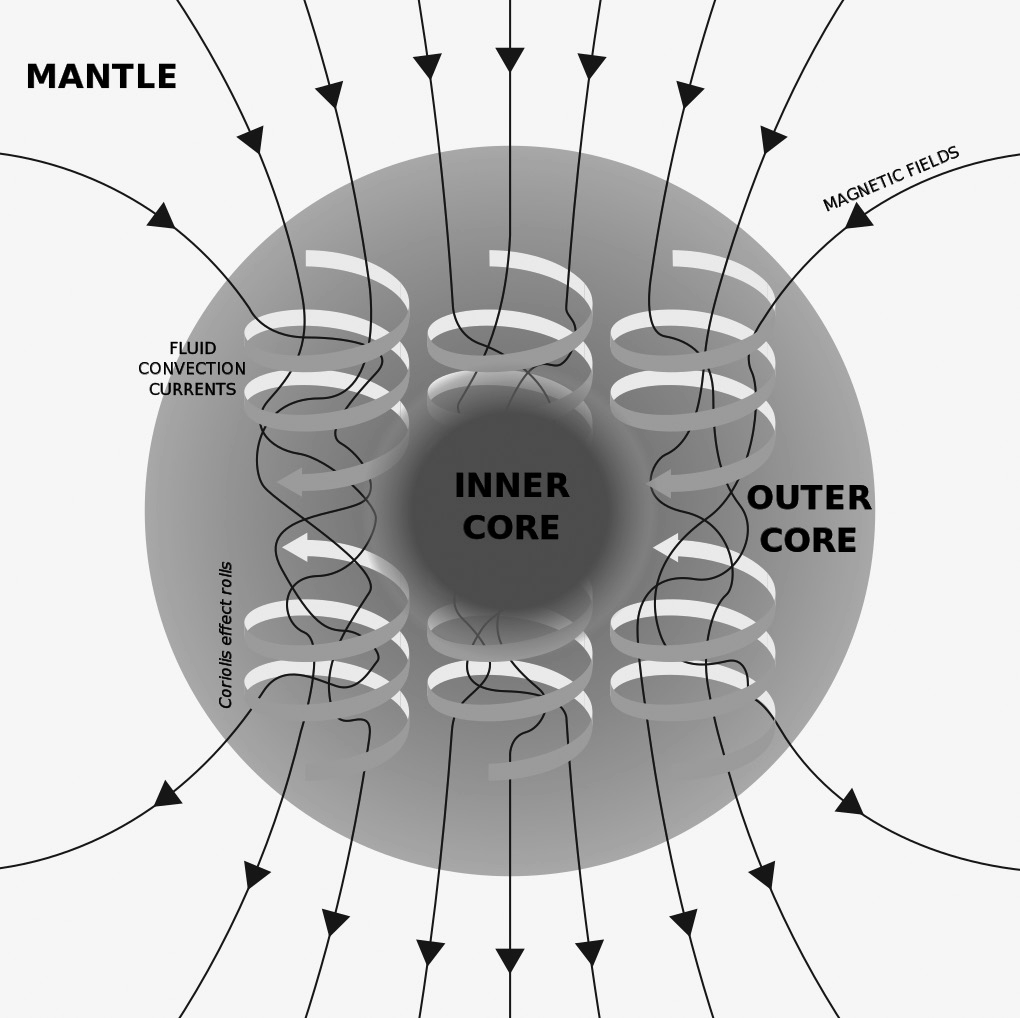
Another important aspect that sets Earth’s magnetic field apart from that of a bar magnet is its magnetosphere. At significant distances from the planet, the magnetosphere plays a major role in shaping the surface magnetic field. Additionally, electric currents generated in the ionosphere produce their own magnetic fields. This magnetic field is particularly prominent near areas where the atmosphere is closest to the Sun, leading to daily changes that can shift surface magnetic fields by up to one degree.
Magnetic field variations
Magnetometers are tools that can sense tiny changes in the Earth’s magnetic field. These changes can happen because of things like iron objects, ovens, certain types of stone buildings, or even holes and garbage dumps in archaeological studies.
• Scientists use special instruments based on technology from World War II to find these changes. Originally used to spot submarines, they’ve been adapted to study the magnetic differences on the ocean floor.
• So basically, magnetometers help scientists find hidden stuff underground or underwater by sensing changes in the Earth’s magnetic field.
The ocean floor is mostly made of basalt, a type of rock rich in iron. Inside basalt, there’s a mineral called magnetite, which is very magnetic. This magnetism can distort compass readings, which Icelandic sailors noticed a long time ago.
But this magnetic property of basalt is useful for scientists. When new basalt forms from volcanic activity and then cools down, it “locks in” the Earth’s magnetic field at that time. This helps scientists study the ocean floor by looking at these magnetic variations.
Sometimes, the Earth’s magnetic field gets hit by solar flares from the sun. When this happens, it can cause geomagnetic storms, which lead to beautiful displays of auroras in the sky.
Scientists measure how unstable the magnetic field is during these storms using something called the K-index. It’s like a scale from 0 to 9, where 0 means everything’s calm and 5 or higher means there’s a geomagnetic storm happening. So, the higher the number on the K-index, the more disturbed the Earth’s magnetic field is.