Regionalism is a political movement and ideology aimed at promoting the interests of specific regions. It stems from a sense of loyalty to a region with a homogenous population that shares common cultural, social, political, economic, or ethnic aspirations.
However, local pride and loyalty to one’s region, state, language, or culture are not synonymous with regionalism, nor do they threaten national unity. These feelings align with national patriotism and loyalty to the broader nation. One’s pride in their region doesn’t equate to regionalism, and this understanding was also reflected in the Indian national movement.
American scholar and journalist Selig Harrison, in his book India – The Most Dangerous Decades, suggested that India might face challenges to its unity due to tensions between national and state governments. However, India has managed to successfully embrace and celebrate its cultural diversity, countering such fears
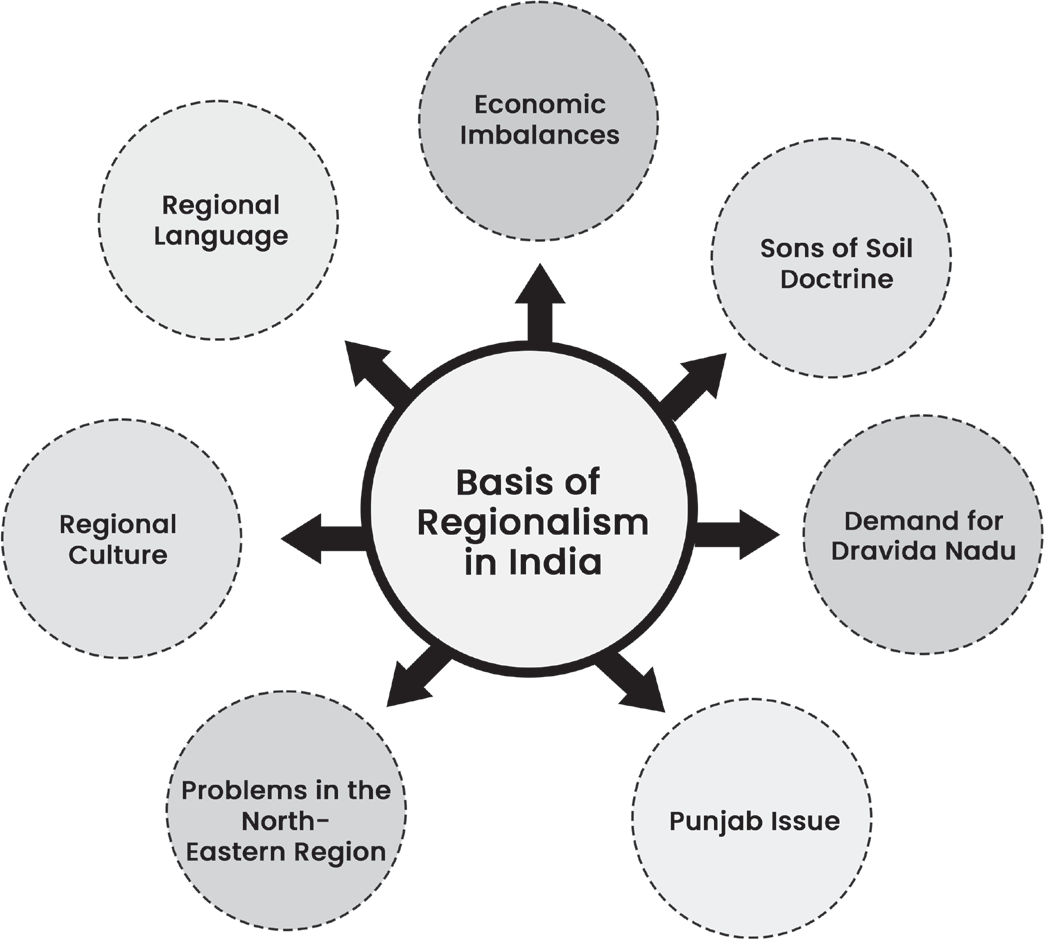
Economic Imbalances & Regionalism
Economic inequality among different states and regions could be a potential source of trouble. Hence, from the
beginning, the national government felt a responsibility to counter the imbalance in regional development. To influence the rates of growth in poorer states and regions and to reduce economic distance from richer states, the central government adopted a whole range of policies.
A major instrument in the government’s hand in bringing development to the poor state was the transfer of financial resources, which was done by the Finance Commission, a constitutional body.
Planning was also used as a powerful instrument to remove regional inequality. Planning Commission allocated greater plan assistance to the backward states. The assistance was given in both forms, grants and loans.
Public investment by the central government in major industries such as steel, fertilizers, oil refining, petrochemicals, heavy chemicals, and in power and irrigation projects have been a tool for the reduction of regional inequality.
Government incentives have been provided to the private sector to invest in backward areas through subsidies, tax concessions, concessional banking and institutional loans at subsidized rates.
In spite of the above-mentioned initiatives and programmes, the backward states have a lower level of infrastructural facilities such as power, irrigation, roads, telephones and modern markets for agricultural produce. Political and administrative failure also bolsters backwardness