Events Leading Up to The Outbreak of War
• The Moroccan Crisis (1905-06)
This was an effort by Germany to expand its imperial influence and to challenge the recently established Anglo-French Entente Cordiale of 1904. Under this agreement, France recognized Britain’s control over Egypt in exchange for British support of a potential French claim over Morocco—one of the few remaining regions in Africa not yet under European colonial rule.
In response, Germany declared its intention to support the Sultan of Morocco in preserving his country's independence and called for an international conference to determine Morocco’s future.
A conference was held in Algeciras, southern Spain, in January 1906 to address the Moroccan crisis. The British feared that if Germany succeeded in its demands, it would effectively gain control over Morocco—marking a significant step toward German diplomatic dominance and advancing its Weltpolitik (world policy) agenda.
Having recently entered into the Entente Cordiale with France, Britain was determined to lead the opposition against Germany at the conference. Germany, however, underestimated the strength of the Entente, assuming that the long-standing rivalry between Britain and France would prevent real cooperation. To Germany’s surprise, Britain, along with Russia, Italy, and Spain, backed France’s demand to oversee Moroccan banking and police affairs.
It marked a significant diplomatic setback for Germany, which came to recognize that the emerging alliance between Britain and France was a powerful and unified front—especially as the crisis was soon followed by Anglo-French military discussions.
• The British agreement with Russia (1907)
The Germans saw Britain’s recent shift toward Russia as another unfriendly act. However, it made sense given that Russia had formed an alliance with France in 1894, which was now part of Britain’s “Entente Cordiale.”
For many years, Britain viewed Russia as a symbol of corruption, dominated by an aristocratic and undemocratic regime. Russia was also regarded as a major threat to British interests in the Far East and India.
However, this perception began to shift after Russia's defeat by Japan in the 1904–1905 war, which revealed its declining military strength.
The internal revolution of January 1905 further weakened Russia. In response, the Russian government aimed to ease tensions with Britain and attract British investment to support its industrial modernization.
In October 1905, Tsar Nicholas II introduced reforms, including freedom of speech and the creation of an elected parliament. These changes led Britain to adopt a more favorable view of the Russian regime.
As relations improved, Britain and Russia were able to resolve their longstanding disputes over Persia, Afghanistan, and Tibet. Although this was not a formal military alliance nor explicitly directed against Germany, the Germans interpreted it as a sign of a strengthening alignment between Britain, France, and Russia—one that they feared could eventually encircle them.
• The Bosnia Crisis (1908)
The crisis over Bosnia, a Turkish province, escalated tensions between Austria-Hungary and Serbia to the breaking point.
In 1878, the Congress of Berlin had made a complex decision that Bosnia should remain under Turkey’s sovereignty, but Austria-Hungary would handle its administration.
By 1908, a new government in Turkey, led by the Young Turks (a group of army officers), opposed Austria’s presence in Bosnia and aimed to reassert Turkish control over the region.
This situation gave Austria the opportunity to act first. They formally annexed Bosnia, which angered Serbia, as Bosnia had a large Serb population, and Serbia had long coveted the province.
Serbia appealed to Russia, hoping for support from their fellow Slavs. Russia called for a European conference, expecting to gain backing from France and Britain.
When it became clear that Germany would back Austria in the event of war, France hesitated, unwilling to get involved in a Balkan conflict.
The British, eager not to upset Germany, only protested Austria-Hungary’s actions. Meanwhile, Russia, still recovering from its defeat by Japan, was too cautious to provoke war without stronger allies. As a result, Serbia received no support, and no conference took place.
This outcome marked a victory for the Austro-German alliance.
• The Agadir Crisis (1911)
The crisis began with further developments in Morocco. French troops moved into Fez, the Moroccan capital, to suppress a rebellion against the Sultan. It appeared that France was on the brink of annexing Morocco.
In response, Germany sent the gunboat Panther to the Moroccan port of Agadir, aiming to pressure France into offering compensation, possibly the French Congo.
Britain became concerned that if Germany gained control of Agadir, it could establish a naval base that would threaten British trade routes.
Despite the tension, France remained resolute and made no significant concessions. Eventually, Germany withdrew the Panther, agreeing to recognize the French protectorate over Morocco in exchange for two strips of land in the French Congo.
While this was seen as a victory for the Entente powers, it sparked strong anti-British sentiment in Germany, particularly as Britain continued to pull ahead in the naval arms race..
• The First Balkan War (1912)
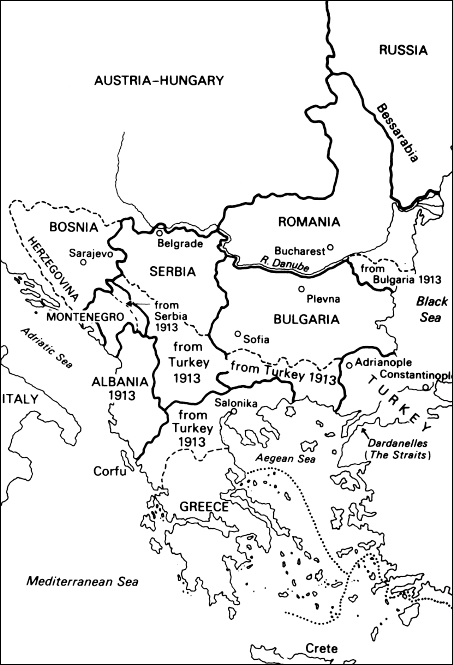
The war began when Serbia, Greece, Montenegro, and Bulgaria, collectively known as the Balkan League, launched a series of attacks on Turkey.
These countries, once part of the Ottoman Empire, saw Turkey’s weakening position as an opportunity to seize more land. They quickly captured most of the remaining Turkish territory in Europe.
In an effort to prevent the conflict from escalating, Sir Edward Grey, the British Foreign Secretary, along with the German government, organized a peace conference in London. The goal was to contain the war and show that Britain and Germany could still cooperate.
The peace settlement divided the former Turkish lands among the Balkan states, but the Serbs were dissatisfied
with their share. They desired Albania to gain access to the sea. However, the Austrians, supported by both Germany and Britain, insisted that Albania should become independent to prevent Serbia from growing stronger.
• The Second Balkan War (1913)
The Bulgarians were dissatisfied with their gains from the peace settlement and they blamed Serbia. They had been hoping for Macedonia, but most of it had been given to Serbia.
Bulgaria therefore attacked Serbia, but their plan misfired when Greece, Romania and Turkey rallied to support Serbia.
The Bulgarians were defeated, and by the Treaty of Bucharest (1913), they forfeited most of their gains from the first war.
It seemed that Anglo-German influence had prevented an escalation of the war by restraining the Austrians, who were itching to support Bulgaria and attack Serbia.
• The assassination of the Austrian Archduke Franz Ferdinand
The tragic event that took place in Sarajevo, the capital of
Bosnia, on June 28, 1914, served as the immediate trigger
for Austria-Hungary’s declaration of war on Serbia—a conflict that quickly escalated into the First World War.
On that day, Archduke Franz Ferdinand, heir to the Austro-Hungarian throne, and his wife visited Sarajevo and were assassinated by Gavrilo Princip, a Bosnian Serb nationalist. Vienna viewed the assassination as an act of provocation by Serbia.
Austria then issued an ultimatum with demands it knew Serbia would likely reject. When Serbia’s response was deemed unsatisfactory, Austria-Hungary declared war on July 28.
In support of Serbia, Russia ordered a general mobilization on July 29, determined not to abandon the Serbs again. In response, Germany demanded that Russia halt its mobilization (July 31). When Russia failed to do so, Germany declared war on Russia on August 1 and on France two days later, on August 3.
When German troops entered Belgium on their way to invade France, Britain (who in 1839 had promised to defend Belgian neutrality) demanded their withdrawal. When this demand was ignored, Britain entered the war (4 August). Austria-Hungary declared war on Russia on 6 August. Other countries joined later.