Factors that Encouraged British Industrialization
• Development of Towns, Trade and Finances
Urban Expansion:
From the eighteenth century onward, many European towns experienced significant growth in both area and population. Among the 19 cities in Europe whose populations doubled between 1750 and 1800, 11 were located in Britain. London was the largest and most prominent of these expanding urban centers.
• Trade and Commerce:
London emerged as the primary hub of national markets, with other major trading centers located in close proximity. By the eighteenth century, London had also gained global commercial importance. The center of international trade had shifted away from the Mediterranean ports of Italy and France to the Atlantic ports of Holland and Britain. In England, the transportation of goods was facilitated by a well-developed network of rivers and a deeply indented coastline offering natural harbor.
• Finance and Banking:
The Bank of England, established in 1694, became the cornerstone of the nation’s financial system. By 1784, England had over a hundred provincial banks, and their number tripled over the following decade. These banks played a critical role in meeting the financial demands of large-scale industrial enterprises, enabling the expansion of industrial activity across the country.
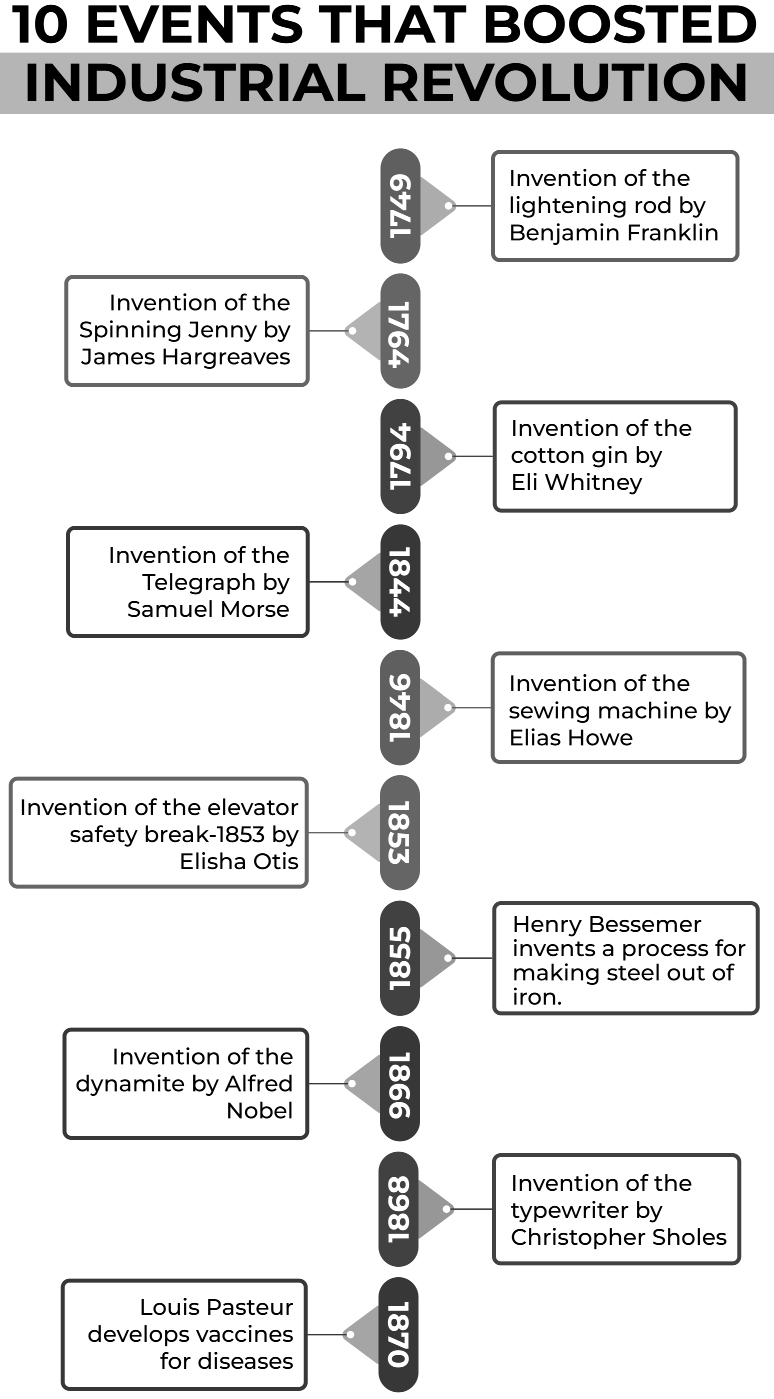
• Industrial Revolution Spreads: Formation of Factories.
• Technological breakthroughs in the textile industry sparked a wave of innovation in iron and steel production, setting the stage for broader industrial advancements. As English-manufactured goods flooded global markets, other nations were motivated to follow suit and develop their own industries.
•
To protect their technological edge, Britain implemented strict laws to prevent textile workers from sharing industrial secrets or leaving the country. However, in 1789, Samuel Slater managed to leave England and move to America, where he brought his knowledge of British textile technology. This act helped ignite America’s own Industrial Revolution and led to the expansion of cotton plantations, which, in turn, fueled the demand for enslaved labor.
• In 1779, Samuel Crompton invented the “Spinning Mule,” while Edmond Cartwright developed the first water- powered loom. These innovations had a ripple effect, stimulating growth in other related industries, such as dyeing, bleaching, and printing.
• Richard Arkwright, known as “The Father of the Factory System,” revolutionized production by establishing the first factory designed specifically to house machinery. This new system introduced fixed working hours and a more stable form of employment, replacing the old system of hiring workers on a contract basis.
• Innovations
The Steam Engine:
• One of the most significant advancements of the Industrial Revolution was the invention and widespread use of steam power.
• For centuries, water had been the main source of mechanical energy, but it was limited by location, seasonal availability, and the flow rate of rivers.
• Steam power, on the other hand, generated high- temperature pressure that could drive a wide range of machinery. This made it the first energy source that was both reliable and cost-effective enough to power the manufacturing of machines themselves.
• Initially, steam engines were used primarily in mining. As the demand for coal and metals grew, steam power became essential for extracting resources from increasingly deeper mines.
Development of Steam Engine
• Flooding in mines was a significant issue during the early years of industrialization. To address this, Thomas Savery (1650-1715) invented a steam engine called the “Miner’s Friend” in 1698, designed specifically to drain water from mines. While innovative, these engines worked slowly, were only effective at shallow depths, and faced the problem of boiler explosions due to excessive pressure.
• In 1712, Thomas Newcomen (1663-1729) developed another steam engine, which, although an improvement, still had a major flaw: it lost energy because the condensing cylinder continuously cooled down, diminishing its efficiency.
• It was James Watt in 1764 who made a breakthrough by improving upon Newcomen’s design. Watt’s enhancements quadrupled the engine’s efficiency. He introduced a new chamber where cold water was sprayed to condense the steam, creating a vacuum that allowed the engine to operate much more effectively.
• This period also marked a significant transfer of technologies. For instance, Watt utilized John Wilkinson’s specialized drill, originally designed for making gun barrels, to bore the large cylinder required for his improved steam engine. This collaboration between different technologies was a pivotal moment in advancing industrial machinery.
Impact of Steam Engine: Revolutionizing Transport and Industry
The steam engine quickly replaced the earlier coal- powered locomotives, creating a surge in demand for railway lines. Its portability revolutionized various industries by eliminating the need for factories to be located along rivers or lakes. Now, industries could set up wherever they found it most beneficial.
After 1800, the steam engine continued to evolve, thanks to advances in lighter and stronger metals, more precise machine tools, and improved scientific understanding. This progress further boosted its efficiency and application across different sectors.
By 1840, British steam engines were responsible for generating over 70 percent of the total horsepower across Europe, highlighting the central role of steam power in industrialization. Together with coal and iron, the steam engine became a cornerstone of modern industry, laying the groundwork for the industrial landscape we recognize today.
Increased Demands for Coal
Working in coal mines was once considered so dangerous that it was believed only those with a "death wish" would take such jobs. Coal was transported through horizontal tunnels in baskets and then lifted to the surface via vertical shafts.
The extraction and movement of coal relied entirely on physical labor—provided by animals, men, women, and even children. Children were often preferred due to their small size, despite the perilous conditions.
As steam power became more widely used, the demand for coal increased significantly. This led to important improvements in mining, including better tunnel ventilation, more efficient coal transportation, the use of gunpowder to break through rock, and the introduction of safety lamps.
Despite these advancements, coal miners continued to face severe risks and health issues, particularly respiratory diseases such as lung conditions caused by prolonged exposure to coal dust.
Inventions in Iron Making
• In 1709, Abraham Darby revolutionized iron production by smelting pig iron with coke, replacing the traditional method that used charcoal derived from wood. This shift helped prevent the rapid depletion of England’s forests, which had been a growing concern.
Fig: Iron and coal manufacturing areas
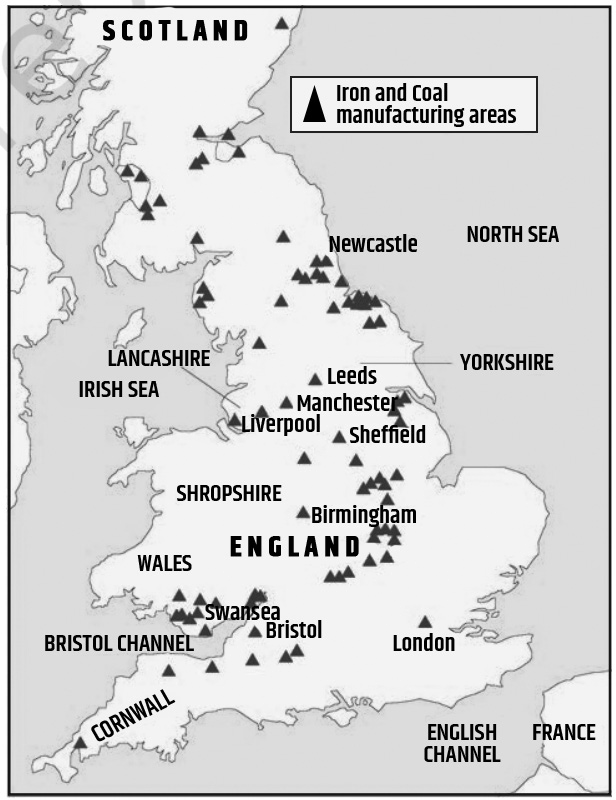
• Then, in 1784, Henry Cort, an ironmaster, developed a method for producing wrought iron, a less brittle form of iron. This innovation proved to be highly valuable in various industrial applications, further boosting the utility of iron in the industrial age.
• Around the same time, in 1774, John Wilkinson invented a drilling machine capable of creating holes with remarkable precision. His invention played a key role in improving the quality and accuracy of iron production. Between 1788 and 1806, iron production surged, with the metal finding new uses in farm machinery, hardware, shipbuilding, and more.
• One of the most iconic achievements during this period came in 1779, when the third Darby, Abraham’s descendant, built the world’s first iron bridge in Coal Brookdale. Spanning the River Severn, this bridge was a landmark in both engineering and the growing importance of iron in modern infrastructure.
• Wilkinson used cast iron for the first time to make water pipes.
• Means of Transportation and Communication
• The advancements in transportation and communicationplayed a crucial role in fuelling the Industrial Revolution. As industries grew, there was a clear need for a reliable system to transport raw materials, finished products, food, and people. In the early 1700s, significant improvements were made in bridge construction and road networks, which helped facilitate the movement of goods from factories to markets.
• In 1801, Richard Trevithick, an engineer from Cornwall, developed the “Puffing Devil,” a steam engine that could pull trucks around the mines. This early experiment laid the groundwork for future innovations in steam-powered transportation. Then, in 1814, George Stephenson built the first true steam locomotive, the “Blücher,” designed to run on railway tracks. This marked the beginning of a revolution in transport, as steam engines and railways soon began moving goods across the country, complementing the existing canal transport system.
• By the mid-19th century, steam-powered ships began to replace sailing vessels. The shift was further marked by the introduction of iron ships, which could traverse oceans more efficiently and securely.
• While steam power drove the first phase of the Industrial Revolution, the second phase was defined by electricity. The development of faster transportation and communication technologies sped up business operations, facilitating quicker exchanges between military units, colonies, countries, and even ordinary people. The invention of the telegraph and telephone transformed global communication, allowing messages to be transmitted instantly, bridging vast distances and connecting people in ways never before possible