FDI In Agriculture
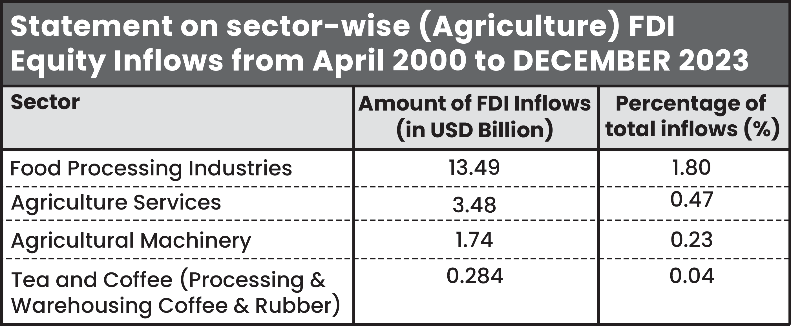
With 157.35 million hectares under agriculture, India holds the second-largest agricultural land in the world. Additionally, India is among the fifteen leading exporters of agricultural products in the world. With a rising population, globalization, a rapidly growing economy and surge of demand, it is no surprise that India stands to gain from increased foreign investments in the agriculture sector. This promotion and approval of Foreign Direct Investment (FDI) in India is done by Department of Industrial Policy & Promotion
According to the circulars issued in 2011, FDI up to 100% is permitted, under the automatic route, subject to certain conditions mentioned in Consolidated FDI Policy, in the following agricultural activities:
Floriculture, horticulture, apiculture and cultiv-ation of vegetables and mushrooms under controlled conditions
Development and production of seeds and planting material
Animal husbandry: fish farming, aquaculture, under controlled conditions
Services related to agriculture and its allied sectors
Other than these activities, foreign investments of up to 100% under the government route are permitted in the tea sector, including tea plantations.
Challenges for FDI Inflow in Indian Agriculture
Main problems in the agricultural sector, as listed by the World Bank, are
• India’s large agricultural subsidies are hampering productivity-enhancing investment.
• Overregulation of agriculture has increased costs, price risks
and uncertainty.
• Infrastructure & Growth: Inadequate infrastructure and sluggish economic growth create hurdles.
• Policy & Regulations of FDI: Lack of transparency and consistency in FDI policies, along with regulatory hurdles.
• Import Duties & Restrictions: High import duties on food items (e.g., 60% on honey) and limitations like APMC rules hinder market access to MNCs.
• APMC rules restrict the ability of any player to deal directly with a farmer.
• Storage is be subject to the Essential Commodities Act.
Agricultural extension services
The Sub-Mission on Agricultural Extension (SMAE) under Green Revolution Krishonnati Yojana aims to improve India’s agricultural extension system. Extension system means those services which provide farmers with improved access to information, technology and expertise leading to enhanced productivity. Its key components are:
• Institutional Reforms: Establishing Agricultural Technology Management Agencies (ATMAs) at the district - level for decentralized extension services.
• Mass Media Support: Utilizing radio (AIR) and television networks (Doordarshan) to disseminate information on latest farming practices.
•
Agri-Clinics and Agri-Business Centres (AC&ABCs): Creating opportunities for agricultural graduates to provide extension services and support self-employment.
• Kisan Call Centers (KCCs): Toll-free helplines offering farmers answers to their queries on agriculture and allied sectors. A Kisan Knowledge Management System (KKMS) has been created at the backend to capture details of the farmers calling.
• Human Resource Development: Strengthening National Institute of Agricultural Extension Management (MANAGE) at Hyderabad for improved training of extension personnel.
• Gender Equity: Supporting the National Gender Resource Centre in Agriculture (NGRCA) to promote gender inclusion in extension services.