Fertilisation in Humans
Fertilisation is the union of male and female gametes to form a zygote. This happens in all sexually reproducing organisms. We need to study about human fertilisation in detail.
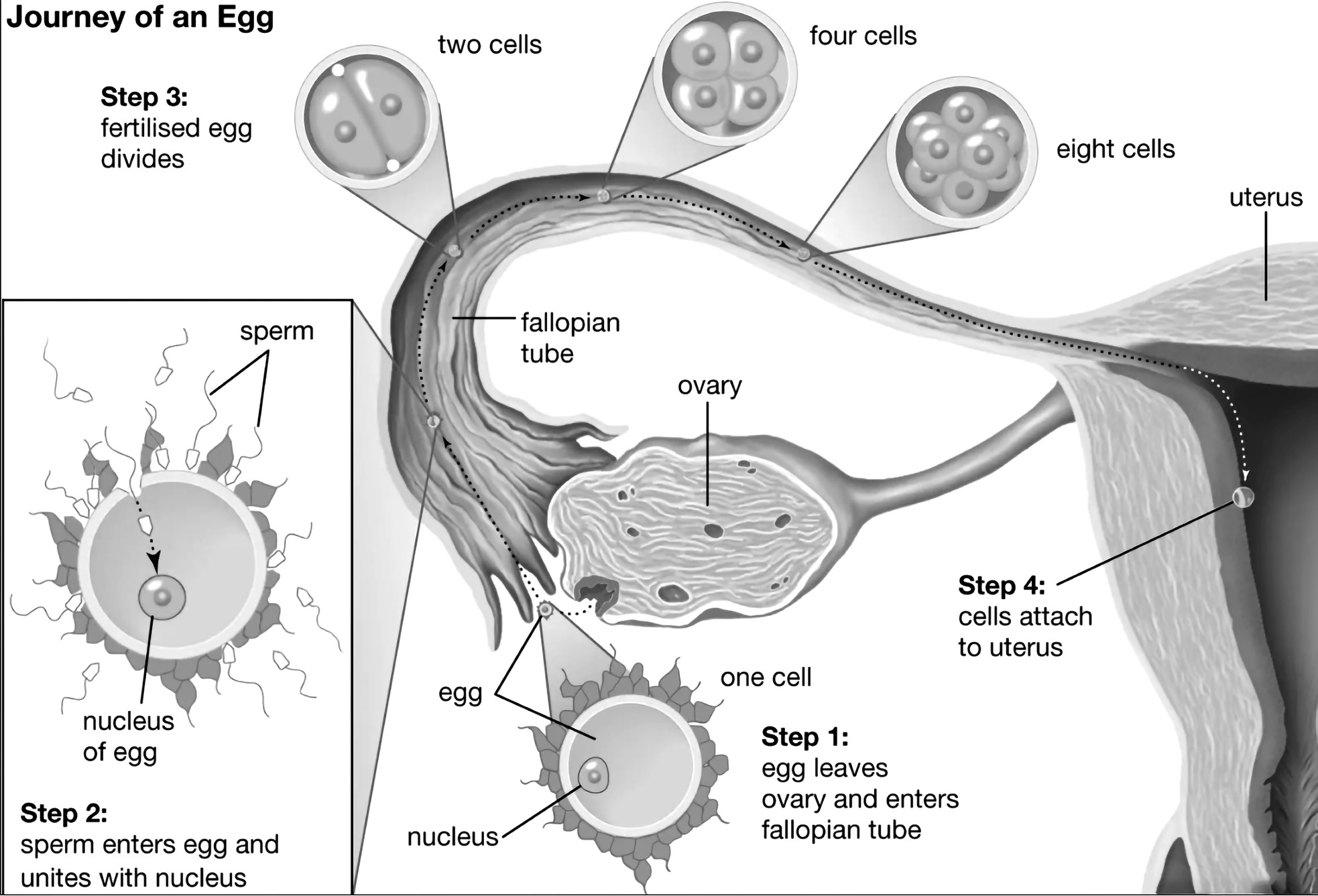
When the human sperm reaches the boundary of the female ovum, it starts a reaction called as the acrosomal reaction to allow the passage of its nucleus through the selectively permeable membrane of the female ovum.
What is important to remember here is that the entire sperm does not enter the ovum, only the nucleus does.
Then the nucleus goes on to fuse with the nucleus of the ovum leading to fertilisation and formation of the zygote

Features of the Zygote
It has nuclei containing chromosomes from the parents.
It has organelles (Mitochondria, Golgi apparatus, etc.) only from the mother as only the nucleus of the sperm enters the ovum and not the complete cell.
Thus, it gets only the DNA and nucleus from the father, other organelles are the ovum or from the mother’s cell.
It is the first cell of the new baby.
Now, try and remember back to the first chapter when we read about Cell Organelles. Was there any DNA present outside the nucleus in the cell? If yes, which cell organelle had this extra DNA? Mitochondria has DNA apart from the nucleus of the cell. We get mitochondria only from the mother and not the father because only the nucleus of the sperm cell enters the ovum.
Pronucleus- when the nucleus of the mother’s and father’s cells haven’t made the nucleus but are about to, it is called the pronucleus. Remember the term Prokaryotes? ‘Pro’ meant older cells which did not have membrane bound nucleus. Similarly, Pro + Nucleus means ‘older’ form of nucleus since the real nucleus hasn’t formed yet.
As we can see from the above diagram, we are getting the DNA and chromosomes from both the mother and father but all other organelles we are getting from the mother’s cell.
What if mother’s mitochondria is defective?
The healthy development of a child cannot happen if there are any defects in the mitochondria of the mother. For ex- Leigh’s disease in children happens when mother’s mitochondria is defective. So, the only solution we have is to replace the Mitochondria of the mother. This is done through a process called as Mitochondrial Replacement Therapy or MRT. It originated as a special form of in-vitro fertilization (IVF) in which some or all of the future baby’s mitochondrial DNA (Mt DNA) comes from a third party. This technique is used in cases when mothers carry genes for mitochondrial diseases.