Fire Risk
Fires can originate due to both human activities and natural causes. Forest fires may result from either of these factors or a combination of both.
The most frequent types of fires are structural fires, both residential and non-residential, which are primarily caused by human actions.
• Industrial and chemical fires are mostly initiated by human activities, often resulting from human errors, flawed designs, or mechanical malfunctions.
• Fires can also be a secondary consequence of disasters such as earthquakes, where post-disaster fires pose significant risks.
• Damage to natural gas infrastructure during earthquakes can lead to severe fires and explosions.
• Electrical system failures during disasters can also trigger major fires.
• Notable fire incidents in India include the Uphaar Cinema fire in Delhi (1997), the AMRI Hospital fire in Kolkata (2011), and the Kumbakonam School fire in
Tamil Nadu (2004).
Fire Hazard Mitigation Understanding Risk
• Applying the classification system for hazardous industries in rural and urban areas based on norms laid down by the Standing Fire Advisory Committee (SFAC) for fire services.
• Vulnerability analysis of densely populated clusters prone to high risk of fire.
• Mapping of hazardous sites that pose fire and explosion risks.
Inter-Agency Coordination
• Preparation and implementation of fire safety and prevention plans in all built environments.
• Ensure the functioning of agencies to ensure proper
compliance of fire safety norms.
Investing in DRR– Structural Measures Medium Term Measures
• Assess deficiencies in current capabilities, including
equipment and infrastructure.
• Bridge gaps in infrastructure and equipment by upgrading firefighting tools, including personal protective gear.
• Develop an action plan for modernization and addressing future requirements.
•
Improve and standardize response protocols for greater efficiency.
Long Term Measures
• Acquire necessary firefighting and urban search-and- rescue equipment as per requirements.
• Establish fire stations and posts from the sub-divisional level down to the block level.
• Strengthen multi-hazard response capacities, taking into account local risks and vulnerabilities.
Investing in DRR- Non-Structural Measures
• Enforce and enhance fire safety regulations rigorously.
• Implement strict fire safety certification procedures before granting building occupancy permissions.
• Conduct regular inspections of fire safety systems and equipment in public facilities.
• Introduce risk transfer mechanisms, including multi- hazard insurance for life and property.
• Advocate for adherence to building codes as per NBC 2016, particularly sections on fire and life safety.
• Establish a legal framework mandating fire clearance from Fire & Emergency Services for buildings, residential complexes, industries, and other installations.
Capacity Development
• Provide specialized training in disaster management for communities and volunteers.
• Foster a culture of awareness, vigilance, and preparedness.
• Disseminate information on the safety, care, and protection of animals affected by disasters.
Forest Fire or Wild Fire
• Among the many threats forests face, fire is the most common, endangering not just forest resources but also the entire ecosystem, disrupting biodiversity, ecology, and the environment.
• During summer, prolonged dry conditions leave forests covered in dry leaves and twigs, which can ignite with even a small spark. The Himalayan forests, especially in the Garhwal region of Uttarakhand, have witnessed frequent fires in recent summers, resulting in extensive vegetation loss.
• Recent satellite data shows that forest fires are becoming more intense and widespread, destroying nearly twice as much tree cover globally as they did two decades ago.
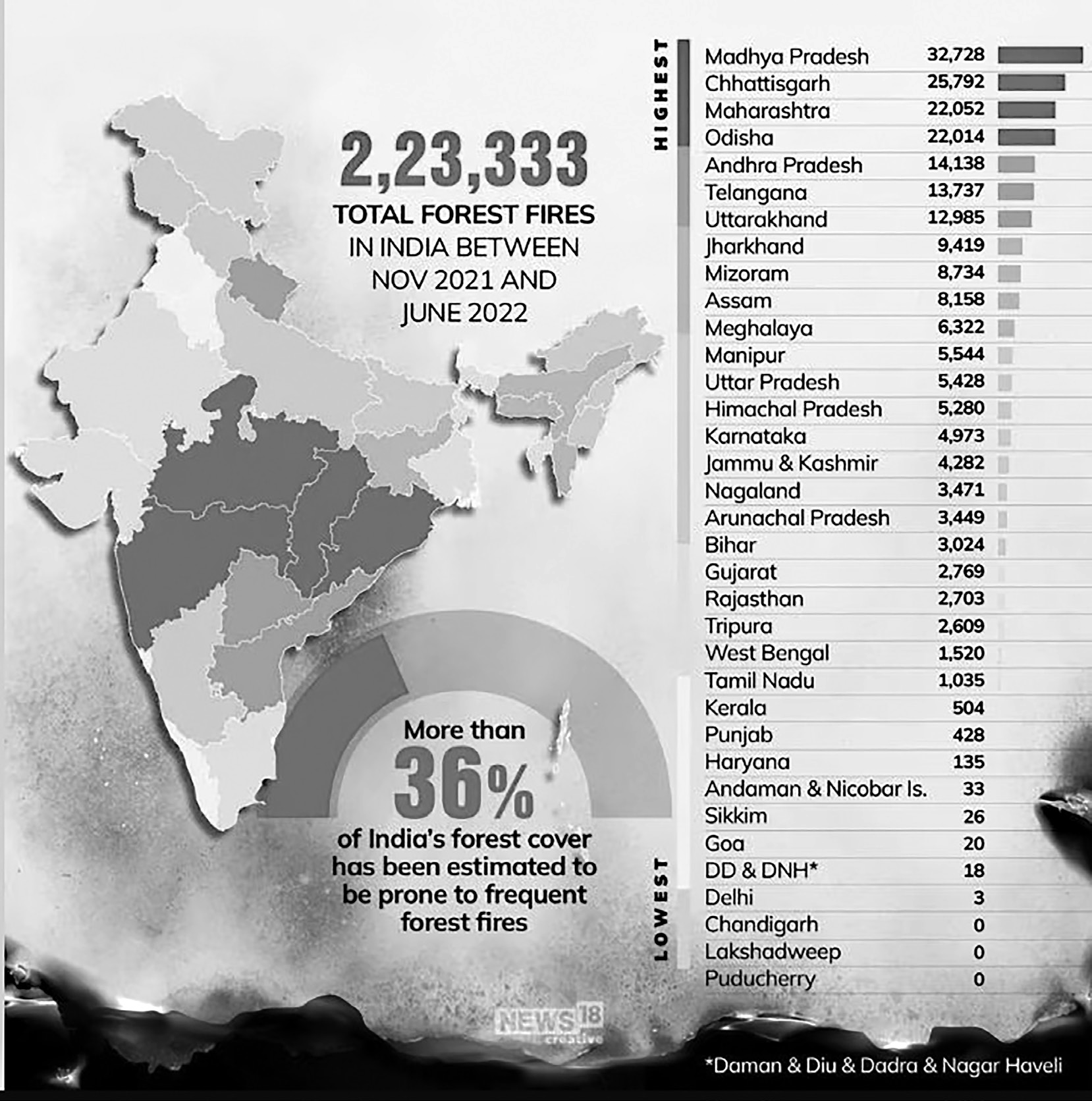
Figure: Forest Fires in 2021-22
Causes
• Forest fires are a common occurrence, especially during the summer months, and happen worldwide. They can be categorized into three main types:
• Naturally occurring or controlled fires that help maintain ecological balance.
• Fires triggered by human negligence, such as those caused by heat accumulation in dry leaves and vegetation during summer.
• Deliberate fires set by local communities, often intended to clear pine needles and encourage the growth of fresh grass, but these can quickly spiral out of control.
• Since such fires deplete the soil of micro nutrients and don’t help to enhance the green cover, villagers are being advised not to indulge in such reckless measures.
•
Many forest fires originate from natural phenomena such as lightning strikes, which can ignite trees. Historical records show instances of lightning-induced fires in India, southeastern and central United States, Australia, Finland, and parts of eastern and southern Africa.
• However, the majority of forest fires are caused by human negligence, such as carelessly discarding a lit bidi or cigarette butt, or an open fire left unattended by picnickers in dry forest conditions.
• These fires typically begin on the forest floor, as dry leaves and twigs ignite easily. If fueled by strong winds, the flames can rapidly spread, consuming large areas of forest and causing significant destruction unless brought under control in time.
Forest Fire Prone Areas Classification
• Forest Survey of India (FSI) has carried out a study based on spatial analysis of forest fires detected over the past 17 years (2004 to 2021), and have identified the fire prone forest areas in the country.
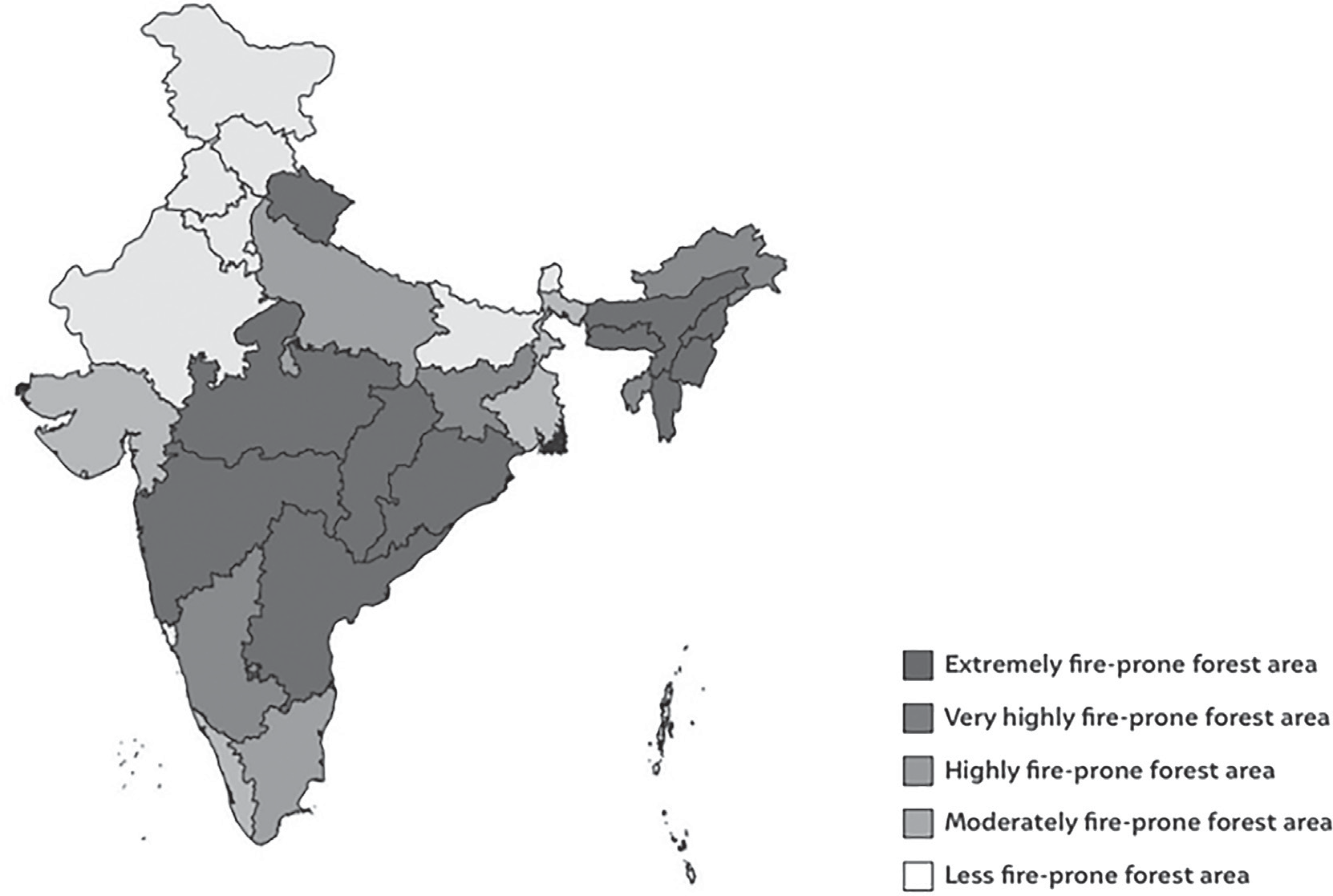
Map: Forest Fire Prone Areas in India
| Forest Survey of India (FSI) Classification of Forest Area into different Fire Prone Categories | |||
| S. No | Category | Forest Cover (in sq km) | % of total forest cove |
| 1 | Extremely Fire Prone | 20 074.47 | 2.81 |
| 2 | Very Highly Fire Prone | 56 049.35 | 7.85 |
| 3 | Highly Fire Prone | 82 900.1 7 | 11.61 |
| 4 | Moderately Fire Prone | 94,126.68 | 13.19 |
| 5 | Less Fire Prone | 4 60 638.36 | 64.54 |
| Total | 7,13, 789.03 | 100.00 |
Types of Forest Fire
Forest fires differ depending upon its nature, size, spreading speed, behaviour etc. basically this can be sub-grouped into four types depending upon their nature and size as follows:
• Underground Fire:
• Underground fires are low-intensity fires that consume organic material beneath the surface along with the litter on the forest floor. These fires are categorized as a subgroup of forest fires. In many dense forests, especially in the wetter regions of the Himalayas, a thick layer of organic matter accumulates above the mineral soil, making them susceptible to such fires.
• These fires spread entirely below the surface, burning a few meters underground at a slow pace, which makes them difficult to detect and control.
• Underground fires can persist for months, gradually consuming the soil’s vegetative cover. They are also
known as muck fires, and in some regions, they are referred to as ground fires.
• Surface Fires:
• Surface fires are the most common type of forest fires, burning undergrowth and dead vegetation along the forest floor. These fires are generally beneficial for forest regeneration and growth.
• However, if they intensify, they can consume ground flora, undergrowth, and even the middle layers of the forest, leading to significant damage.
• Surface fires spread through flaming combustion, igniting fuels at or near the surface, such as grass, fallen branches, dry leaves, forest needles, and debris from land clearing or harvesting activities.
• Ground Fires:
• Underground fires can smolder for a period before transforming into ground fires. These fires consume roots and other materials present on or beneath the
forest surface, including herbaceous growth and decaying organic matter.
• They cause more damage than surface fires, often leading to the complete destruction of vegetation. These fires occur in subsurface organic fuels such as duff layers under forest stands, Arctic tundra, taiga, and organic soils found in swamps or bogs.
• Ground fires spread beneath the surface through smoldering combustion and are usually ignited by surface fires. Due to their underground nature, controlling and extinguishing them is extremely challenging and requires significant effort.
• Crown Fires:
• Crown fires are highly unpredictable and spread rapidly, burning the upper canopy of trees with the help of strong winds.
• These fires are often ignited by surface fires, allowing the flames to move from treetop to treetop independently of the fire on the ground.
• In dense conifer forests, especially on steep slopes or flat terrain with strong winds, crown fires can spread swiftly, sometimes outpacing the surface fire below. This type of fire is one of the most dramatic and intense forest fires.
• Firestorms:
• Among the forest fires, the fires spreading most rapidly are the firestorm, which is an intense fire over a large area.
• As the fire burns, heat rises and air rushes in, causing the fire to grow. More air makes the fire spin violently like a storm.
Flames fly out from the base and burning embers spew out the top of the fiery twister, starting smaller fires around it. Temperatures inside these storms can reach around 2,000 degrees Fahrenheit