FIVE YEAR PLANS
The planning commission proposed that India should formulate a plan for a period of 5 years for its development and economic growth, known as the Five- Year Plan. Under the influence of then Prime Minister Pt Jawahar Lal Nehru, India established its first five-year plan inspired by the Soviet Union.
Till now, India has established twelve five-year plans. The first eight plans in India were focused on growing the public sector, but since the launch of the Ninth Plan, The focus has shifted towards making the government a growth facilitator.
Goals of Five-Year Plan
The main aim of the five-year plan is to remove the economic backwardness of the country and make India a developed economy. It also ensures that the weaker sections of the population benefit from economic progress.
The basic goals of five-year plans are:
Growth
The primary and foremost objective of any economic plan is economic growth. The growth implies:
• Either a large size of supporting services like banking and transport;
• Or a larger stock of productive capital;
• Or an increase in efficiency of productive capital & services.
Economic growth can be measured by the increase in the Gross Domestic Product (GDP) of the nation or country. GDP is the market value of all the goods & services produced in a country during a particular year. Higher GDP indicates that the general public can avail more benefits from the nation’s economic policies.
This economic growth takes place due to an increase in the production capacity of goods & services or due to an influx of capital into the economy. The GDP of the country is derived from various sectors, the basic sectors of an economy are: Agriculture, Industrial and Service sector, and every sector contribute to the composition of GDP. In some countries, the agricultural sector contributes more to the GDP, while in some countries, the service sector contributes more to the GDP.
Increase in share of service sector in GDP
By 1990, the share of the service sector was 40.59%, more than that of agriculture and industry. This phenomenon of growing share of the service sector was accelerated in post 1991 period, which marked the beginning of globalization in the country.
Modernisation
Modernisation refers to the incorporation of technology into the economy. It helps in raising the standard of living of people in society. Inventions, advancements and innovations in technology play a vital role in the growth of our economy and increasing its output. Modernisation includes:
Adopting New Technology: The main aim of modernisation is to increase the production of goods
& services by using new technology. For example, the introduction of technology in agriculture resulted in increased output, and over the years, the Indian economy has also witnessed a rise in the IT sector due to modernisation.
Change in Social Outlook: Modernisation also needs changes in social outlooks, such as women empowerment or providing equal rights to women. A society can be more prosperous or civilised if it uses the talent of women employees in the workplace.
Self-Reliance
Post-independence Indian economy became too reliant on imports, therefore, for seven editions of the five-year plan government encourages self-reliance. Self-reliance means anything that India is capable of manufacturing domestically will not be imported, especially food and agricultural products. In nutshell, self-reliance means development through domestic resources.
Self-reliance was encouraged due to two reasons:
• To reduce Foreign Dependence: As India recently got freedom from foreign control, it was necessary for India to become independent or self-reliant and reduce its dependency on foreign countries, especially for food or agricultural items.
• To avoid Foreign Interference: The government of India was afraid that dependency on foreign countries for food supplies, capital, & technology may increase foreign interference in the economic policies of the country.
EQUITY
The previous goals focus on the development of the economy only. But only economic development is not sufficient. The five-year plan must focus on the development of society also. It is necessary to make sure that all the members of society equally enjoy these benefits from the economy. This is where equity comes in. In addition to the previous three goals (growth, modernisation, and self-reliance), equity is also important. Equity concentrates on ensuring that all citizens of the nation have their basic needs for clothing, food and shelter properly met. It also tries to reduce the inequality and wealth gap in society. In short, equity aims at raising the standard of living of people and promoting social justice.
Planning Commission of India
Once the National Planning Committee published its report in 1949, there was a firm inclusion of the need for” ECONOMIC and SOCIAL PLANNING” in the constitution. Thus, the stage was set up for the formal launching of Planning Commission in the country. For the formal planning to begin, for the whole economy at the national level, there was a need for a permanent expert body that could take over the responsibility of the whole planning. Thus, on 15 March 1950, the Planning Commission was set up by the government by a cabinet resolution.
• It is an extra-constitutional body.
• It is an advisory body to the Government of India on an
array of issues of economic development.
• It is a “think tank” on economic development with the Prime Minister as its ex-officio Chairman and with the provision of a Deputy Chairman. The main function of the Deputy Commissioner was to coordinate the work of the commission.
• It had an open provision for the number of its members other than Six Union Cabinet Ministers as its ex-officio members and a Member Secretary. The minister of Planning is already an ex-officio member of the PC.
• The Planning Commission is chaired by the Prime Minister of India and Jawaharlal Nehru was the first chairman of the Planning Commission.
• Planning Commission was seated at the “Yojana Bhavan”, New Delhi. The commission had a staff of secretaries and advisers, and also a research organization.
• The planning commission was a technical body with experts and professionals coming from an array of specific areas as per the need of planning.
Functions of the Planning Commission
• Assess the country’s material, capital, and human
resources, as well as technical staff.
• Make a plan to use the country’s resources in the most
efficient and balanced way possible.
• On a determination of priorities, define the stages in which the plan should be carried out and the purpose of allocation of resources.
• Indicate the factors which are tending to retard
economic development, and determine the conditions.
• Determine the nature of the machinery which will be necessary for securing the successful implementation of each stage of the plan.
First five-year plan (1951 to 1956):
Jawaharlal Nehru, who was the prime minister during that time, unveiled the first five-year plan.
Raising the level of living for Indians was the main goal of the first five-year plan. This might be accomplished by wisely utilising India’s natural riches.
It was based on the Harrod-Domar Model.
Community Development Program launched in 1952.
Main focus was on agriculture, price stability, power and transport.
Enough money was also set aside for the industrial sector.
Furthermore, steps were done to support the expansion of small-scale industries.
Second Plan (1956 - 61)
Also called Mahalanobis Plan named after the well- known economist.
Its main emphasis was on quick industrialization. It promoted massive imports made possible by foreign borrowing. Far too soon, the primary focus shifted from agriculture to industry.
Five steel plants, including those in Bhilai, Jamshedpur, and Durgapur, were established in accordance with the second five-year plan. The Second Five-Year Plan saw the formation of hydroelectric power plants. The production of coal increased significantly.
The establishment of the Atomic Energy Commission took place in the course of the Second Five Year Plan. The Tata Institute of Fundamental Research was established in this same time frame.
Third Plan (1961 - 66)
When it was first proposed, the Indian economy was thought to be in its ascendancy. Making India a “self- reliant” and “self-generating” economy was, thus, its goal.
In order to support industry and exports, agriculture was given high priority based on the lessons learned from the first two plans.
Total failure to meet targets because of unanticipated circumstances, such as the Indo-Pak War (1965), the Chinese assault (1962), and the severe drought (1965–1966).
The states were given more prominence and their role grew. Boards for state electricity were established. Building roads fell under the purview of the state administrations.
Three Annual Plans (1966-69) Plan holiday for 3 years
Severe agricultural crisis and food shortages due to consecutive droughts in 1965–66 and 1966–67, forcing an immediate focus on food security rather than long-term growth targets.
After-effects of the Third Plan’s failures, particularly the inability to achieve self-sufficiency in foodgrains and industrial growth as expected.
External pressures, including the 1962 war with China and the 1965 war with Pakistan, which strained public finances and diverted resources to defence.
Macroeconomic instability, marked by high inflation, balance of payments stress, and dependence on food imports (notably PL-480).
Need for policy reorientation in agriculture, leading to the adoption of a new strategy based on High-Yielding Varieties (HYV), fertilisers, irrigation, and modern inputs, which required short-term, flexible planning rather than a rigid Five Year Plan
Fourth Plan (1969 - 74)
The “Garibi Hatao” slogan was announced in 1971.
In order to facilitate the advancement of other sectors, the growth rate of agriculture was highlighted.
The plan’s first two years saw record production. Because of the weak monsoon, the previous three years were lacking.
It was felt that foreign reserves were necessary. This promoted an increase in exports. A lot of emphasis was paid to import substitution. The industrial platform was expanded by each of these initiatives.
Pre- and post-Indo-Pak war (1971) Bangladeshi refugee inflow was a significant concern.
Fifth Plan (1974-79)
D.D. Dhar created and implemented the fifth plan.
It aimed to accomplish two primary goals: “eliminating poverty” (Garibi Hatao) and “achieving self-sufficiency.”
The promotion of rapid development, improved income distribution and a notable increase in the domestic savings rate were considered essential tools.
The plan was terminated in 1978 (instead of 1979) when Janata government came to power to power.
Rolling Plan (1978 - 80)
There were two sixth plans. The Janta Government presented a plan for the years 1978–1983. But the government was only in power for two years. When the Congress Government took back office in 1980, they implemented a new strategy.
Sixth Plan (1980 - 85)
Priorities: raising the country’s income, updating technology, guaranteeing a steady decline in unemployment and poverty, managing the population through family planning, etc.
The sixth five-year plan has changed a lot of things in India. On one hand it had improved the tourism industry in India and on the other hand it aimed at development in the Information Technology sector.
Under this Plan, the transport and communication system was also enhanced. During this period, the National Highways were completely constructed.
The depreciation of the Indian currency during this period resulted in a sharp rise in the number of foreign visitors to India, which aided in the country’s development as a tourism destination.
In India, economic liberalisation was implemented for the first time during this time.
In India, family planning was introduced for the first time.
Seventh Plan (1985- 90)
The main priorities are the quick rise in the production
of food grains, more job possibilities and productivity all within the bounds of the fundamental planning principles.
Special care was taken to spread education among girls, enhance telecommunication within the country. The government of India also strove to maintain a balance in the economy and by striking a balance within export and import.
First time the private sector gets priority over the public sector.
The plan was very successful, the economy recorded 6% growth rate against the targeted 5%.
Eighth Plan (1992- 97)
Focus on “Human Resource Development”.
At the start of the plan, the main concerns were inflation
during 1990–1991 and the balance of payments situation.
During this period only India received a coveted opportunity to become a member of the World Trade Organization on January 1st 1995.
The plan implemented stringent policy measures aimed at countering the adverse economic conditions and achieving an average yearly growth rate of 5.6%.
Some of the main economic outcomes during the eighth plan period were rapid economic growth, high growth of agriculture and allied sector, and manufacturing sector, growth in exports and imports, improvement in trade and current account deficit.
Ninth Plan (1997- 2002)
Aim was “Growth with Social Justice”.
It was created with consideration for four key factors: self-reliance, regional balance, the creation of productive jobs and quality of life.
Tenth Plan (2002- 2007)
The plan’s goal is to “Double the Per Capita Income”
over the following ten years.
Reduction of poverty ratio by 5 percentage points by 2007.
Offering high-quality, gainful work to those who join the labour force during the tenth plan period.
Reduction in gender gaps in literacy and wage rates by at least 50% by 2007.
Increase in literacy rate to 72% within the plan period to 80% by 2012.
Cleaning of all major polluted rivers by 2007 and other notified stretches by 2012.
Eleventh Plan (2007- 2012)
It focuses on “Faster and more Inclusive Growth”.
It was prepared by C Rangarajan.
It aims to accelerate GDP growth from 8% to 10%. Increase agricultural GDP growth rate to 4% per year.
It aims to create 70 million new work opportunities and reduce educated unemployment to below 5%.
It aims to connect every village by telephone and provide broadband connectivity to all villages.
It aims to ensure direct and indirect beneficiaries of all government schemes are women and girl children.
Twelfth Plan (2012- 17)
The Twelfth Plan focuses on “Faster and more Inclusive and Sustainable Growth”.
The rate of poverty will be 10% lower than it was at the conclusion of the eleventh plan.
Close the social and gender gaps in school enrollment.
Cut children’s undernutrition in the 0–3 age group to half
of NFHS-3 levels.
Expand the amount of green space by one million hectares annually.
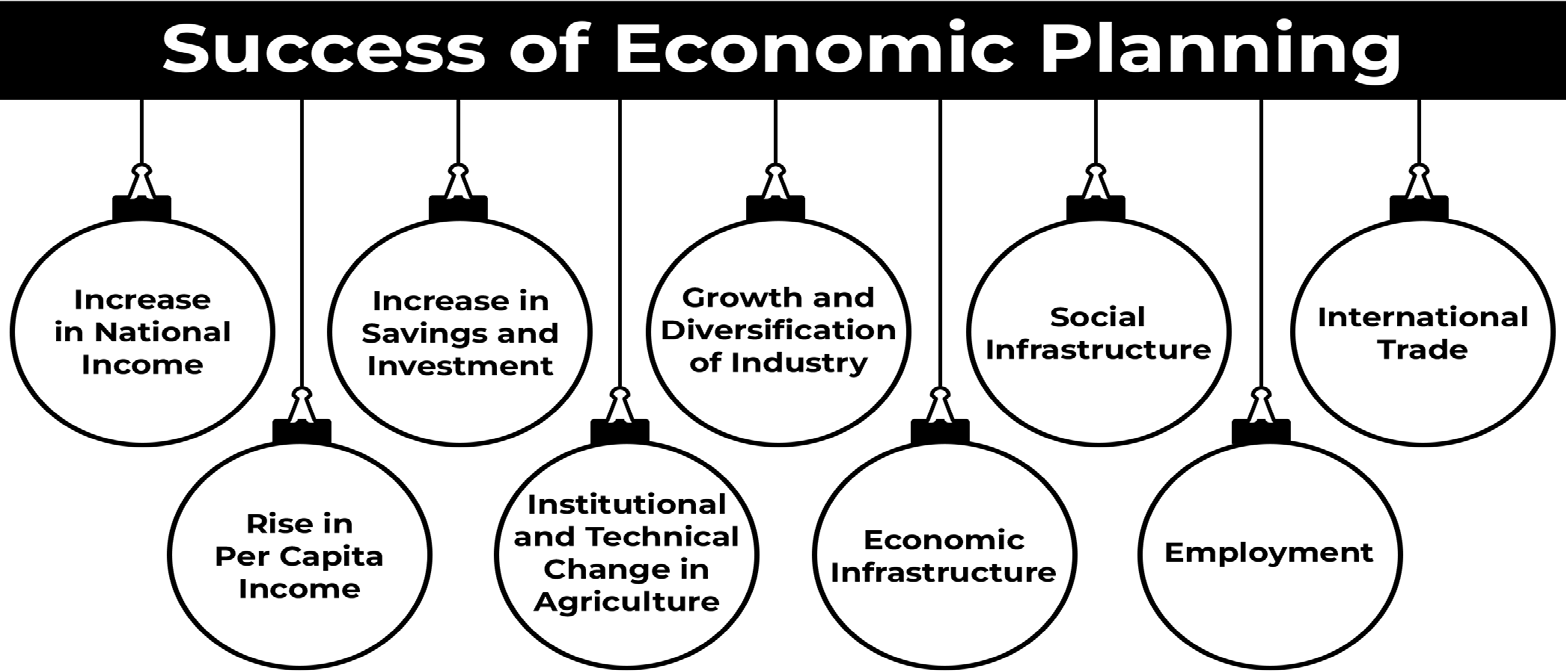
Achievements of the Five-Year Plans
Increase in National Income: India’s national income grew by 0.5% annually before planning. India’s average yearly growth rate has been around 5% during the planning period.
The rise in per capita income during the planning period:
The annual per capita income growth rate was 2.9%.
Institutional and technical advancements in agricultural planning have significantly contributed to the growth of agriculture in our nation. The average annual growth rate of agricultural output was 2.8% during the planning period.
Industry expansion and diversification: During the planned period, the growth rate of industrial production was roughly 7% annually. Industries producing capital and essential goods have expanded significantly. The nation became independent in the consumer products sector. The industrial sector has evolved and been modernized.
Economic and social infrastructure: During the planning phase, financial and insurance infrastructure, as well as transportation and communication infrastructure, irrigation, and power infrastructure, grew significantly. Facilities for health and education have saw a tremendous increase.
Increased job prospects were the focus of targeted efforts throughout the plan period. The government set a goal of 58 million employees in the eleventh five-year plan.
Foreign trade: India’s trading abroad has also expanded astronomically. The value of international commerce in 1948–1949 was Rs. 792 crores. It was Rs. 38,11,422 crores in 2011–2012.
Therefore, we may conclude that during the plan period, our economy made significant improvement.
Major Failures of National Planning Commission
The National Planning Commission (NPC) of India was constituted on the 15th of March 1950. The NPC was founded by a Resolution of the Government of India as an advisory and a specialized institution. It was an extra-constitutional, non-statutory and advisory body. The Commission has effectively played an important role in India’s rejuvenation from the reins of the British to an independent nation with ambitious developmental goals.
In 2014 however, the NPC was replaced by the Niti Aayog a more vibrant organization compared to the NPC. It aims at achieving goals of sustainable development by adopting cooperative federalism thereby enhancing the
participation of the states in the developmental activities of the nation.
Despite the many developmental goals fulfilled by the NPC, the body has been accused of a lot of criticisms. The Commission has often been criticized for being a soviet styled-bureaucratic body that stifled the economic growth of the country.
The actual growth rate of the Indian economy was much less compared to the targeted rate of growth. Barring the First and the Sixth Five Year Plans, the actual rate of growth remained way below the aimed growth rates of GNP and per capita income. There was a gap between the aimed target and the actual growth rate which is
4.4% against the 5% targeted growth rate. This difference between the target growth rate and the achieved growth rate portrays the failure of the Five-Year Plans. India continues to be one of the poorest nations even today despite 50 years of economic planning.
Failure to Eliminate Poverty: Poverty is one of the major impediments which continue to haunt India. More than a quarter of the population in the rural areas which is 25.7 percent live below the poverty line. In the urban areas, the situation is a little better than the rural areas where
13.7 percent of the population live below the poverty line. Altogether about 22 percent of the Indian population is carrying out their livelihood while sustaining themselves below the poverty line. Despite numerous schemes launched by the Planning Commission via the Five Year Plans the problem of poverty has not been eliminated properly.
Failure to reduce inequality of income and wealth: Throughout the planning period, the rich have turned richer while the poor have become poorer. Even though the incidence of poverty went down to some extent, the incidence of inequality increased significantly owing to the concentration of wealth in the hands of a few wealthy people. India’s richest 1 percent acquired about 73% of the country’s total wealth according to a survey by the International Rights group Oxfam while 67 crore Indians which comprise the population’s poorest lot saw an average increase in their wealth by only 1%. This can be attributed significantly to the increase in the prices of essential goods, inflation which has favored the rich but deprived the poor.
Regional imbalance: The five-year plans aggravated the gap between the states furthermore. A lot of changes were expected from the Planning Commission concerning developmental activities, but instead, it emphasized more on macro, sectoral, economic and national aspects while it lacked the regional thrust. This has led to an unequal distribution of resources between the states. The backward areas continue to be neglected and underdeveloped while the metropolis has seen a surge of developmental activities.
Failure to Implement Land Reforms: Land reform measures have been largely neglected by the five-year Plans. The policy decisions of transferring ownership of land to the peasantry were not implemented properly. The government was not eager to implement these measures which aimed at progressive agriculture and socialism this led to the alienation of a large number of peasants and brought them more hardship.
Inability to Check the flow of Black Money: For several reasons, there has been a concentration of a large amount of black money with a section of the wealthy population. These people have misused the available resources and indulged in illegal activities, which has also led to the misallocation of resources. The schemes adopted to check the concentration of black money have also failed to serve their purpose
National Development Council (NDC)
• The Prime Minister chairs the National Development Council (NDC), also known as the Rashtriya Vikas Parishad, which is India’s premier council for development decision-making and deliberation. The National Development Council is one of India’s most important planning systems. It represents the federal approach to planning and serves as a check to ensure that the planning system is really national in scope.
Powers, Functions and Responsibilities of NDC
• The Council was formed in October 1967, following the recommendations of the Administrative Reforms Commission, and its powers were redefined to include:
• Establishing guidelines for the creation of the National Plan, which encompass resource evaluations and the National Plan as formulated by the National Development Council
• Examining important social and economic policy
matters that affect the development of the country.
• Periodically assess the Plan’s functioning and suggest any actions required to meet its goals and objectives, which include guaranteeing people’s active involvement and cooperation, enhancing the effectiveness of administrative services, ensuring the community’s less developed areas and sections receive the fullest development, and through equally sharing sacrifices from all citizens.
• The National Development Council was tasked with advising and recommending policies to the state and federal governments.
• It has served as a high-powered consultative group from its formation, where the framework of the Five- Year Plans, the major problems facing the Indian economy and the policies that must be enacted to address the important problems have all been discussed and solutions reached.
• As a result, in addition to the Plan, the Council has focused on issues such as food, the establishment of the State Trading Corporation, and land reforms.
• The NDC chairman (chairman of National Development Council) or the Council’s primary role is to serve as a link between the Union government, the Planning Commission, and state governments.
It aids in the coordination of not only policies and plans, but also other issues of national significance. It gives a good forum for discussion and a free and open sharing of views