OVERVIEW
India’s food processing sector is a sunrise sector that has gained more prominence in recent years. Major processed food products exported from India include processed fruits and juices, pulses, guar gum, groundnuts, milled products, cereals preparations, oil meals and alcoholic beverages.
The Indian food processing industry is among the largest in the nation in terms of growth, production, consumption and exports. The industry produces several food products such as meat, poultry, fisheries, fruits, vegetables, spices, milk and milk products, alcoholic beverages, plantations and grains. It also manufactures cocoa products and chocolates, confectionery, mineral water, soya-based items and high-protein foods. Since liberalisation of economy in 1991, the government proposed and accepted multiple projects, for instance, creating foreign collaborations, joint ventures, 100% export-oriented units and industrial licenses to encourage growth and investment in the food processing industry.Food processing industry exports- USD 10.07 billion in 2024–25 with employment in 2.23 million workers in registered units. Employment increased from Rs. 17.73 lakh in 2014-15 to Rs. 20.68 lakh in 2021-22.
GVA has increased from Rs. 1.61 lakh crore in 2015-16 to
Rs. 1.92 lakh crore in 2022-23
Average annual growth rate (AAGR) of around 5.35% for 8 years until 2022-23.
USD 7.33 billion FDI equity inflow in the last one decade
in food processing sector. (World Food India 2025).
Percentage share of processed food export in agri-food export is increased to 23.4% in 2022-23 from 13.7% in 2014- 15.
Value of processed food export is Rs. 10,881.81 in 2022-23.
Indian food processing market size reached Rs. 30,49,800 crore (US$ 354.5 billion) in 2024 and is expected to grow to Rs. 4,584,415 crore (US$ 535 billion) by the end of FY-26.
The food processing sector contributes 7.9% to manufacturing GVA and 8% to agriculture GVA, while accounting for 13% of India’s exports and 6% of industrial investment, with processed food forming 20.4% of agri- exports.
According to the Viksit Bharat@2047 report, India's food processing sector will grow significantly, reaching US$ 1,100 billion by FY35, US$ 1,500 billion by FY40, US$ 1,900 billion by FY45, and US$ 2,150 billion by FY47.
From April 2000-December 2025, the food processing sector attracted Rs. 1,10 lakh crore (US$ 15.86 billion) FDI equity inflows.
India is largest producer of milk, onions and pulses, second largest producer of rice, wheat, sugarcane, tea, fruits & vegetables and eggs.
Food Processing Industry in India
The rise in the preference for processed food is driven by two worldwide consumer megatrends
The increasing demand for convenience
A growing emphasis on health and wellness.

Industry Segments
The food processing industry in India is made up of 5 segments including grains, cereals and pulses, fruits and vegetables, meat and poultry, dairy products and processed foods.
• Grains, cereals, and pulses: India is the largest producer of rice, wheat, and other grains including corn, sorghum, and millets in the world. India has a substantial grain processing sector with the majority of the nation’s grain production going towards food processing. The industry comprises the processing of cereals and pulses into many forms, such as flakes, puffed cereals, and ready-to-eat snacks, as well as the milling of grains to generate flour, rice, and other products.
• Fruits and vegetables: India is a significant producer of a variety of fruits and vegetables, with the industry making up around 28% of the nation’s overall agricultural output. These items are highly perishable and have a limited shelf life, hence the food processing industry is essential in processing and preserving them. The sector includes the preparation of fruit and vegetable juices, jams, and pickles, as well as the processing of fresh and frozen fruits and vegetables.
• Meat and poultry: India is a major producer of beef, mutton, and poultry, and the country’s meat and poultry industries are expanding quickly. These items, which include the manufacturing of frozen meat, meat products, and poultry products, are processed and preserved with the help of the food processing sector.
• Dairy products: India is the world’s largest producer of milk, and the dairy sector is a significant part of the nation’s food processing business. The industry involves the transformation of milk into a variety of dairy products, including butter, cheese, yoghurt, and others.
• Processed foods: In India, the processed food sector produces a wide variety of food items, including convenience foods, ready-to-eat meals, and snacks. The industry is supported by a robust supply chain that comprises primary processors and food processing companies.
Exports in the Indian Food Processing Industry
During 2011-12 to 2020-21, the export of goods under the Ready to Eat (RTE), Ready to Cook (RTC), and Ready to Serve (RTS) divisions saw a CAGR of 10.4%. India exported finished food goods worth more than US$ 2.14 billion in 2020-21. The United States, the United Arab Emirates, Nepal and Malaysia are the top destination for these foods from India.
What is Food Processing?
Since humans have been processing food since ancient times, the food processing industries are nothing new. For longer food storage, they employed fermentation, sun
drying, and salts. The food processing industry still does the same thing today, but with the aid of improved food preservative chemicals and cutting-edge technology like butylated hydroxytoluene (BHT), butylated hydroxy anisole (BHA), calcium propionate, etc.
Food processing can be separated into two categories: primary and secondary products. Primary products are made from raw materials and include things like fruits and vegetables. Secondary products are made from primary food products and include things like sauces, butter, jams, and other items that are processed from primary food products to create new ones. Food processing is done to extend the shelf life of primary food products so they stay fresher for longer periods of time and to create new products out of them. This sector can operate on a large or small scale from home hence these industries can be clustered or decentralised.
Importance of Food Processing Industries (FPI)
Abundant Raw Materials: India is a wealthy country that depends heavily on agriculture, employing over 50% of its workforce in this industry. India therefore possesses an abundance of raw materials for the food processing industry.
Value Addition: FPI transforms raw agricultural products into processed foods, increasing their value.
Economic Growth: According to the Minister of Food Processing in 2020–2021, the food processing industry accounts for 12.8% of India’s GDP.
Reduced Food Waste: Food processing techniques help minimize food spoilage and wastage.
Enhanced Exports: Processed food has a longer shelf life, which makes it easier to export to other countries.
Increased Farmer Income: FPIs can create a direct market for farmers’ produce, potentially increasing their income.
Scope of Food Processing Industries in India
Large Domestic Market: India boasts the world’s 6th
largest food and grocery market, with 70% retail sales.
FDI Attraction: FPI attracted significant foreign investment with $709.72 million equity FDI between April 2021 and March 2022, totaling $11.51 billion overall.
Strong Agricultural Base: India is a leading producer of various agricultural goods like milk, spices, fruits, and vegetables, providing a solid foundation for FPI.
Export Potential: FPI facilitates processing and export of food products like spices (valued at $4 billion in FY 2021) due to their extended shelf life and easier transportation.
Diverse Climate and Geography: India’s varied climate and soil types enable year-round production of a wide variety of food items.
Growing Demand: Rising population necessitates a
corresponding growth in FPI to meet the increasing demand for food products.
Investment Opportunities: Government initiatives to improve FPI infrastructure present lucrative investment prospects.
Location of Food processing industries (FPI) in India
Food Processing Industries (FPIs) are spread across various parts of India, including Gujarat, Maharashtra, Andhra Pradesh, Kerala, Punjab, Uttar Pradesh, and West Bengal. Due to the accessibility of raw materials and the ease of transportation, the FPIs in India are primarily found in the coastal states. There are about 37,175 registered processing industries in India, according to data from the Ministry of Food Processing and the ASI (Annual Survey of India).
Challenges for FPI in India
Climate: It is a well-known fact that many Indian farmers experience crop loss each year as a result of unfavourable weather, which leaves the food processing industries with a shortage of raw materials.
Lack of technology: In order to increase efficiency, the food processing industries still need to adopt cutting- edge technology.
Infrastructure: It is challenging to move food items from one location to another when there is inadequate infrastructure.
Food Standards: Food processing businesses are required to meet all of the national food standards that apply to consumable foods. Nevertheless, India lacks the laboratories necessary to verify that these food products meet the required standards.
Government Initiatives
National Mission on Food Processing (2012): Launched by the Ministry of Food Processing Industries, this program aims to expand, improve existing food processing facilities, provide adequate oversight and monitoring for those that already existed.
Food Processing Vision 2015: This initiative focuses on establishing new food processing units to increase production capacity and improve the existing ones.
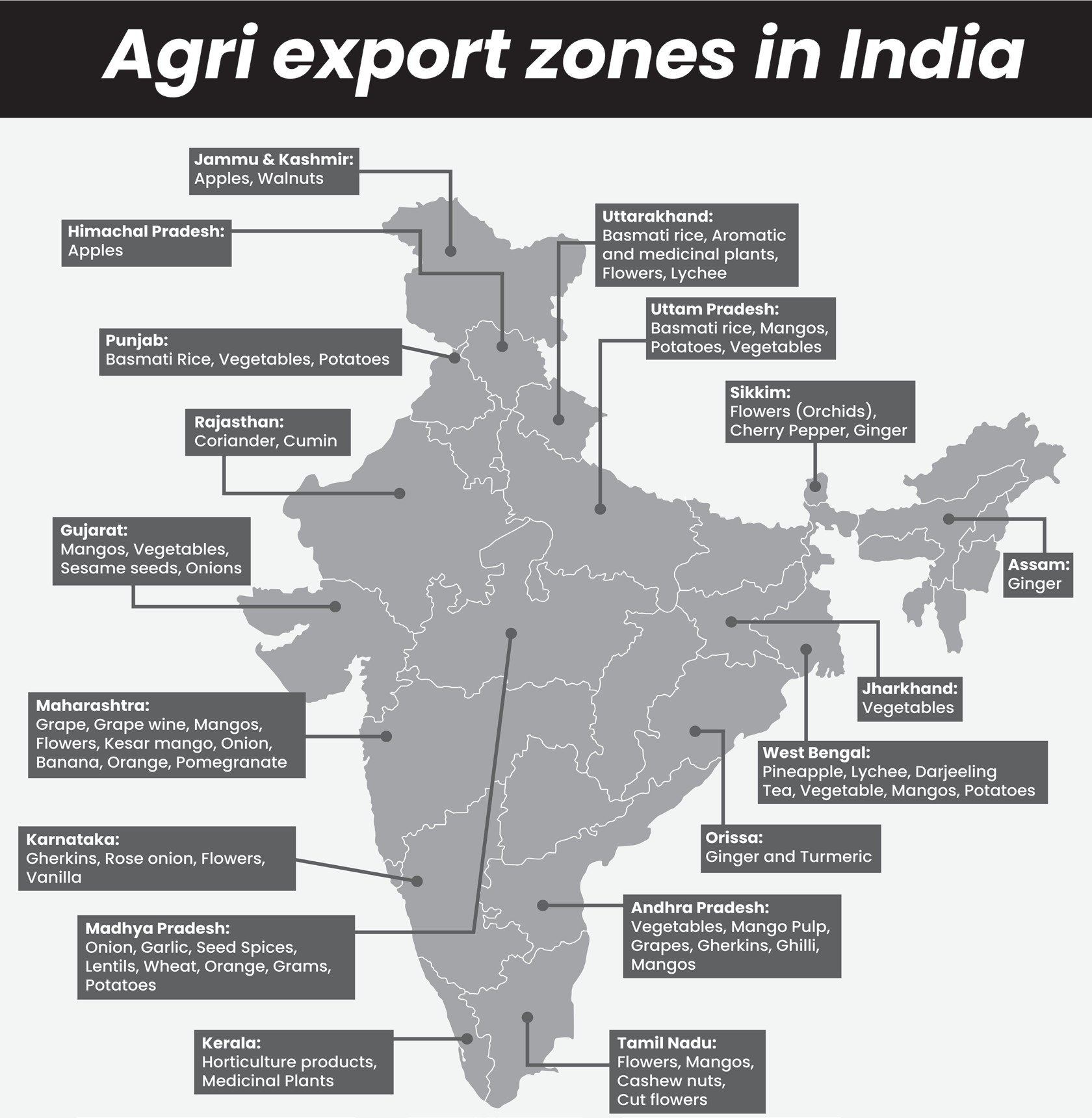
Agri Export Zones (AEZs): These zones provide dedicated infrastructure and support for food processing companies targeting exports. The government of India has recently approved 60 AEZs covering roughly 40 agricultural commodities in various locations. By fortifying all backward links with a market-oriented approach, this zone serves the export needs of India’s food processing industries and fosters healthy competition both domestically and internationally.
Exemption from Licensing: Processed food items are exempted from licensing under the Industries (Development and Regulation) Act, 1951, easing regulatory burdens for businesses.
Foreign Direct Investment (FDI): 100% FDI is permitted through an automatic route for the food processing sector, with additional provisions for trading in food products produced in India.
Lower GST Rates: More than 70% of food products fall under lower tax slabs of 0% & 5%, encouraging production and consumption within the sector.
Fiscal Incentives for MSMEs: MSMEs in the food processing sector receive fiscal benefits such as capital subsidies, tax rebates, and reduced customs and excise duties.
Priority Sector Lending (PSL): Food and agro-based processing units, along with cold chain infrastructure, have been categorized as priority sectors for lending.
Operation Green: Subsidies are provided for processing, transformation, and cold storage of select vegetables to ensure year-round availability at reasonable prices.
Nivesh Bandhu – Investors’ Portal: A portal that provides information on government policies and incentives for the food processing sector.
Agriculture Infrastructure Fund: Banks and NBFCs are providing loans worth 1 lakh crores for post-harvest management infrastructure such as warehouses and cold storage facilities.
Pradhan Mantri Kisan Sampada Yojana (PMKSY): A centrally sponsored scheme, Pradhan Mantri Kisan SAMPADA (Scheme for Agro-Marine Processing and Development of Agro-Processing Clusters) Yojana is a comprehensive package which will result in the creation of modern infrastructure and efficient supply chain management from the farm gate to the retail outlet. Initially allocated Rs. 6,000 crore for the 2016-20 period (extended to 2020-21) under the 14th Finance Commission cycle, it has been restructured for the 15th Finance Commission cycle with Rs. 4,600 crore. It will help deliver greater returns to the farmers’ income, creating huge employment opportunities, particularly in rural regions, reducing agricultural waste, raising processing levels, and enhancing the export of processed foods. The following schemes subsumed under PM Kisan SAMPADA Yojana
₹ 6,520 crore allocation under the 15th Finance Commission cycle, including additional ₹ 1, 920 crores under PMKSY upto 16.01.2026
• Mega Food Parks: It aims to link agricultural production to the market by bringing together farmers, processors, and retailers. These parks maximize value addition, minimize wastage, increase farmers’ income, and create employment opportunities, particularly in rural areas. Each Mega Food Park includes supply chain infrastructure such as collection centers, processing centers, cold chain facilities, and food processing units.
• Integrated Cold Chain and Value Addition Infrastructure
• Creation/ Expansion of Food Processing/ Preservation Capacities (Unit Scheme)
• Infrastructure for Agro-processing Clusters
• Creation of Backward and Forward Linkages
• Food Safety and Quality Assurance Infrastructure
• Human Resources and Institutions
Production Linked Incentive Scheme for Food Processing Industry (PLISFPI): The Production Linked Incentive Scheme for Food Processing Industry (PLISFPI), a central sector scheme has been allocated a financial outlay of Rs. 10,900 crore for the period of 2021-22 to 2026-27. It aims to assist the emergence of global food manufacturing champions commensurate with India’s natural resource endowment and to encourage Indian brands of food products in foreign markets. By 2026- 27, the scheme’s implementation would enable an increase in processing capacity, resulting in a processed food output of US$ 4.07 billion (Rs. 33,494 crore) and the creation of roughly
2.5 lakh jobs.
PM Formalisation of Micro Food Processing Enterprises Scheme
Launched in 2020 under the Atmanirbhar Bharat Abhiyaan, this centrally sponsored scheme aims to formalize and upgrade existing micro-enterprises in the unorganized food processing sector. Beneficiaries include Individual micro- processing units, SHGs involved in food processing, Farmer Producer Organizations (FPOs), Cooperatives, State agencies and private entrepreneurs for common infrastructure.
Objectives
Formalization of micro food processing units
Financial assistance to individuals for up-gradation of units
Training and technical knowledge
Financial assistance to groups for the common infrastructure
Branding and marketing support
Support and assistance to avail loans and prepare detailed project reports (DPRs)
Financial Assistance
Individuals: Up to Rs.10 lakh credit-linked subsidy for unit upgradation.
• Self-Help Groups (SHGs): Rs.40,000 seed capital per member for working capital and small tools purchase.
• Groups (FPOs, Cooperatives)
• 30% credit-linked grant for capital investment along the food processing value chain.
• 35% credit-linked grant for common infrastructure
development (warehouses, cold storage).
The One District One Product approach
An initiative of the Ministry of Food Processing Industries (MoFPI) under which various states in the country will be required to identify one product per district based on existing clusters and the availability of raw material. Assistance in the form of common infrastructure facilities and branding & marketing support will be preferably given to micro food processing enterprises following the ODOP approach. However, other existing units would also be supported.
Negotiable Warehouse Receipt
• Negotiable Warehouse Receipt (NWR) system in the country enables farmers to store their produce for safe and scientific storage and preservation in warehouses near their farms and to seek pledge loan from banks against the NWRs issued against deposit of their stock. Hence, the NWR help the farmers to avoid distress sales of agricultural produce during the peak marketing season and to avoid the post-harvest storage loss. Warehousing Development and Regulatory Authority (WDRA), Government of India ensures implementation
of the NWR as per the provisions of the Warehousing (Development & Regulation) Act, 2007.
Moving to Electronic Warehouse Receipts (e-NWRs): In the past, Warehouse Receipts (NWRs) were issued on paper, leading to security concerns. These paper NWRs could be damaged, forged, or even issued multiple times for the same stock. Additionally, some warehouses might have issued fake NWRs without proper registration. In 2018 e-NWRs were introduced which are stored securely in a central repository, minimizing the risk of fraud.
All information about an e-NWR is readily available, ensuring transparency. The validity of e-NWRs automatically expires after a set time or when goods are withdrawn from the warehouse. Furthermore, e-NWRs can be easily traded on online platforms, and the system prevents the same e-NWR from being used for multiple transactions simultaneously.
Food Safety Standards in India
The Food Safety and Standards Authority of India (FSSAI) was established in 2006 under the Food Safety and Standards Act, 2006 to ensure the safety and quality of food in India. It sets science-based standards for food production, storage, distribution, and sale. The FSSAI is overseen by the Ministry of Health & Family Welfare.
The FSSAI Act lays down science-based standards for articles of food and to regulate their manufacture, storage, distribution, sale and import, to ensure availability of safe and wholesome food for human consumption and for matters connected therewith or incidental thereto