Fourth Industrial Revolution
The concept of the Fourth Industrial Revolution was coined in 2016 by Klaus Schwab, the founder of the World Economic Forum.
“The Fourth Industrial Revolution creates a world in which virtual and physical systems of manufacturing cooperate with each other in a flexible way at the global level”. The Fourth Industrial Revolution, however, is not only about smart and connected machines and systems. Its scope is much wider. Occurring simultaneously are waves of further breakthroughs in areas ranging from gene sequencing to nanotechnology, from renewable energies to quantum computing. It is the fusion of these technologies and their interaction across the physical, digital and biological domains that make the Fourth Industrial Revolution fundamentally different from previous revolutions.
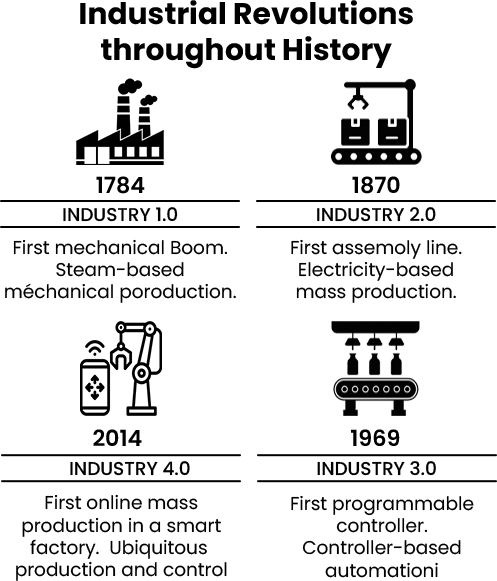
First Industrial Revolution: It occurred at the end of the 18th century, in 1784, when steam was harnessed for mechanical production. The invention of the first mechanised loom was a watershed.
Second Industrial Revolution: In 1870, mass production powered by electricity was first introduced. The assembly line was invented and the industrial sector speeded up exponentially.
Third Industrial Revolution: In 1969, advances in computing led to machine programming, which opened the door to progressive automation.
Technologies of the Fourth Industrial Revolution
Artificial Intelligence is set to be one of the key technologies in the sweeping transformation of the economy, society and the labour market.
Internet of things: Internet of things technology, which is designed to establish a connection between the physical and digital worlds, has revolutionised numerous sectors. In fact, billions of devices are already interconnected and more and more devices are becoming smart.
Cobots: Robotics is constantly evolving and the cobots, specially designed to interact physically with humans in collaborative environments, will be key to industry. Among other things, they optimise production and save employees from doing monotonous and dangerous tasks.
Augmented reality and virtual reality: Augmented reality and virtual reality, technologies that combine the real world and the digital world using computer science, enrich the visual experience of both users and consumers by generating immersive experiences.
Big data: Information is power. The full-blown Fourth
Industrial Revolution will allow us to change data into information. Big data allows massive data management and interpretation for business purposes, which is particularly relevant when devising business strategies or making decisions.
3D and 4D printing: These days we have the means to develop prototypes or products for sale quickly, accurately and economically with 3D and 4D printing. This technology is becoming increasingly important in design, architecture, engineering, etc.
Effects and Advantages of the Fourth Technological Revolution
All revolutions have benefits and drawbacks, challenges and opportunities, uncertainties and certainties. In the case of the Fourth Industrial Revolution, the advantages are evident: increased productivity, efficiency and quality in processes, greater safety for workers by reducing jobs in dangerous environments, enhanced decision making with data-based tools, improved competitiveness by developing customised products that satisfy consumers’ needs, etc.
As far as the drawbacks are concerned, the experts point to many: the dizzying speed of change and the need to adapt, burgeoning cyber risks that force us to ramp up cybersecurity, high dependence on technology and the so-called digital gap, lack of qualified staff, etc. Regarding the latter, it is worth remembering that the deep impact of Industry 4.0 on employment is one of the biggest challenges for the Fourth Industrial Revolution. At the start of the process, a McKinsey Global report confirmed that up to 800 million jobs will have disappeared by 2030 as a result of automation. However, this may also be an opportunity, because, as novel technologies emerge, so will new professions that will create millions of jobs in new sectors.