Geosynchronous Transfer Orbit (GTO)

After lift-off, a launch vehicle makes its way to space following a path shown by the yellow line, in the figure. At the target destination, the rocket releases the payload which sets it off on an elliptical orbit, following the blue line which sends the payload farther away from Earth. The point farthest away from the Earth on the blue elliptical orbit is called the apogee and the point closest is called the perigee.
When the payload reaches the apogee at the GEO altitude of 35 786 km, it fires its engines in such a way that it enters onto the circular GEO orbit and stays there, shown by the red line in the diagram. So, specifically, the GTO is the blue path from the yellow orbit to the red orbit.
A transfer orbit is a HEO, geosynchronous with perigee = 300- 400 km and apogee = 36000 km to 38000 km
This orbit is used for initial launch of a communication satellite or a spacecraft
This orbit is used by space agencies to manoeuvre a satellite for various applications.
India used GTO in case of Mangalyaan.
Geo Centric Phase
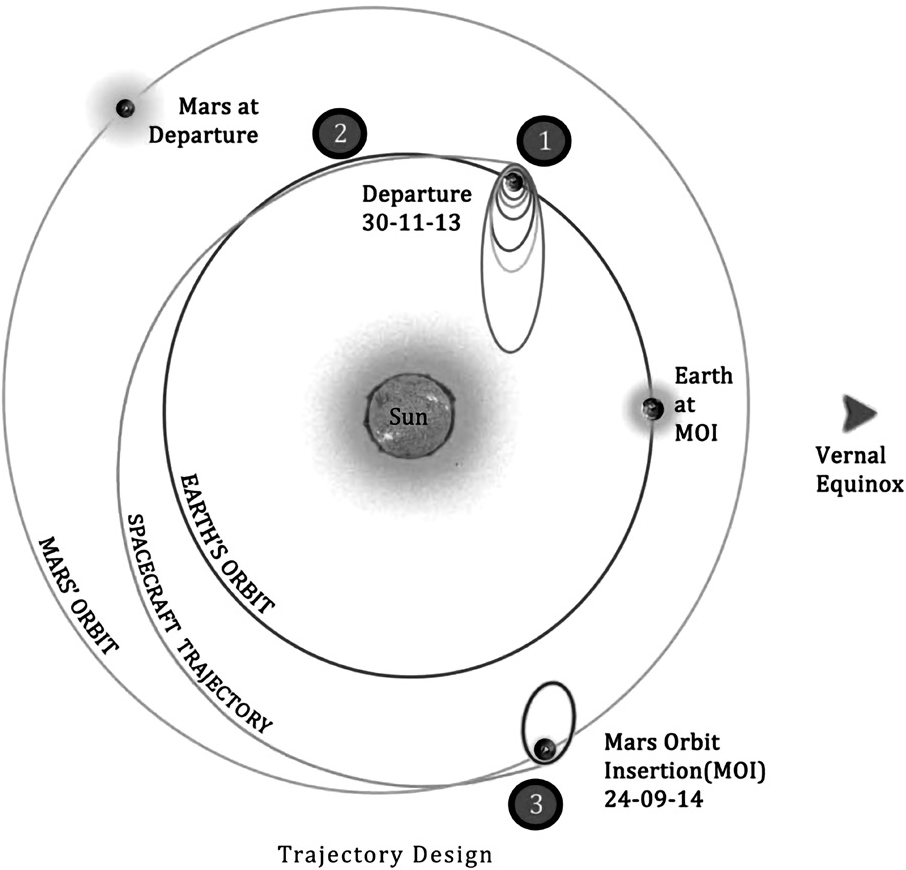
The spacecraft was injected into an Elliptic Parking Orbit by the launcher. With six main engine burns, the spacecraft is gradually maneuverered into a departure hyperbolic trajectory with which it escapes from the Earth’s Sphere of
Influence (SOI) with Earth’s orbital velocity + V boost. The SOI of earth ends at 918347 km from the surface of the earth beyond which the perturbing force on the orbiter is mainly due to the Sun. One primary concern was how to get the spacecraft to Mars, on the least amount of fuel. ISRO used a method of travel called a Hohmann Transfer Orbit – or a Minimum Energy Transfer Orbit – to send a spacecraft from Earth to Mars with the least amount of fuel possible.
Helio-Centric Phase
The spacecraft left Earth in a direction tangential to Earth’s orbit and encountered Mars tangentially to its orbit. The flight path was roughly one half of an ellipse around sun. Eventually it intersected the orbit of Mars at the exact moment when Mars was there too. This trajectory became possible with certain allowances when the relative position of Earth, Mars and Sun formed an angle of approximately
440. Such an arrangement recurs periodically at intervals of about 780 days. Minimum energy opportunities for Earth- Mars occurred in November 2013, January 2016, May2018 etc.
Martian Phase
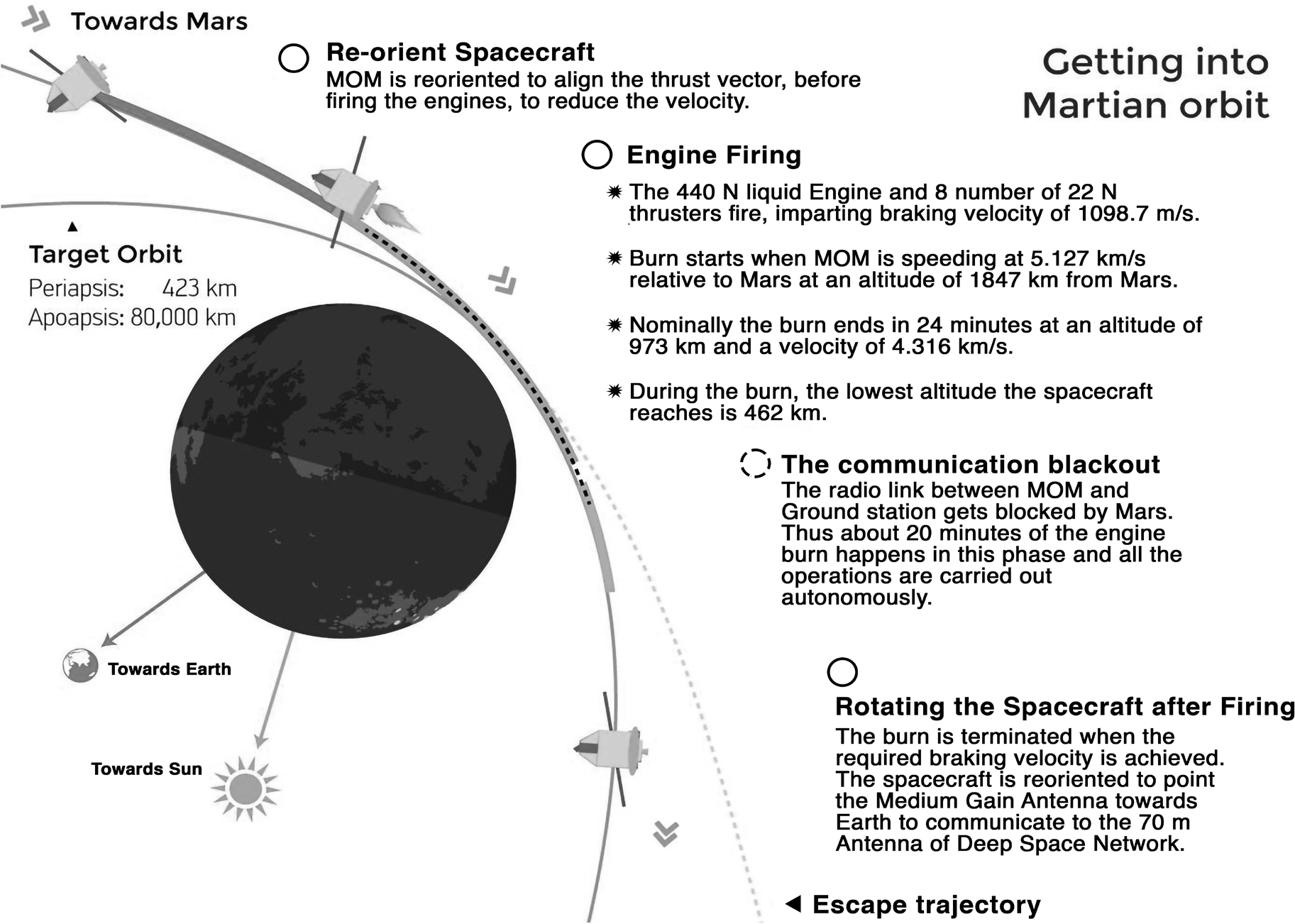
The spacecraft arrived at the Mars Sphere of Influence (around 573473 km from the surface of Mars) in a hyperbolic trajectory. At the time the spacecraft reached the closest approach to Mars (Periapsis), it was captured into planned orbit around mars by imparting ∆V retro which is called the Mars Orbit Insertion (MOI) manoeuvre. The Earth-Mars trajectory is shown in the above figure. ISRO launched the Mars Orbiter Mission during the November 2013 window utilizing minimum energy transfer opportunity.