HUMAYUN (1530- 1540; 1555-1556)
Succession and Challenges
• Following Babur’s death in 1530, his son Humayun ascended the Mughal throne.
• Despite his name meaning “fortune,” Humayun’s rule was marked by significant challenges, earning him the moniker of the most unfortunate ruler of the Mughal Empire.
• Unlike his military-inclined father, Humayun was more of a scholar than a soldier.
Weak Financial System and Afghan Threat
• Humayun grappled with a weak financial structure and the growing threat of predatory Afghans, particularly Sher Khan (later Sher Shah), who consolidated power in regions like Bihar and Uttar Pradesh.
Conflict with Bahadur Shah
• Humayun’s capture of Gujarat from Bahadur Shah marked a pivotal moment in his reign.
• Bahadur Shah, a formidable adversary, had taken over Ajmer and parts of eastern Rajasthan, establishing his court as a haven for those opposed to the Mughals.
• To counter this threat, Humayun strategically invaded Malwa, displaying remarkable military prowess and forcing Bahadur Shah to retreat successively from Chittor to Mandu, Champaner, Ahmedabad, and finally Kathiawar.
• Humayun’s relentless pursuit and conquest of Mandu and Champaner significantly weakened Bahadur Shah’s grip on Gujarat.
• Although Humayun’s control over Gujarat was short- lived due to local attachments to former rulers, the campaign was crucial.
• It eliminated Bahadur Shah as a substantial threat to the Mughal rule, allowing Humayun to redirect his focus and resources towards dealing with internal conflicts, particularly against Sher Khan and the Afghan adversaries, thus reshaping the strategic landscape and consolidating his authority.
Conflicts and Defeats
• In an attempt to counter the Afghan ascendancy, Humayun faced Sher Shah in battles.
• Despite an initial victory at Daurah in 1532 and the siege of Chunar, Humayun suffered a significant defeat at the Battle of Chausa in 1539.
• The following year, the Battle of Kannauj in 1540 saw Sher Shah’s complete triumph, leading to Humayun’s expulsion and Sher Shah’s independent rule.
Exile, Return, and the Mughal Recovery
• Humayun sought refuge outside India and married Hamida Banu Begum during his journey to Sind.
• His son Akbar was born in 1542 during their stay in Amarkot.
• Seeking assistance in Iran, Humayun later defeated his brothers, Kamran and Askari, aiming to reclaim the Mughal throne.
Recovery and Untimely Demise
• Humayun successfully retook the throne in 1555 by defeating the Afghans (Battle of Sirhind).
• However, within six months, his reign was cut short when he tragically fell from the staircase of his library in 1556.
Legacy and Final Rest
Gulbadan Begum chronicled Humayun’s life in the Persian-language biography “Humayunnama.”
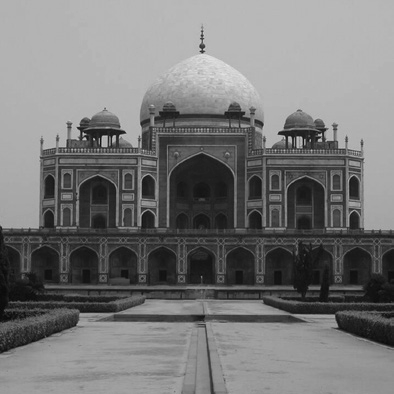
Humayun’s burial took place in Delhi, marking the end of a reign marked by trials and temporary victories.
Note: During the reign of Humayun, a significant progress in the field of painting commenced. While returning from Persia, Humayun brought two famous Persian painters with him. They were Khwaja Abdus Samad and his son Mir Sayyid Ali. Under their guidance, the art of painting started flourishing in Mughal Courts