Impact of Industrial Revolution
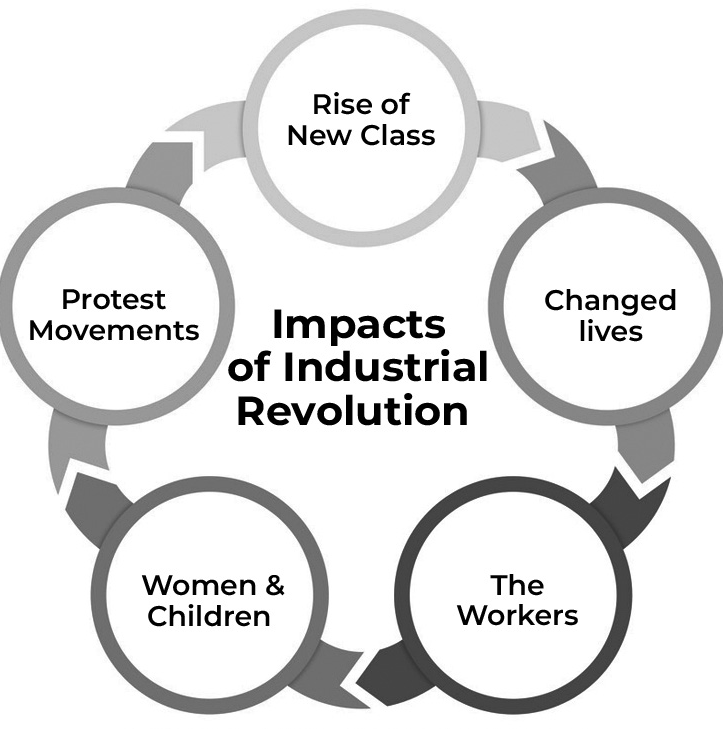
The term ‘Industrial Revolution’ was used by European scholars – Georges Michelet in France and Friedrich Engels in Germany. It was used for the first time in English by the philosopher and economist Arnold Toynbee (1852-83), to describe the changes that occurred in British industrial development between 1760 and 1820.
• Rise of New Class
Industrial production surged dramatically, leading to a significant drop in the cost of goods. Machines replaced manual labor, bringing an end to the domestic, home- based production system. At the same time, increased agricultural output helped lower food prices.
A new source of wealth emerged from factory and machinery ownership, giving rise to a new social class known as the capitalists. This group played a key role in shaping the modern banking system, channeling capital from regions with surplus income to areas where investment was needed most.
• Urbanization
Wealth increased significantly during this period— measured in goods, income, services, knowledge, and productivity. However, this economic progress came with a steep human cost, reflected in broken families, forced relocations, deteriorating urban environments, and harsh factory working conditions.
The number of English cities with populations over 50,000 grew from just two in 1750 to 29 by 1850. Yet this rapid urban expansion was not accompanied by adequate housing, sanitation, or access to clean water for the growing population.
New arrivals were often forced to live in overcrowded slums located in the congested centers of industrial towns, close to factories. In contrast, wealthier residents moved to suburban areas, where the air was cleaner and water more reliable.
• The Workers
A survey in 1842 revealed that the average lifespan of workers was lower than that of any other social group in cities.
Deaths were primarily caused by epidemics that sprang from the pollution of water, like cholera and typhoid, or of the air, for example - tuberculosis.
Women and Children
The Industrial Revolution brought significant changes to the roles of women and children in the workforce.
Factory work was a drastic shift from rural labor—it involved long, repetitive hours under strict supervision, with harsh punishments for mistakes or disobedience.
As machines became more widespread and required fewer operators, industrialists increasingly hired women and children. They were seen as less likely to protest poor working conditions and were willing to work for lower wages than men.
Women and children were employed in large numbers, particularly in the cotton textile mills of Lancashire and Yorkshire.
In coal mines, children were used to reach deep or narrow seams where adults couldn’t fit.
Factory owners viewed child labor as a form of early training for future factory work. Records from British factories show that nearly half of the workers began their employment before the age of ten, and 28 percent started when they were under 14.
• Protest Movements
• The early phase of industrialization coincided with the spread of revolutionary political ideals inspired by the French Revolution (1789–1794).
• The revolutionary slogans of liberty, equality, and fraternity demonstrated the power of collective mass action—not only in the creation of democratic institutions such as the French parliamentary assemblies of the 1790s but also in efforts to mitigate wartime suffering by regulating the prices of essential goods like bread.
• In England, growing discontent with the harsh conditions in factories led to a surge in political protests. Industrial workers increasingly demanded the right to vote and greater representation.
• As cities and factories became overcrowded with incoming laborers, workers expressed their anger through various forms of resistance, including widespread food and bread riots that erupted across the country from the 1790s onward.
• Another source of hardship was the enclosure movement, beginning in the 1770s, in which small farms were consolidated into larger estates controlled by powerful landlords. This process displaced many rural families, forcing them to seek employment in industrial centers.
• The Luddite movement (1811–1817), led by the influential figure General Ned Ludd, represented a distinct form of industrial protest. Contrary to the belief that it was simply a reactionary attack on machines, Luddism was driven by broader social and economic demands. The Luddites called for a minimum wage, regulation of women’s and children’s labor, job opportunities for those displaced by mechanization, and the legal right to form trade unions to voice their demands collectively.
• In August 1819, 80,000 people gathered peacefully at St Peter’s Fields in Manchester to claim democratic rights
– of political organization, of public meetings, and of the freedom of the press. They were suppressed brutally in what came to be known as the Peterloo Massacre and the rights they demanded were denied by the Six Acts, passed by Parliament the same year.
• Reforms through Laws
• In 1819, laws were passed to regulate child labour in factories, prohibiting the employment of children under the age of nine and limiting the working hours of those between nine and sixteen to twelve hours a day. However, these laws lacked effective enforcement mechanisms and were largely ineffective in bringing about change.
• It wasn’t until 1833, after widespread protests by workers across northern England, that the government took more concrete action. The new Factory Act restricted the employment of children under nine to silk factories only, set work-hour limits for older children, and introduced factory inspectors to ensure the law was followed.
• Despite these improvements, it took over three more decades of sustained pressure before the Ten Hours’ Bill was passed in 1847. This law was a significant victory, as it reduced the working hours for women and young workers, securing a ten-hour workday for male labourers as well.
• However, these labour reforms initially applied only to the textile industry and not to the mining sector. In response to growing concerns, the Mines and Collieries Act of 1842 banned children under ten and women from working underground. The Factory Act of 1847 also established limits, setting a ten-hour workday for women and children under eighteen in industrial settings.
• These laws marked important steps in the fight for better working conditions, but they were just the beginning of a larger movement to improve labour rights across various industries.
• Beginning of Colonialism:
The Industrial Revolution quickly spread to other parts of the world, driven by the discovery of new trade routes. This sparked a fierce competition among colonial powers, each eager to expand their empires in search of raw materials, new markets, and cheap labour. A race for colonies emerged, with England and France leading the charge, while countries like Italy, Germany, and others eventually joined in. As these imperial powers expanded their territories, they sought to dominate and exploit their colonies, disrupting traditional social, economic, and political systems. The consequences of this exploitation were severe, but it also sowed the seeds for resistance. Colonies, subjected to foreign rule, began to rise up and fight for their independence, setting the stage for conflicts that would shape the course of history in the years to come