Imperialism in different countries
Africa:
• From the time of European explorations in the later part of the fifteenth century, a new phase began in the history of some parts of Africa.
• Besides the establishment of commercial relations in some parts of Africa, this phase was characterized by slave trade.
Slave Trade:
• One of the earliest consequences of European contact with coastal African states was the emergence of the transatlantic slave trade.
• European traders relied on African villages being raided, with people captured and sold into slavery.
• Initially, the Arab traders had dominated the slave trade, but over time, some African chiefs began to participate, exchanging slaves for firearms supplied by European traders.
• The Portuguese were the first Europeans to engage in the African slave trade, but it was soon dominated by the English. In the seventeenth century, the British government granted a charter to a company to conduct the slave trade.
• Later, Spain granted England the monopoly on trading slaves to its American colonies, and this trade continued until the mid-nineteenth century.
Territorial Expansion & Decline of Slave Trade
• By the early nineteenth century, the slave trade had become less significant within the colonial exploitation system. Slavery itself was seen as an obstacle to fully exploiting the interior of Africa.
• Some colonial powers used the excuse of abolishing the slave trade to justify wars against African chiefs and kings, seeking to expand their territories.
• At the same time, European exploration of Africa’s interior began, and preparations were made to establish direct colonial control over nearly the entire continent.
• Up until the mid-nineteenth century, much of Africa’s interior remained largely unknown to Europeans.
• The coastal regions were primarily controlled by established trading powers, including the Portuguese, Dutch, English, and French.
• There were only two places where European rule extended deep into the interior.
In the north the French had conquered Algeria.
In the south the English had occupied Cape Colony to safeguard their commerce with India. It had earlier been a Dutch colony where a number of Europeans, mainly the Dutch, had settled. These settlers, known as Boers, had taken to farming.
Scramble for Africa
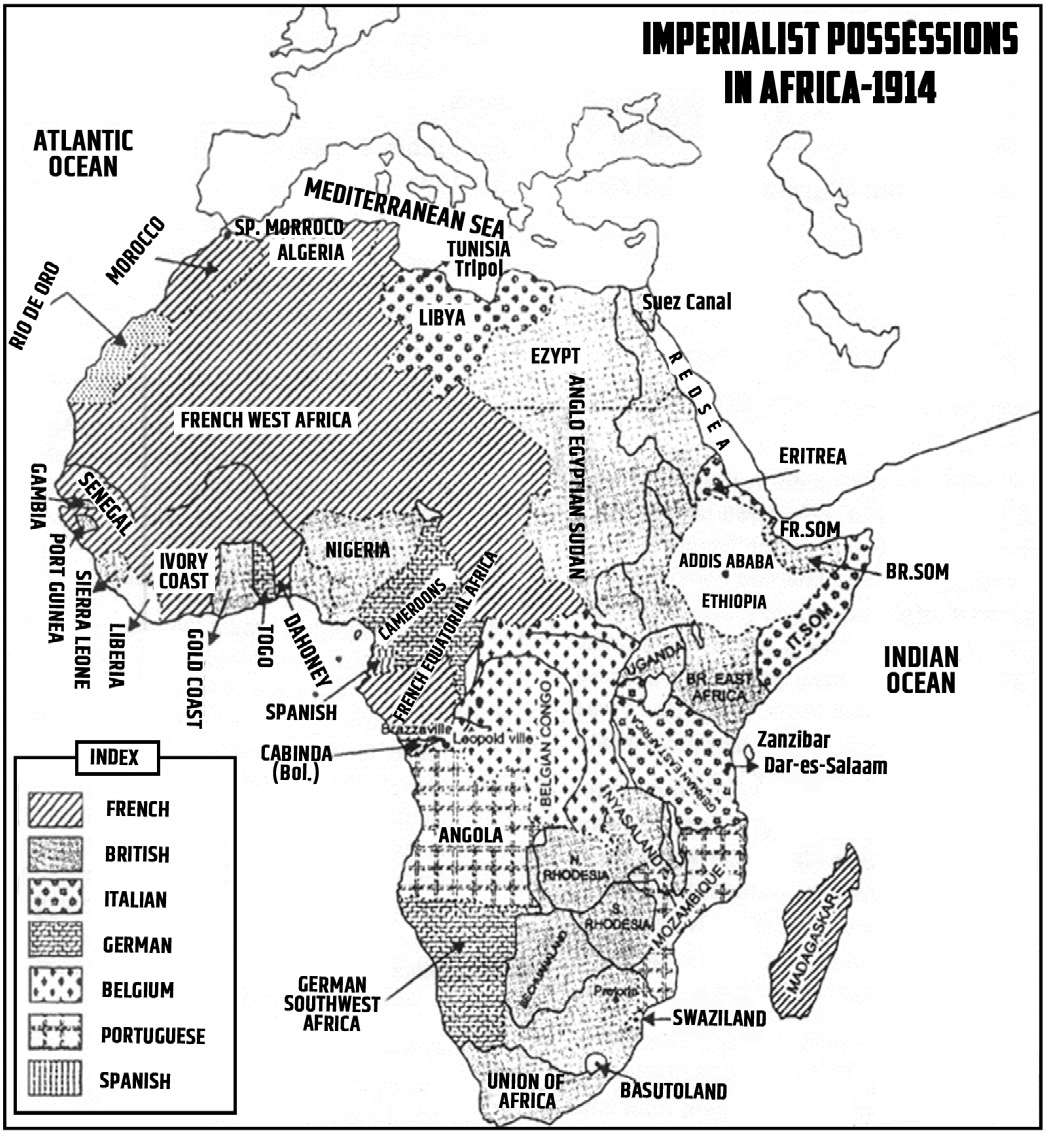
• Within a few years, a fierce scramble for colonies began, and almost the entire African continent was divided among European powers.
• Explorers, traders, and missionaries each played significant roles in the conquest of Africa.
• Until 1875, European territories in Africa were limited to a few forts, trading posts along the coast, and small colonies.
• However, between 1880 and 1910, nearly the whole of Africa was carved up by European powers. For the next 50 years, all significant decisions concerning Africa were made in European capitals like London, Paris, and Lisbon.
• France established a vast empire in North and West Africa, taking control of Algeria, Tunisia, Morocco, Ivory Coast, Dahomey, Mali, and other regions in the west.
• Britain ruled over a wide range of territories, including Gambia, Sierra Leone, Gold Coast, Nigeria, South Africa, Rhodesia, Uganda, Kenya, Egypt, Sudan, Eritrea, parts of Somaliland, and Libya.
• Germany controlled Southwest Africa, Tanganyika, Togoland, and Cameroon until its defeat in World War I.
• By 1914, only two independent African countries remained: Liberia and Ethiopia. However, Ethiopia was later taken over by Italy in 1935.
• While France controlled the largest number of colonies in Africa, Britain governed the largest population across its African territories.
Factors responsible for the Scramble-
• The economic power of the imperialist nations far outstripped the resources of the African states.
• African nations lacked the military strength to engage in prolonged warfare, as the imperialist countries were far more advanced in terms of power and resources.
• The Africans were equipped with outdated firearms, sold to them by European traders, which were no match for the advanced rifles and guns used by the Europeans.
• Politically, African states, much like Indian states in the eighteenth century, lacked unity. Internal conflicts and rivalries were common, with rulers and chiefs often seeking European support against their enemies. In contrast, the imperialist powers engaged in the scramble for Africa were united in their pursuit.
Imperialism in Asia
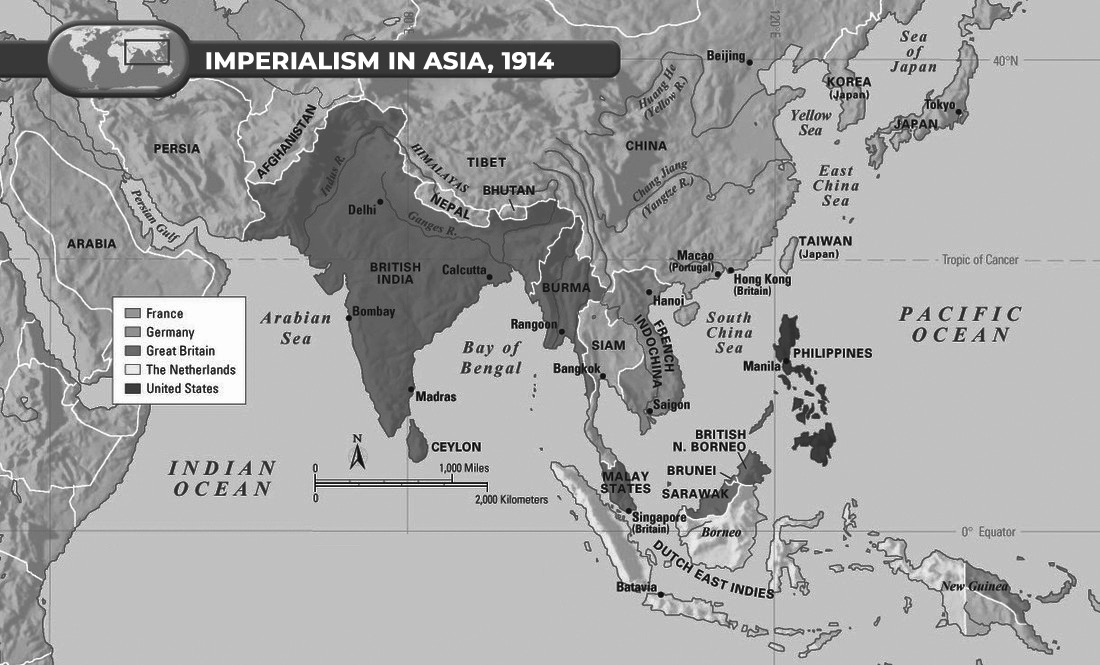
• In 1763, the British ended the French influence in India and established their own control.
• Countries like Japan and China refused to accept the western culture and way of life because of their belief in their traditional ways.
China
• European demand for Chinese goods was high, but there was little interest in European products in China, making trade unprofitable for European merchants. To balance this, they began smuggling opium into China, which weakened the Chinese population and allowed them to trade it for valuable Chinese goods.
• This led to the First Opium War, where China was swiftly defeated by Britain, resulting in China granting multiple concessions to the British.
• As a result, China was forced to open five ports to British trade, disallow tariffs on foreign goods, and allow British subjects to be exempt from Chinese law. Additionally, the island of Hong Kong was ceded to Britain.
• The Second Opium War was sparked by British retaliation for the insult to the British flag and the killing of a French missionary. Once again, China was defeated, resulting in the granting of extraterritorial rights to foreign powers.
• The Boxer Rebellion was a violent resistance movement against the foreign exploitation of China and the influence of Christian missionaries. Young Chinese militants, with covert support from the imperial court, attacked foreigners, especially foreigners seen as “invaders,” using their fists as a symbol of defiance.
Japan
The Meiji Restoration, which began in 1868, ushered in an era of ‘enlightened rule’ that transformed Japan from a secluded feudal society into the first industrialized nation in Asia. With few natural resources of its own, Japan needed access to overseas markets and raw materials.
In 1871, a group of Japanese officials travelled to Europe and the US to observe and learn, laying the groundwork for Japan’s state-led industrialization strategy.
• By 1877, the Bank of Japan was established, and industries like steel and textiles were rapidly developed. Education was expanded, and many Japanese students were sent abroad to study in the West.
• By 1905, Japan had become a powerful industrial and military force, guided by the motto “Enrich the Country, Strengthen the Military.”
Japan’s success extended to its conquests, as it gained control over territories such as Taiwan, Southern Sakhalin, Korea, Manchuria, Indo-China, Burma, Malaya, Singapore, Indonesia, and the Philippines.
India
India has generally been considered a classic colony. Different stages of colonialism operated in India.
First Stage - In the first stage, the East India Company quickly achieved its dual objectives: gaining control over trade and securing government revenues, starting with Bengal and parts of South India, and later expanding throughout the rest of India.
• The Company used its political power to establish a monopoly on trade and handicrafts in India.
• Indian traders were devastated, and weavers were forced to sell their goods at low prices, as the Company’s monopoly crippled local industries. In the following stage, the influx of cheap manufactured goods from Britain further undermined Indian craftsmanship.
• During this period, India did not experience major societal shifts. Changes were mostly seen in military organization, technology, and high-level revenue administration.
• Ideologically, there was a certain respect for traditional systems, unlike in the next stage, where colonial authorities began to openly reject these values.
Second Stage
During the period of free trade, India became a key market for manufactured goods and a source of raw materials and food grains.
• The import of Manchester cloth saw a dramatic rise, increasing from 96 lakh sterling in 1860 to 27 crore sterling by 1900. This influx led to the destruction of traditional weaving industries, as local artisans couldn’t compete.
• Instead of industrial growth, the country witnessed a decline in its industries, a process known as deindustrialization.
•
The expansion of railways took place alongside the establishment of a modern postal and telegraph system. This improved infrastructure enabled imports to reach even remote villages while facilitating the extraction of raw materials.
• Efforts were made to strengthen the legal system, ensuring the sanctity of contracts.
• A modern education system was introduced, designed to create a class of clerks and officials to manage the expanding colonial administration.
Third Stage
The third stage is often known as the era of finance capital, characterized by significant investments in railways, loans to the Indian government, trade, and to a lesser extent, sectors like plantations, coal mining, jute mills, shipping, and banking.
• During this time, Britain’s global dominance faced increasing challenges from rising imperial powers, pushing Britain to reinforce its hold over India.
• Under the viceroyalties of Lytton and Curzon, more reactionary imperialist policies were implemented. The idea of self-government was discarded, and British rule was firmly established as a permanent trusteeship over India, cementing colonial control.
Imperialism in South and South-East Asia
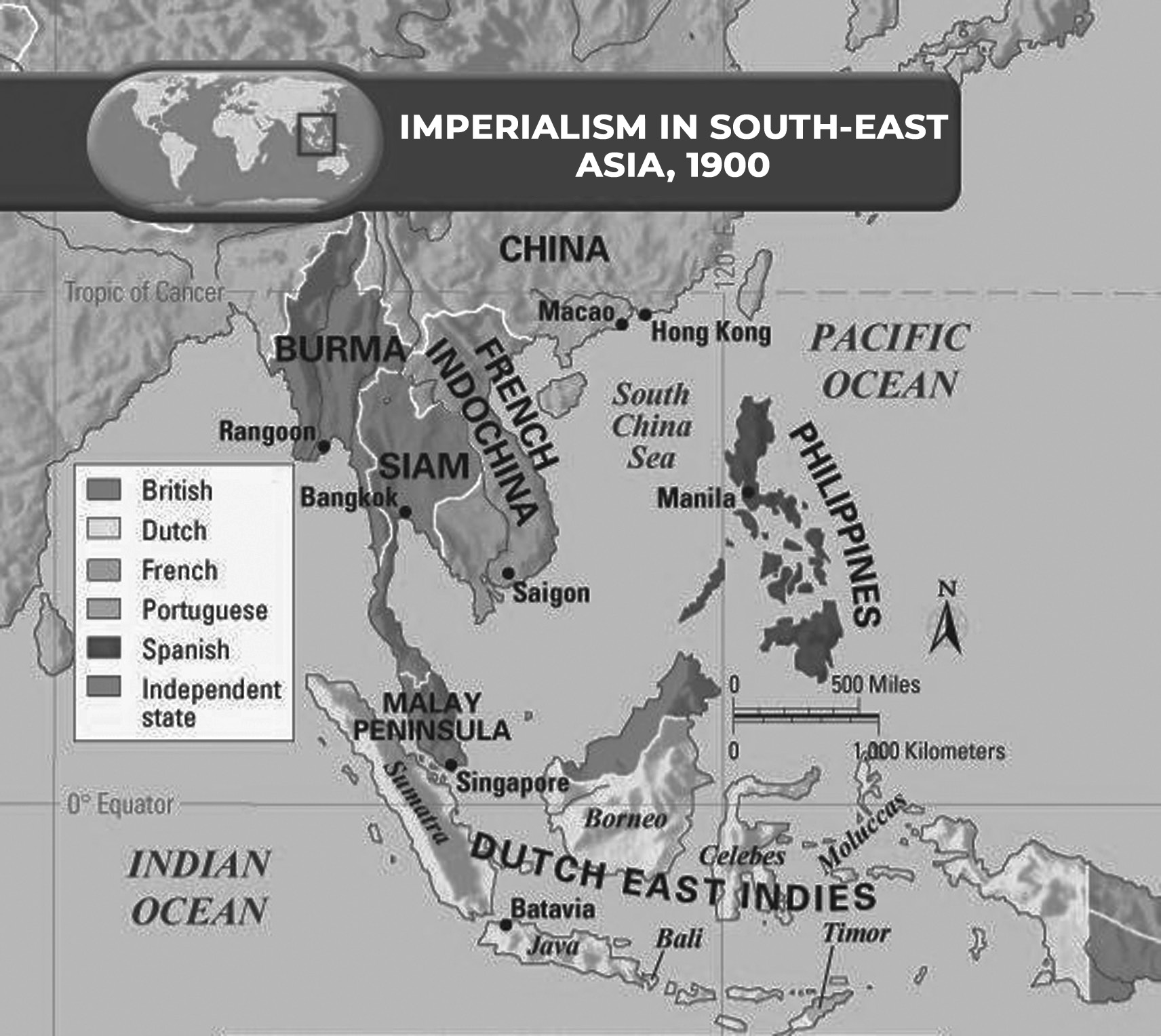
South and Southeast Asia, which includes countries like Nepal, Burma, Sri Lanka, Malaya, Indonesia, Indochina, Thailand, and the Philippines, had already seen European domination long before the rise of New Imperialism.
• Sri Lanka, for instance, was first occupied by the Portuguese, then the Dutch, and later the British, who introduced tea and rubber plantations, which came to account for most of Sri Lanka’s exports.
• Other Southeast Asian nations also fell under imperialist control. French forces attacked Vietnam, justifying their actions as a means of protecting the Christian community in Indochina.
• Over time, France expanded its control, adding Vietnam, Laos, and Cambodia to its colonial empire.
• The British, seeking to dominate the Malaya states, added Burma and the port of Singapore to their possessions.
• The United States entered the imperialist race in Southeast Asia in the late 19th century.
• The Filipino revolt against Spanish rule prompted the
U.S. to occupy both Cuba and the Philippines. Despite Filipino resistance, the Americans suppressed the uprising, and the Philippines was ultimately made an American colony.
Imperialism in Central and Western Asia
England and Russia were engaged in a fierce rivalry for control over Central Asia, Iran (Persia), Afghanistan, and Tibet.
• By the latter half of the 19th century, the Russian Empire managed to annex nearly all of Central Asia.
• Tensions between the two powers escalated over Iran and Afghanistan, where their interests collided.
• While Britain had some economic interests in these regions, its primary concern was securing its colonial holdings in India against any potential Russian expansion from Central Asia.
• Anglo Russian Arrangement for Iran, Afghanistan and Tibet in 1907.
In 1907, England and Russia came to an agreement, dividing Iran into spheres of influence—Britain controlled the south, Russia the north, while the central region was neutral and open to both powers.
• That same year, they also resolved issues regarding Afghanistan and Tibet. Both countries agreed to stay out of Tibet, and Russia acknowledged Afghanistan as outside its sphere of influence. In return, Britain promised not to annex Afghanistan, provided its rulers remained loyal.
• Following the Russian Revolution in 1917, the new Soviet
government renounced the Anglo-Russian agreement and relinquished its claims in Iran. However, British troops continued to occupy Iran.
• After the 1911 overthrow of the Chinese monarchy, British influence over Tibet gradually strengthened.
German Imperialism Eliminated from Asia
During this period, Germany aimed to expand its influence over Turkey and its surrounding Asian territories. A German company was granted permission to construct a railway linking Constantinople to Baghdad and the Persian Gulf. This project was intended to advance Germany’s economic interests in the region, with hopes of eventually extending its reach to Iran and India. However, France, Britain, and Russia opposed the plan. A compromise was eventually reached, allowing the three powers to divide the region among themselves.
• The outbreak of the First World War drastically changed the situation. Germany and its ally, Turkey, were defeated. As a consequence, territories such as Syria, Palestine, Mesopotamia (modern-day Iraq), and Arabia were taken from Turkish control and placed under British and French administration.
• As a result, Germany’s ambitions to become a dominant imperial power in Asia and other regions were effectively crushed.