IMPORTANT TERMS
Stagflation
Stagflation means slow growth and a high unemployment rate accompanied by inflation. Economic policymakers and experts find this combination particularly delicate to handle, as trying to correct one of the factors can complicate another.
Recession
A recession is a significant downturn in economic activity characterized by a sustained decline in real Gross Domestic
Product (GDP). This translates to a contraction in the production of goods and services within an economy. Key economic indicators like GDP growth, corporate profits, and employment levels all experience a decline during a recession. This reflects a decrease in overall economic output and activity. To handle the menace, economies generally respond by loosening monetary policy by lowering interest rates. Governments can implement fiscal stimulus measures, such as increased spending on infrastructure projects or social programs. Reducing tax burdens on businesses and individuals can incentivize spending and investment, thereby providing a shot of stimulus to the economy.
Skewflation
Economists generally distinguish between inflation and a relative price hike. ‘Inflation’ refers to a sustained, across the board price increase, whereas ‘a relative price increase’ is a reference to an episodic price increase pertaining to one or a small group of goods.
On the other hand, Skewflation is a relatively new term used to describe a scenario where prices of a specific good or a small basket of goods experience a sustained and significant increase, while the overall price level in the economy remains relatively stable. This creates a skewed distribution of price movements across different sectors.
Deflation
Deflation is a general decrease in Inflation is the steady rise in the overall price level of goods and services in an economy over time. It leads to a reduction in purchasing power, meaning that each unit of currency can buy fewer goods and services. As inflation increases, the value of money diminishes, causing a decline in its purchasing power. for goods and services, associated with a reduction in the supply of money and credit in the economy. During deflation, the purchasing power of currency rises over time.
Disinflation
Disinflation is a temporary slowing or decreasing of the pace of price inflation and is used to explain cases when the inflation rate has reduced hardly over the short term. Unlike inflation and deflation, which relate to the direction of prices, disinflation means the rate of change in the rate of inflation. A healthy quantum of disinflation is necessary since it protects the economy from overheating.
Reflation
Reflation is a financial or monetary policy designed to expand output, stimulate expenditure, and curb the impact of deflation, which generally occurs after a period of economic volatility or a recession. Reflationary policies are typically implemented after periods of economic slowdown or recessions. They can also describe the initial stages of economic recovery, characterized by rising prices and renewed economic activity.
Headline and Core affectation
Headline inflation captures the overall rise in the cost of living, encompassing a broad basket of goods and services. This includes volatile components like food and energy prices. Core inflation, on the other hand, excludes these volatile elements to provide a more stable measure of underlying inflation trends. This focus on non-food and non- energy prices helps isolate the impact of factors like changes in demand and production costs. The unpredictable nature of food and energy prices makes headline inflation a more fluctuating indicator. Core inflation, by contrast, offers a more reliable gauge of long-term inflationary pressures within an economy.
Inflationary Gap
The inflationary gap measures the difference between the economy’s current real GDP and the level achievable at full employment. It reflects excess demand in the economy:
Inflationary Gap = Actual GDP – Potential GDP
Governments can use fiscal policy to close this gap and curb inflation by tightening the money supply, reducing government expenditure, tax increases, issuing more bonds to absorb liquidity and reducing transfer welfare payments to reduce aggregate demand. These measures aim to restrict consumer spending, ultimately bringing demand and inflation closer to desired levels.
Recessionary Gap
The recessionary gap, also known as the contractionary gap, is a macroeconomic concept that arises when a country's real Gross Domestic Product (GDP) falls below its potential GDP at full employment. This situation signifies a deficiency in aggregate demand relative to the economy’s productive capacity.
• Causes of the Recessionary Gap: It can be caused due to involuntary unemployment due to high wages. Another reason can be unexpected events like financial crises or external trade disruptions can trigger a sudden drop in aggregate demand, creating a recessionary gap or due to tightening fiscal or monetary policy excessively.
• Consequences of the Recessionary Gap: Increased unemployment due to reduced demand leading to underutilized resources. It can lead to deflation and a decline in the general price level.
Policy Responses
• Expansionary Monetary Policy: Central banks can lower interest rates and engage in quantitative easing to increase the money supply and stimulate borrowing and investment.
• Expansionary Fiscal Policy: Governments can increase spending on infrastructure projects or social programs, or implement tax cuts, to inject additional money into the economy and boost aggregate demand.
Base Effect
The base effect refers to a phenomenon that distorts the interpretation of inflation figures when comparing them across different time periods. It arises because inflation is typically measured as a percentage change from a previous period (often the same month a year ago). Hence, it doesn’t reflect a true change in inflation itself, but rather a mathematical distortion caused by the chosen reference point.
High Base Effect: If inflation was unusually high in the corresponding period of the previous year (the base), even a moderate increase in prices this year will result in a seemingly high inflation rate due to the larger starting point (base). This can be misleading as the actual price increase might be smaller than it appears.
Low Base Effect: Conversely, if inflation was very low in the previous year’s corresponding period, a similar absolute increase in prices this year will translate into a seemingly large inflation rate. However, this inflation rate might be overstated because it’s measured against a very low base.
Phillips Curve (Inflation vs Unemployment)
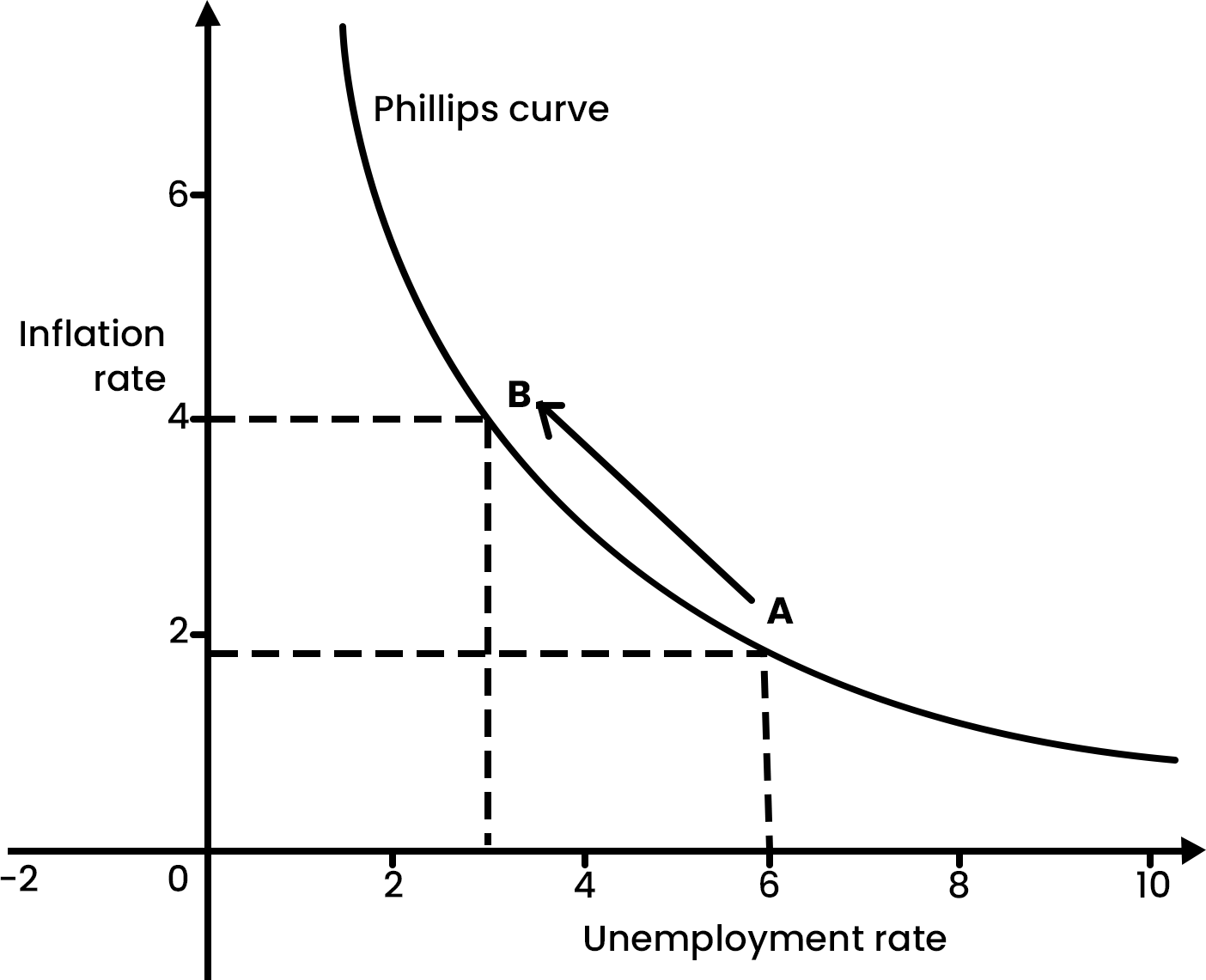
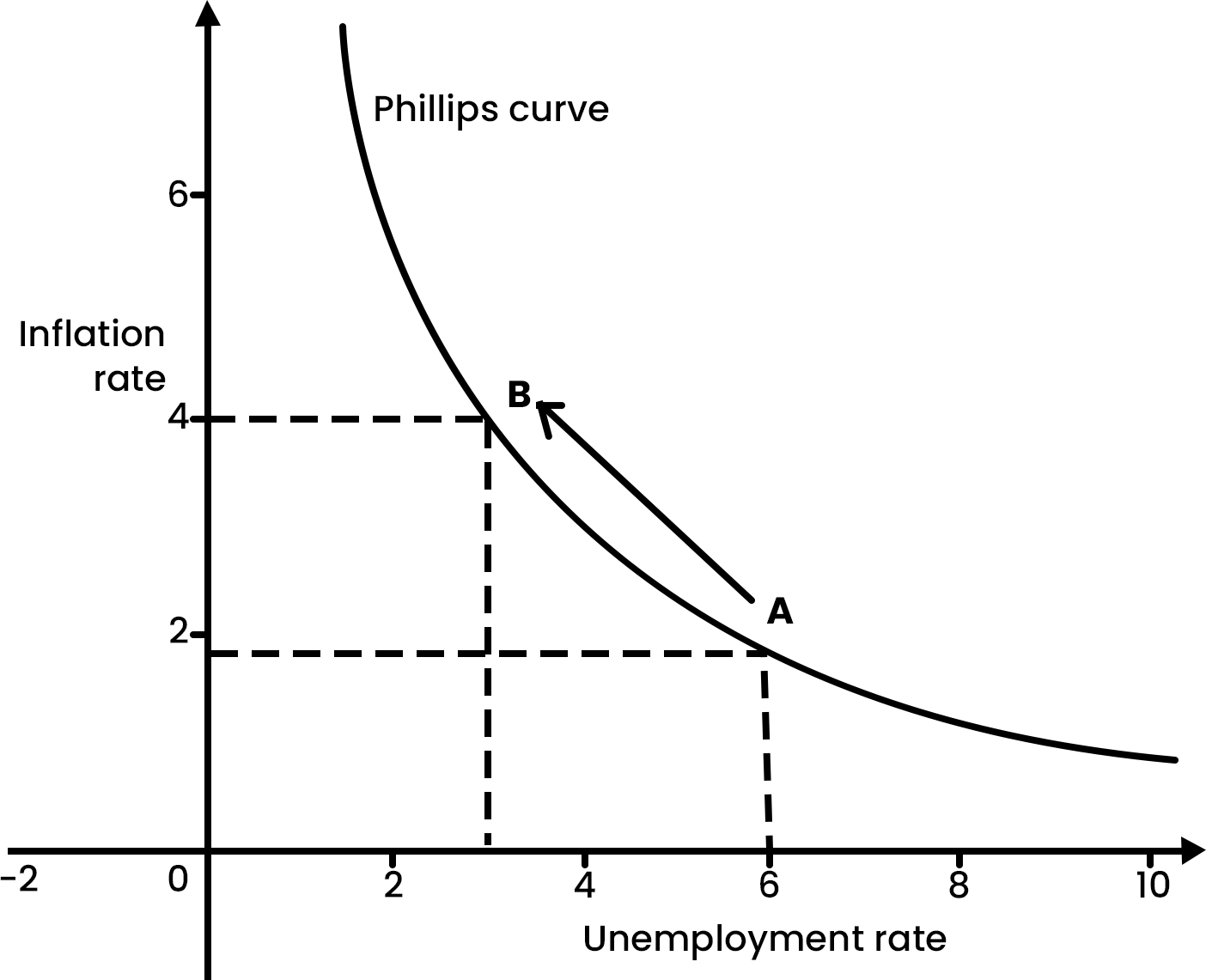
The Phillips curve explains that inflation and unemployment have an inverse relationship. Advanced inflation is associated with higher employment and vice versa.
The inverse relationship between higher employment and inflation is represented as a downward sloping, concave curve, with inflation on the Y- axis and unemployment on the X-axis.
This curve shows that unemployment and inflation are inversely proportional to each other. This means if inflation increases unemployment rate will decrease and vice versa. However, the relationship breaks down under conditions of hyperinflation, where extremely high inflation rates render the curve inapplicable. Despite these limitations, the Phillips Curve remains a valuable framework for understanding the potential relationship between inflation and unemployment, especially in more stable economic environments.
Inflation-Indexed Bonds (IIBs)
IIBs are a special type of debt security designed to hedge against inflation. Their key characteristic is that both the principal amount (face value) and the interest payments are adjusted for inflation, typically against the Consumer Price Index (CPI). While IIBs offer protection against inflation, they may not perform well in deflationary environments (falling prices). However, fixed coupon rate of IIBs might be lower compared to traditional bonds, as investors are compensated for the inflation protection feature.
Advantages of IIBs
• Principal Protection: The inflation-adjusted principal
ensures you receive at least your original investment amount, even if inflation erodes its purchasing power over time.
Real Returns: The combination of a fixed coupon rate and inflation-adjusted principal helps you achieve positive returns that outpace inflation.
Regular Income: IIBs typically offer fixed interest payments at regular intervals, providing a predictable income stream.
Low Default Risk: As IIBs are usually issued by the government, they carry a very low risk of default compared to corporate bonds.