INDIA PAKISTAN WARS
1965 India-Pakistan War
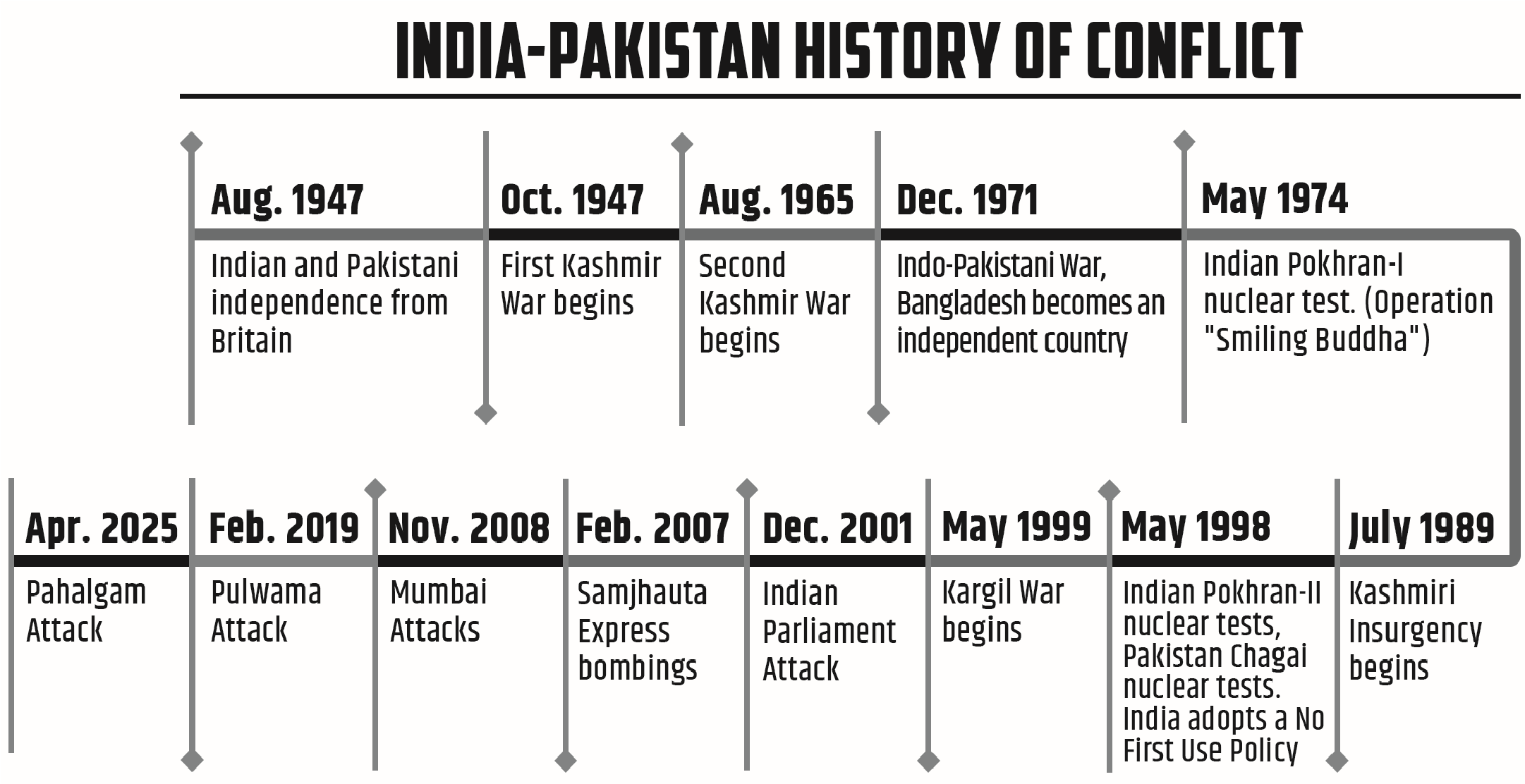
In 1965, India-Pakistan relations worsened to the point of armed conflict. The countries engaged in battle with one another “because of their conflicting claims over the Rann of Kutch at the southern end of the international boundary. War was a consequence of Operation Gibraltar by Pakistan to infiltrate forces into J&K to incite [begin] an insurgency against Indian state. The situation steadily deteriorated during the summer of 1965, and, in August, military hostilities between India and Pakistan erupted on a large scale along the ceasefire line in Kashmir.
On January of 1966, the leaders of India and Pakistan met to discuss the cease-fire to the ongoing conflict. Both sides returned from the meetings saying that they would retreat their troops to positions before August 5th, 1965, and that this should be recognized by February 25th, 1966. The military leaders met again, and confirmed an agreement on both sides to remove troops, which they both executed on the 26th of February, 1966.
The UN mandated a ceasefire and Soviet Union (USSR) got involved which subsequently led to the Tashkent declaration. On January 10, 1966, Indian Prime Minister Lal Bahadur Shastri and Pakistani President Ayyub Khan signed an agreement at Tashkent (now in Uzbekistan), agreeing to withdraw to pre-August locations and that economic and diplomatic ties between the warring sides would be restored.
1971 India-Pakistan War
India and Pakistan go to war a third time, this time over East Pakistan (now Bangladesh). The conflict began when the central Pakistani government in West Pakistan, led by Zulfiqar Ali Bhutto, refuses to allow Awami League leader Sheikh Mujibur Rahman, a Bengali whose party won the majority of seats in the 1970 parliamentary elections, to assume the premiership.
A Pakistani military crackdown on Dhaka begins in March, but India becomes involved in the conflict in December, after the Pakistani air force launches a pre-emptive attack on airfields in India’s northwest.
India then launches a coordinated land, air and sea assault on East Pakistan. The Pakistani army surrendered at Dhaka, and its army of more than 90,000 armed soldiers became prisoners of war. Hostilities lasted 13 days, making this one of the shortest wars in history of armed combat.
This led to birth of an independent country, Bangladesh (erstwhile East Pakistan), on December 6, 1971. The Instrument of Surrender signed by Pakistan marked the end of the 1971 war.
1972 - Pakistani Prime Minister Zulfikar Ali Bhutto and Indian Prime Minister Indira Gandhi signed an agreement in the Indian town of Shimla, which came to be known as Shimla Agreement.
The Shimla Agreement designates the ceasefire line of December 17, 1971, as being the new “Line-of-Control (LoC)” between the two countries.
Shimla Agreement: Main Features
• India and Pakistan resolved to put an end to the conflict and confrontation that had strained their relations in the past and work to promote a friendly and harmonious relationship to establish durable peace in the subcontinent.
• Both India and Pakistan agreed that the relations between the two will be governed by the principles of the United Nations charter.
• The two countries resolved to solve their differences by peaceful means, through bilateral dialogue or any other means mutually agreed upon by them.
• Both India and Pakistan agreed to respect the line of control in Jammu and Kashmir without any prejudice to the recognized position of either side. They also agreed that neither will seek to alter it unilaterally, irrespective of mutual differences and legal interpretations.
• Further, the two nations also agreed to refrain from the use of threat or force in violation of this Line.
1974 - The Kashmiri state government affirmed that the state "is a constituent unit of the Union of India". Pakistan rejected the accord with the Indian government. On May 18, India detonated a nuclear device at Pokhran, in an operation codenamed “Smiling Buddha”. India referred to this device as a “peaceful nuclear explosive”.
1999 Kargil War
After the debacle of 1971 war, Pakistani army never tried to fight with Indian army directly & started the proxy war by infiltrating the terrorists trained by their intelligence agencies to create havoc and panic in India, especially in J&K.
In 1999, so called Mujahideens along with Pakistani forces occupied several strategic Himalayan peaks and areas on the Indian side of LOC in the Mashkoh, Dras, Kaksar, Batalik.
Suspecting Pakistan’s sinister design behind such activities, Indian forces immediately began retaliating to such proxy war which came to be known as “Kargil conflict” (1999).
There was a huge controversy surrounding the Kargil conflict, the then PM of Pakistan was kept in the dark of such moves by Pakistani Army backed Mujahideens. Later, the then Pakistani Army Chief General Parvez Musharraf took over as its President.
This conflict got worldwide attention because of the nuclear capabilities attained by both countries in 1998, which could be used by either side, however nuclear weapons were not used in war, and Indian troops regained their peaks.
| Ceasefire violations | |
| • | Ceasefire is a situation where countries mutually agree to not fire at towards each other’s territory so as to ensure peace and tranquillity on borders. |
| • | Even after the 2003 Ceasefire Agreement, the post-Kargil Conflict came into effect, Pakistan has been engaged in regular ceasefire violations. This violence has led to multiple casualties of civilians and the army on both sides. |
The Kargil conflict ended with Operation Vijay being declared a success, which confirmed complete withdrawal of Pakistani forces and Mujahideens from Indian territory.
