INTRODUCTION
A circus is a group of performers that put-on performances that include clowns, acrobats, trained animals, trapeze acts,
musicians, dancers, hoopers, tightrope walkers, jugglers, magicians, unicyclists and other object manipulation & stunt artists.
The modern circus, as described by Philip Astley (seen as the founder of modern circus), first appeared in India in the 1880s.
However, similar to circuses, street entertainment has occurred in India from ancient times.
Note: Vishnupant Chatre is known as the father of Indian Circus.
Evolution of Indian Circus
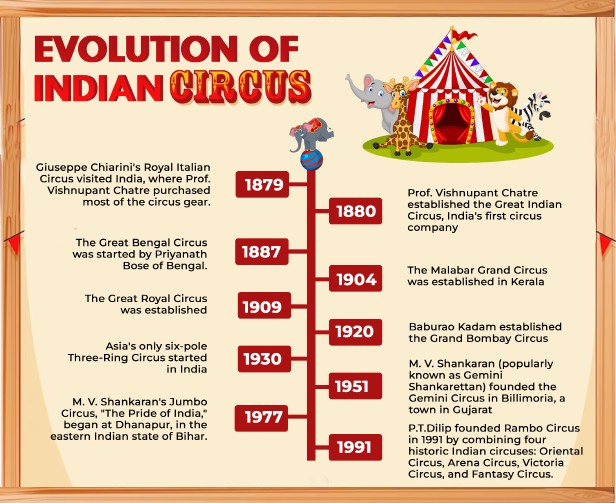
SOME MAJOR CIRCUS COMPANIES IN INDIA
Three Ring Circus
In the 1930s, K. Damodaran began his budding circus as a two-pole show. It acquired popularity throughout South India before evolving into Asia’s only six-pole three-ring circus.
Gemini Circus
M. V. Shankaran (popularly known as Gemini Shankarettan) founded the Gemini Circus in 1951 in Billimoria, a town in Gujarat. Shankaran worked with Kallan Gopalan’s Great Rayman Circus before starting his own Gemini Circus with another entrepreneur, K. Sahadevan. On August 15, 1951, the circus first opened its doors. Shankaran led the first Indian circus delegation to an International Circus Festival in the Soviet Union in 1964. The Indian troupe made appearances in Moscow, Sochi and Yalta.
The Gemini Circus has developed relationships with the Indian film industry, which has utilised it as a backdrop in films such as Raj Kapoor’s Mera Naam Joker, Mithun Chakraborty’s Shikari and Kamala Hassan’s Apoorva Sahodarangal.
Jumbo Circus
On October 2, 1977, M. V. Shankaran’s Jumbo Circus, “The Pride of India”, began at Dhanapur, in the eastern Indian state of Bihar. The largest and most well-known circus in India, it has had a significant travelling menagerie since its start. It is a contemporary company. It is a component of the family Shankaran’s collection of circuses. It has recently shown a troupe of Russian performers.
Rajkamal Circus
Gopalan Mulloli, a youthful daredevil, founded his little circus business in the Punjab town of Zeera in 1958. By merging his son, Raj and his wife, Kamala’s names, he titled his circus Rajkamal. The Rajkamal Circus developed in popularity and undertook extended tours throughout India, visiting the country’s major towns and subsequently, the Gulf countries. It is now one of India’s major circuses.
Rambo Circus
P.T.Dilip founded Rambo Circus in 1991 by combining four historic Indian circuses: Oriental Circus, Arena Circus, Victoria Circus and Fantasy Circus. Rambo Circus has travelled widely in India and the Middle East.
Circus - A Disappearing Art and Industry
The circus is usually seen as a risky occupation. As a result, most families, especially those struggling to make ends meet, are hesitant to send their children to join it. The dismal working conditions and bad circumstances in which its animals were sometimes kept contributed to the circus’s decline in India.
Circuses’ appeal among the general public has plummeted dramatically. The prohibition on the use of wild animals has damaged the industry. The Ministry of Environment, Forests, and Climate Change (MoEFCC) has revoked the licences of all circuses in the country that compel wild animals to perform acts for entertainment purposes.
The sector has also been impacted by an amendment to the Child Labour Act that made it illegal for circuses to hire anybody under the age of 18, as doing so could not be profitable for the circuses.
Additionally, it is economically impossible to support oneself in India as a circus performer.
The financial struggles of the circus businesses in India have been made worse by the pandemic crisis.
Way Forward
Indian Circus Academy’s establishment in Thalassery in 2010 was a positive development. Sadly, the institution is in danger of closing owing to a lack of students and funding issues. However, some further potential treatments for the resurgence of the circus industry include:
The impression of circus as a professional option might be improved by placing more focus on safety rules and strictly implementing them.
Circus performances may be utilised to raise public awareness of vanishing skills. Also, the circuses’ level of attractiveness would rise as a result.
Additionally, government protection for circus organisations and performers would aid in resurrecting the sector. By the time they reach 40, the majority of artists have retired and must work as menial workers. It’s essential to provide them with security and remuneration.
At the moment, the Department of Sports and Youth Affairs has jurisdiction over circuses. It may be better resurrected if it were placed under the Ministry of Culture. Additionally, there would be a recognition of the circus as a fine art.
MARTIAL ARTS IN INDIA
Indian martial arts refer to the fighting systems of the Indian subcontinent.
In ancient India, martial art was used by warriors in wars and battles as well as for public entertainment during exhibitions and gatherings.
Martial artists need to acquire the knowledge of Marma Shastra.
Marma Shastra is the study of vulnerable spots in the human body.
These vulnerable spots of the opponents are targeted during fights.
Sources of Martial Arts
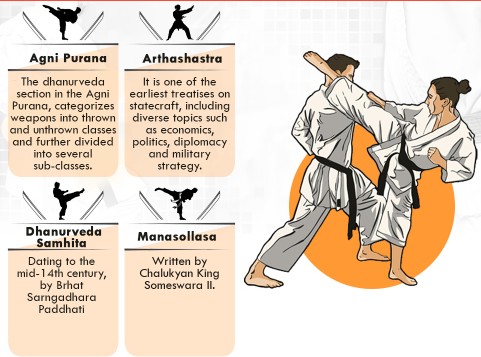
Sou rces of Martial Arts
| MARTIAL ART | LOCATION | FEATURES |
| Kalaripayattu | Kerala and nearby areas of Tamil Nadu | Often known as the ‘Mother of All Martial Arts’, this is 3000-year- old art form. The term ‘kalari’ refers to the place where this combat style is taught while ‘payattu’ means to practise. Footwork pattern are most critical elements in this martial art. It was banned during British Raj It includes techniques like Uzhichil (massage with gingli oil), Koltharipayyatu (Use of wooden weapons), Angathari (use of metal weapons and sticks of Kolthari) and Verumkai (bare-handed fight) |
| Silambam | Tamil Nadu | It is a weapon based martial art. It is a kind of staff fencing. Pandyas, Cholas and Cheras promoted it during their reign. It was mentioned in silappadikaram Food pattern (Kaaladi) plays an important role. It was banned during British Raj. |
| Thang Ta (Huyen Langlon) | Manipu | It finds its mention as one of the most lethal combat forms. Thang-Ta literally means ‘sword and spear’, is one aspect of Huyen Langlon (art of war or method of safe guarding). Sarit Sagar is the weapon less version of Thang Ta. |
| Gatka | Punja | Gatka is a weapon-based martial art practiced by the Sikhs of Punjab. The term "Gatka" refers to one whose freedom is granted by grace. It involves the skilled use of various weapons, including sticks, Kirpan, Talwar and Kataar. The techniques of attack and defense are influenced by the positioning of the hands and feet, as well as the type of weapon used. |
| Musti Yoddha | Uttar Pradesh | It is an unarmed material art form. Originated in one of the oldest city Varanasi. It facilitates in the development of all three aspects - physical, mental and spiritual. |
| Lathi | Bengal and Punjab Regions | An ancient armed martial art form of the country, Lathi also denotes one the world’s oldest weapons used in martial arts. |
| Mardani Khel | Maharashtra | This is a traditional Maharashtrian armed martial art, which is practiced widely in the district of Kolhapur. It was created by Maratha Warriors. It is known for the use of the unique Indian Patta (sword) and Vita (corded lance). Famous practitioners included Shivaji Maharaj. |
| Pari khanda | Biha | Pari-khanda, created by Rajputs. It involves fighting using sword and shield. Still practiced in many parts of Bihar, its steps and techniques are widely used in Chhau dance. The name of this martial art consists of two words, ‘Pari’ that means shield while ‘khanda’ refers to sword, thus the use of both sword and shield in this art. |
| Cheibi Gad ga | Manipu | It involves fighting using a sword and a shield. At present warrior use a stick instead of sword and leather made shield. The contest takes place in a circle of 7 m. diameter on a flat surface. |
| Thoda | Himachal Pradesh | It is a mixture of martial arts, sports and culture. It takes place during Baisakhi festival. It originated in kullu region. Archery prowess is used in it. It can be dated back to Mahabharata; the times when bows and arrows were used in the epic battle |
| Inbuan | Mizoram | It is form of wrestling originated in 18th century. The contest takes place on a carpet or grass in a circle of 15 feet diameter. It follows very strict rules that prohibit stepping out of the circle, kicking and knee bending. |
| Sqay | Kashmi | It is weapon based martial form and involves sword fighting. It has recognised as sport form by Indian government. More than 40 countries organize championship in sqay. |
| Kara Kathi Samu | Andhra Pradesh | It was originally practised by royal armies. Various kinds of swords are used in this. Vairi is a stick fight in this and like prelude to actual sword fight. |
OTHER IMPORTANT MARTIAL ART FORMS
| Martial Art Form | Region | Binot | Madhya Pradesh | |
| Bothati | Punja | |||
| Ranapa Nacha | Southern parts of Odisha | |||
| Adithada adi | South India | |||
| Bandesh | Andhra Pradesh | |||
| Gatta gusthi. | Kerala | |||
| Varma Kalai | Tamil Nadu | |||
| Aki Kiti | Nagaland | |||
| Paika Akhada | Odisha | |||