INTRODUCTION
Indian civilization has produced plenty of literary works dealing with diverse topics and issues such as religion and philosophy, science and technology, politico-administrative system and socio-religious life.
Indian literature can be broadly divided into 2 categories, namely religious literature and secular literature. Vedas, Puranas, epics and Smritis are part of religious literature whereas books like Arthashastra and Rajatarangini are examples of secular literature. Religious literature deals with issues like religion and philosophy whereas secular literature deals with issues like social life, administration and economy.
ANCIENT INDIAN LITERATURE
Vedic Literature
The word Veda is derived from the Sanskrit root Vid which means ‘to know’. The vedas are collection of hymns, charms, prayers and sacrificial formulae. The Vedas were initially handed down orally by generations of Brahmin families but it is estimated by historians that they were compiled around 1500-1000 BC. In the Hindu tradition, they are considered
sacred because they are the divine revelations, which were determined by Gods to guide humans eternally.
The vedic knowledge is considered as timeless and universal in nature. This is the reason the vedas are also are known as Nityas.
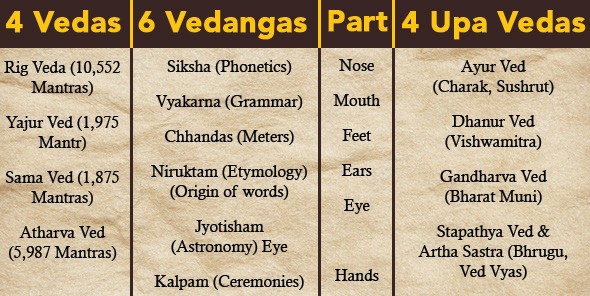
There are four major Vedas: Rig Veda, Yajur Veda, Sama Veda and Atharva Veda. Each of these has 4 sub parts in the form of Samhitas, Brahmanas, Arankyas and Upanishads.
The Vedic Literature is divided into two types:
Shruti Literature - The meaning of ‘Shruti’ in Shruti Literature is ‘to hear’ (sound). It explains the sacred texts which consist of Vedas, Brahmanas, Aranyakas and Upanishads. It has the knowledge of revelations and undoubtful truths.
Smriti Literature - Remember or Remembering is the meaning of ‘smriti’. It may or may not change over time. Smriti Literature has post-Vedic Classical Sanskrit literature. It consists of vedanga, Shad darshana, Puranas, Itihasa, Upveda, Tantras, Agamas, Upangas.



Rigveda


Rigveda is the oldest among the all 4 vedas. It has 1028 hymns or suktas classified in 10 mandas (chapters). Hotri priests were associated with Rigveda. The 2nd, 3rd, 4th, 5th, 6th and 7th mandals are the oldest. They were composed by different families of priests and therefore these mandals are famously known as family books.
Furthermore, each mandala contains a number of Suktas or hymns, which are typically used for sacrificial purposes. The majority of the hymns are about life, death, creation, sacrifice, and seeking godly pleasure or soma. The entire Rig Vedic hymns are dedicated to various deities, specifically to their chief deity, Indra. The Rig Veda also mentions other prominent gods such as Agni (God of Fire), Varuna (God of Water), Rudra (God of Wind/Storm), Aditya (a form of Sun God), Vayu (God of Air), Ashwini twins. There are hymns dedicated to female Goddesses as well, such as Usha (Goddess of Dawn), Prithvi (Goddess of Earth), and Vak (the Goddess of speech).
Gayatri mantra is a part of 3rd mandala of Rigveda. It was composed by Vishwamitra and is dedicated to Savitri.
Aitareya Brahmana and Kaushitaki Brahmana are part of Rigveda. Aitareya Brahmana was composed by Mahidasa Aitareya. It contains the first reference of kingship origin and divides India into 5 geographical regions.
Yajurveda
Yajurveda samhita is a collection of hymns used by priests during rituals and ceremonies. It was originally recited by Adhvaryu priests during rituals and ceremonies. It is divided into Krishna Yajurveda and Shukla Yajurveda. They are in prose and verse forms respectively. Taittiriya Brahmana and Satapatha Brahmana are part of Yajurveda. Satapatha Brahmana has detailed description of Upanayana Samskana. An entire chapter of Satapatha Brahmana is dedicated to ploughing or agricultural rituals.
Taittriya Upanishad, Brihadaranyaka Upanishad, Katha Upanishad, Isa Upanishad, Svetasvatara Upanishad and Maitrayaniya Upanishad are associated with Yajurveda. Brihadaranyaka Upanishad contains the first or earliest reference of transmigration of soul.
Samaveda
The Sama Veda is named after ‘Saman’ (melody), and it focuses on melody or songs. While the entire text contains 1875 hymns, historians argue that only 75 are original and the rest are from the Sakala branch of the Rig Veda. It consists of hymns, detached verses, and 16,000 ragas and raginis (musical notes). The text has also been referred to as the “book of chants” due to its lyrical nature. It also demonstrates how Indian music evolved during the Vedic period.
It is available in 3 version, namely Jaiminiya in Carnatic,
Kauthuma in Gujarat and Rayaniya in Maharashtra.
Tandya Mahabrahmana or Panchavimsha Brahamana,
Shadavimsa Brahmana and Jaiminiya Brahmana belong to Samveda. Kena Upanishad or Talavakara Upanishad and Chhandogya Upanishad also belong to Samveda.
Atharvaveda
This Veda, also known as Brahma Veda, has been attributed to two rishis named Atharvah and Angira. Because of its connection to the two rishis, it was also known as Atharvangirasa in the past. While it is primarily concerned with the peace and prosperity of human society and encompasses all aspects of a man’s daily life, it focuses specifically on the treatment of various ailments. The book is known to contain treatment recommendations for nearly
99 diseases. The Paippalada and Saunakiya are the two major recensions (sakhas) of the text. The majority of the text is concerned with healing and black and white magic; speculation on the changes in the universe; and even issues concerning everyday problems in a householder’s life.
Gopatha Brahmana and Mundaka Upanishad belong to Atharvaveda. The phrase ‘Satyameva Jayate’ is mentioned in Mundaka Upanishad.
Upvedas
All the 4 Vedas have 1 Upaveda each associated with them. These Upavedas are like appendices to main books. They deal with specific issues in detail. They are a collection of applied knowledge. These Upavedas are:
Dhanurveda is Upaveda of Rigveda. It deals with the
science of warfare.
Shilpaveda is Upaveda of Yajurveda. It deals with the science of engineering and architecture.
Gandharvaveda is Upaveda of Samaveda. It deals with music, dance, poetry, sculpture and erotica, etc.
Ayurveda is Upaveda of Atharvaveda. It deals with the science of longevity. It is a book of the medicine branch of medical science.
Vedangas
The literal meaning of Vedanga is ‘limb of Veda’. Vedangas were composed to facilitate proper understanding of the Vedas. They are 6 in number:
Nirukta Vedanga deals with etymology, i.e., origin of words. Example: Yaska’s Nirukta.
Vyakarana Vedanga deals with grammar. Example: Panini’s Ashtadhyayi.
Shiksha Vedanga deals with phonetics, i.e., proper pronunciation of words. Example: Panini’s Shiksha.
Chhanda Vedanga deals with the science of metres. Example: Pingala’s Chhandasashtas.
Jyotish Vedanga deals with astronomy. Example: Lagadha’s Vedanga Jyotish.
Kalpa Vedanga deals with ritual portion, i.e., how

and when a particular sacrifice should be conducted. Example: Sulva Sutras and Srauta Sutras.

Brahmanas
The Brahmanas are a part of sruti literature in Hinduism. Each Veda is accompanied by a Brahmana, which is essentially a collection of texts with commentaries on the specific Veda. They are typically a mix of legends, facts, philosophy, and in-depth explanations of Vedic rituals. They also include instructions on how to properly perform rituals and explain the science of sacrifice. They also explain the symbolic meaning of the sacred words used in rituals. Although historians disagree on the dating of the Brahmanas, it is generally assumed to have been written and compiled between 900 and 700 BC.

Aranyakas
The Aranyakas are texts related to the Vedas that describe the Vedic rituals and sacrifices from various perspectives. They are said to be assemblages of ritualistic information on the birth and death cycles, as well as the complexities of the soul. It is claimed that they were taught by holy and learned men known as Munis, who preferred to live within the boundaries of the forests.
Upanishads
The term Upanishad or u (at), pa (foot), ni (down), and s(h)ad (to sit), i.e., to sit near (the teacher), completely describes the text. We have over 200 known Upanishads, and the teacher usually passed them down verbally to his students while they sat in front of him in the forest. This custom was a part of guru-shishya parampara.
These are Sanskrit treatises that give an account of the Vedas in primarily monastic and mystical terms.
The Upanishads are said to contain the “truth” about human life and to point the way to salvation, or moksha. They discuss the abstract and philosophical problems that mankind faces,
particularly the origin of the universe, the supposed origin of mankind, the life and death cycle, and man’s material and spiritual quests.
While Aranyakas deals with ritualistic sections, the Upanishads deals with spirituality and knowledge.
Sutra Literature
These texts were created by rearranging Vedic hymns in short forms to ease their memorization. By the 6th century BC, the quantum of Vedic knowledge had become huge. It was becoming practically impossible to remember this Vedic knowledge and was classified into 4 specialized sections in short form and these texts were known as Sutras. The four sutras were in the form of Srautasutra, Sulvasutra, Grihyasutra and Dharmasutra.
TWO EPICS
Following are the two great epics which also known as Mahakavya because they have become part of the collective memory of Hindus.
• Ramayana
Valmiki, also known as Adikavi (the first poet), is credited with composing the most famous and revered version of the Ramayana, often referred to as Adikavya. This epic consists of 24,000 verses and is divided into seven sections, known as Khandas. The Ramayana narrates the story of the battle between Lord Rama and the demon king Ravana, who abducts Rama’s wife, Sita. Key characters such as Hanuman, Lakshmana, and Vibhishana played crucial roles in the battle, which took place in Lanka (modern-day Sri Lanka). Ultimately, Rama's victory over Ravana and the rescue of Sita symbolize the triumph of good over evil.
• Mahabharat
The Mahabharata exists in several versions, with the most well-known one written by Ved Vyasa. Originally composed in Sanskrit, it began with 8,800 verses and was known as the Jaya, meaning the "story of victory." Over time, additional stories were incorporated, increasing the verse count to 24,000, and it was renamed Bharata, after the ancient Vedic tribes. The version we know today contains 100,000 verses, divided into 10 parvas (books). The epic centers around the conflict between the Kauravas and the Pandavas, who vie for the throne of Hastinapur. It also includes the Bhagavad Gita, a significant philosophical and spiritual text.
PURANAS
The term "Purana" refers to texts that "renew the old," preserving and passing down ancient knowledge. These mythological texts of ancient India narrate the creation of the universe and its history, extending to its eventual destruction. They tell the tales of kings, heroes, sages, and demi-gods, with a particular emphasis on the divine Hindu trinity: Brahma, Vishnu, and Mahesh (Shiva).

There are 18 major Puranas (Mahapuranas), each dedicated to a specific deity and elaborating on the philosophical and religious concepts associated with them. Some of the more prominent and well-known Puranas include the Bhagavata, Brahma, Vayu, Agni, Garuda, Padma, Vishnu, and Matsya.


These texts offer valuable insights into the social, cultural, and religious life of Post-Vedic India, providing historians with critical information about geography, history, and dynastic genealogies. Written in a simple, narrative style, the Puranas combined myths, legends, and teachings about deities, making them accessible to the masses, especially those who did not understand the complex Vedic texts.
As a result, the Puranas were translated and disseminated in various vernacular languages. They use parables and fables to convey their messages:
• Parable: Short stories that illustrate spiritual, moral, or religious lessons, typically involving human characters.
• Fable: Brief stories that impart moral lessons through a maxim or a clever narrative, often featuring animals, inanimate objects, mythical creatures, or plants endowed with human-like qualities.
Vishnu Sharma's Panchtantra is a famous example of such stories, using animals to teach moral lessons and provide worldly wisdom. Similarly, Hitopadesha, written by Narayan Pandit, is another well-known work in the same genre.
Upapuranas
The Puranas were so popular among the masses that they spawned a new sub-genre known as Upa-Puranas, or minor Puranas.
There are approximately 19 minor Puranas that are based on five major subjects as dictated by Amarasimha, a Sanskrit lexicographer from the Gupta Period.
Sanskrit Poetry
In contrast to the drama section, where the storey is the primary focus of the text, poetry focuses on the form, style, figure of speech, and so on.
Kalidasa, who wrote Kumara Sambhava (the birth of Kumar) and Raghuvamsa (the dynasty of the Raghus), is one of the greatest Sanskrit poets. He also wrote two shorter epics, Meghaduta (the Cloud Messenger) and Ritusamhara (medley of seasons).
Harisena during the Gupta period wrote several poems in praise of Samudra Gupta’s bravery, and they were so well received that they were inscribed on the Allahabad pillar.
Jayadeva, who wrote Gita-Govinda was another well-known Sanskrit poet. It focuses on Lord Krishna’s life and adventures. The text incorporates elements of Lord Krishna’s devotion, his love for Radha, and the beauty of nature. Bharavi (550 A.D) wrote Kiratarjuniyam (Kirat and Arjun) and Magha (65-700 A.D) wrote Sishupalavadha (the killing of Shishupal)
Other Important Sanskrit Texts
Historians believe that between 500 and 200 BC, several major books on law, known as the Dharamsutras, were written and compiled. These were compiled alongside the Dharamshastras, which are smritis. Most Hindu kingdoms’ subjects are governed by laws based on these principles.
Manusmriti (Laws of Manu) – It is another important text that defines the role of man and woman in society, their interaction on a social level, and the code of conduct that they were expected to follow. The text is written in the style of a speech given by Manu, mankind’s ancestor. The Manusmriti was possibly written and compiled between 200 BC and 200 AD.
Kautilya’s Arthashastra – It is one of the most famous texts on statecraft from the Mauryan period. It focuses on the Mauryan empire’s economic and social conditions. The military strategy that the state should employ was given careful consideration. The text mentions ‘Kautilya’ or ‘Vishnugupta’ as the author. Historians believe that both of these names were aliases for Chanakya, a learned scholar at Emperor Chandragupta Maurya’s court.
Some important scientific texts written during this time period are:
• Charak’s Charak Samhita (Book on Medicine)
• Sushruta’s Sushruta Samhita (Book on surgery)
• Varamihira’s Pancha Siddhantika (Book on astrology) and Brihat Samhita (book on wide-ranging subjects like planetary movements, geology, architecture
• Aryabhatta’s Aryabhatiya (Book on astronomy and mathematics)
Buddhist Literature
Has been covered in Chapter-14 ' Buddhism'
Jaina Literature
Has been covered in Chapter-15 ' Jainism'
DRAVIDIAN LITERATURE
It consists Tamil, Telugu, Kannada and Malayalam literatures.
Tamil Sangam Literature
This literature is a collection of works that contains approximately 2381 poems that have been attributed to 473 poets. There are also 102 poets who remains anonymous. The poets were both men and women from different classes of society. The literary tradition was so popular that the period between 300 BC and 300 AD, when the majority of these were composed and compiled, is commonly referred to as the Sangam period.
There are two major schools of Sangam literature:
Aham/agam – It is the ‘inner field,’ which focuses on the abstract discussion of human aspects such as love, sexual relations, and so on.


Puram – It is the ‘outer field,’ which discusses human experiences such as social life, ethics, valor, and customs, among other things.
This literature is known as ‘Sangam’ because the kingdom of Pandya organized assemblies to which poets, bards, and writers from all over South India would flock. These gatherings were known as ‘Sangamas,’ and the literature produced during these gatherings was known as Sangam literature. Over a 600-700-year period, three Sangams were organized.
| SANGAM | KINGDOM | PLACE OF ORGANISATION | CHAIRMAN | BOOKS |
| First | Pandya | Madurai | Agastya or Shiva | There is no surviving book. Grammar was Agattiyam. |
| Second or Middle Sangam period | Pandya | Kapatapuram | Initially, Agastya was in charge, and then his disciple Tolkappiyar took over. | Tolkappiyam was composed of approximately 2,000 poems. Tolkappiyam is a Tamil grammar textbook that explains the inflection and syntax of words and sentences as well as the classification of habitats, animals, plants, and humans. |
| Third | Pandya | Madurai | Nakkira | The majority of the existing Sangam literature corpus was written. |
In the extant Sangam literature, approximately 30,000 lines of poetry have been arranged in eight anthologies known as Ettuttokoi. It was further divided into: Patinenkil Kanakku (eighteen lower collections) is the older and more historically significant group, and Pattupattu(the ten songs).
Thiruvallurar, a well-known and revered Tamil saint contributed the ‘Kural’ to Sangam literature. Avvaiyar is another well-known female saint who contributed to Sangam literature.
The Tolkappiyam was written to elaborate on the finer points of Tamil grammar and poetry.
Like the twin Sanskrit epics, Ramayana and Mahabharata, Tamil has two major texts written in the sixth century AD, namely Silappadikaram (story of an anklet) written by Ilango Adigal and Manimekalai (the story of Manimekalai) written by Sattanar.
BHAKTI LITERATURE
The development of the Bhakti movement took place in Tamil Nadu between the seventh and twelfth centuries. Originally began in South India in the 9th century with Shankaracharya spread over all parts of India and by the 16th century was a great spiritual force to reckon with, especially after the great wave made by Kabir, Nanak and Shri Chaitanya.
During the early medieval period, Vaishnava Bhakti sentiments began to influence Tamil literature, with texts
written between the 7th and 12th centuries being highly devotional. The 12 Alvars, saint poets in Tamil-speaking regions, wrote several texts, including Andal, a woman known as Alvar.


The Nayanars, who sang the praises of Shaivism, also contributed to the Bhakti movement.
Two popular literary works, Periya Puranam and Kamba Ramayanam, were developed during the Chola period. Thayumanavar, a Tamil spiritual philosopher, advocated for Shaiva Siddhanta philosophy and protested against temple entry abuses and the caste system.
Tolkappiyam
It is acknowledged as the earliest surviving Tamil literary work and was written by Tolkappiyar (one of the 12 disciples of saint Agastya). It is a work on the grammar of spoken and written language Tamil. It talks about the twofold walks of life, the aham or agam and puram. It also deals with the cultural history and geographical studies of ancient Tamil Land.
Silappadikaram
This earliest Tamil epic (palm leaf manuscript) is a tragic love story, which involves the ordinary couple, Kannaki and her husband Kovalan, and Kovalan’s later love Madhavi. The couple is caught up with universal questions and internal, emotional war. Silappadikaram literally means the tale of an anklet, as the anklet belonging to Kannaki plays a vital role in the story. It revolves around Kannaki, who having lost her husband to a miscarriage of justice at the court of the King of the Pandyan Dynasty, wreaks her revenge on his kingdom. The River Cauveri, Sun, Moon and the city of Poompuhar are praised by author llango- Adigal in this Tamil epic, written around the 5th-6th century. It is believed to have Jain elements.
Manimekalai
It is again a Tamil epic composed by Satanar probably around the 6th century. It is an anti-love story, a sequel to the love story in the earliest Tamil epic. It describes the story of Manimekalai, the beautiful daughter of Kovalan and Madhavi. She was a nun of Mahayana Buddhism. The text is believed to have Buddhist elements.
Nature of Bhakti Literature
• Inter-religious Harmony: Bhakti and Sufi cults collaborated, with various sufi saints’ recitations included in Sikh religious canons. Shri Guru Granth Sahib incorporated Kabir’s teachings, and Bhakti spread through adoption of vernacular languages.
• Inclusive Literature: It preached for removal of sectarianism and casteism. The Bhakti literature called for inclusion of castes and out-castes.
• Against unorthodox rituals of the traditional society.
• Muslim poets Daulat Kazi and Sayed Alaoal wrote poems that were a cultural synthesis of Hinduism and Islam.
Contribution of Bhakti Literature to Indian Culture
• Growth of Vernacular languages: The Bhakti literature promoted the growth of vernacular language in different parts of the country.
• In eastern Uttar Pradesh Sufi saints, such as Mulla Daud, the author of ‘Chandayan’, Malik Muhammad Jaisi, the author of ‘Padmavati’ wrote in Hindi and put forward Sufi concepts in a form which could be easily understood by the common man.
• Amongst the eastern group of languages, Bengali was used by Chaitanya and by the poet Chandidas, who wrote extensively on the theme of the love of Radha and Krishna.
• It was also a Bhakti leader Shankaradeva, who popularized the use of the Assamese in the Brahmaputra valley in the 15th century. He used an entirely new medium to spread his ideas.
• In today’s Maharashtra, Marathi reached its apogee at the hands of saints like Eknath and Tukaram.
• Other prominent saints like Kabir, Nanak, and Tulsidas contributed enormously to regional
literature and language with their captivating verses and spiritual exposition.
• Emergence of a new cultural tradition with the influence of Bhakti and sufism.
• Also emergence of new sects like Sikhism, Kabir panth etc.
Philosophical Growth: Post-Vedanta ideas were explored by Madhvacharya through his Dvaitadvaita, Ramanujacharya in his Vishishta Advaita etc.
• As a literary movement, it liberated poetry from singing the praises of kings and introduced spiritual themes. From a style point of view, it introduced simple and accessible styles like vachanas (in Kannada), saakhis, dohas and other forms in various languages and ended the hegemony of Sanskrit metrical forms.
The ideas of Bhakti movement continued to permeate the cultural ethos of the society through the enormous body of literature left by them. The congruence in their ideas not only saved us from the likely internecine conflicts but also built the spirit of tolerance. To appeal to the common masses, their messages were composed into songs, proverbs, and stories that led to the development of Awadhi, Bhojpuri, Maithili and a number of other languages.
Malayalam Literature
Malayalam language is spoken in Kerala region. Although linguists argue that the language originated in the 11th century, it developed a corpus of literature rich enough to be called an independent language within a span of four hundred years.
Kokasandisan and Bhasa Kautilya, a commentary on Arthashastra, are two major Malayalam works from the medieval period. Ramacharitam, an epic poem written by Cheeraman in the 13th century, is another significant literary work in Malayalam. Ezhuthachan, a staunch supporter of the Bhakti movement, is regarded as the father of Malayalam literature.
Telugu Literature
It is believed Nannaya (11th century) was the first Telugu poet. Several great works have been written in Telugu, but they reached their pinnacle during the Vijayanagara period, also known as the golden age of Telugu literature.
Nachana Somanatha, a well-known court poet of King Bukka I, composed one of the most successful works during this period, titled Uttaraharivamsam. Not only were court poets producing exceptional literature, but kings such as Krishnadevaraya (1509-1529) were also producing exceptional poetry titled Amuktamalyada. During Krishnadevaraya’s reign, his court was attended by eight learned literary figures. They were known as ashtadiggajas.

| POET | WORK |
| Allasani Peddana (also known as Andhra Kavita pitamaha) | Manucharitam |
| Nandi Thimmana | Parijathapaharanam |
| Tenali Ramakrishna | Panduranga Mahatmayam |
| Ramaraja Bhushanudu (also known as Bhattumurti) | Vasucharitram Narasabhupaliyam Harishchandra Nalopakhyanam |
| Madayyagari Mallana | Rajashekharacharitra (about the love and war of the King Rajasekhara of the kingdom of Avanti) |
| Ayyalaraju Ramabhadrudu | Ramabhyudayam Akalakathasara |
Kannada Literature
The first foray into Kannada literature was made by Jain scholars. The best example of a Jain-influenced text is Madhava’s Dharmanathapurana, a biography of the fifteenth Tirthankara. Several other scholars, including Uritta Vilasa, wrote Dharma Parikshe about the Jain teachings of the time.
Kavirajamarga, written by Nripatunga Amoghavarsha I in the tenth century, is one of the earliest recorded Kannada texts. He was also a Rashtrakuta king of great power. There were many great scholars in Kannada, but the ‘ratnatraya’ or ‘three gems’ were unparalleled. The ratnatraya was made up of three poets named - Pampa, Ponna, and Ranna.
Pampa also known as the “Father of Kannada,” wrote two of his most famous works, Adipurana and Vikramarjuna
Vijaya, in the tenth century. He known for his mastery of the rasa used in poetic compositions, was assigned to the court of Chalukya Arikesari.
Ponna wrote a well-known treatise called Shanti Purana, and Ranna wrote Ajitanatha Purano. These two poets were associated with Rashtrakuta king Krishna III’s court.
Although Kannada became a full-fledged language by the tenth century, the growth of Kannada literature has been closely linked to the Vijayanagara empire’s patronage.
Sarvajna, who wrote tripadi, was given the title of people’s poet. Even more remarkable is Honnamma, the first poetess of some renown in Kannada who wrote Hadibadeya Dharma (Duty of a Devout Wife).


| POET/AUTHOR | TEXTS |
| Harishvara | Harishchandra Kavya Somanatha Charita |
| Bandhuvarma | Harivamshabhyudaya Jiva Sambodhana |
| Rudra Bhata | Jagannathavijaya |
| Andayya | Madana Vijaya or Kabbigara Kava (First pure Kannada text which did not have any Sanskrit word) |
| Kesirja | Shabdamanidarpana (Grammar book) |
| Mallikarjuna | Suktisudharnava |
| Narahari | Tarave Ramayana (The first story on Rama was inspired by the Valmiki Ramayana and written entirely in Kannada.) |
| Lakshamisha | Jaimini Bharata (It is also called Kamata-Karicutavana-Chaitra) |

SIKH LITERATURE


Sikhism was established in the 15th century and is based on the teachings of Guru Nanak. The beliefs and philosophies of Sikhism are written in the religion’s sacred scripture, the Guru Granth Sahib.
Important literary works of Sikhism:
• Adi Granth: It was compiled in 1604 by Bhai Gurdas under the auspices of the fifth guru, Guru Arjan Dev. It’s written in the Gurumukhi script.
• Guru Granth Sahib: Guru Gobind Singh, the tenth guru, expanded on Adi Granth in 1678. It is regarded as the Sikhs’ eleventh and final spiritual authority. It is written in Gurumukhi script and in the Sant Bhasa language.
• Dasam Granth: It is widely assumed that the hymns written by Guru Gobind Singh (Tenth Guru) are compiled in this book, but many disagree. It consists fables and Puranic stories.
• Janamsakhis: The Janam Sakhis, which literally translate as “birth stories,” are writings that are biographies of Guru Nanak. Bhai Bala Janamsakhi, Miharban Janam Sakhi and Adi Janam Sakhi are popular books.
MEDIEVAL LITERATURE
During medieval many dialects and languages emerged from the Apabhramsa language which was derived from Pakrit language. This period was marked by emergence of the Persian as the writing language of the Delhi Sulatanate and the Mughal courts.
Persian Literature
Although the roots of the Persian language are as ancient as Sanskrit, it made its way to India with the arrival of the Turks and Mongols in the 12th century. During their rule, Persian became the primary language of the royal courts. One of the most celebrated Persian poets of this era was Amir Khusrau Dehlavi (12th-13th century), who not only compiled a Divan (a collection of Persian poetry) but also authored Nuh Sipihr and the tragic love poem Duval Rani-Khizr Khan.
Ziauddin Barani, a prominent historian of this period, is best known for his work Tarikh-e-Firoz Shahi, while another important historian, Minhaj-i-Siraj, also made significant contributions to historical literature. Famous travelers like Ibn Battuta, a Moroccan explorer, wrote extensively about the socio-political landscape of the time.
The Mughal era saw a significant rise in the production and dissemination of Persian literature. Babur’s Baburnama, written in Turkish, is an invaluable autobiography that provides insights into the Mughal conquest of India. Tuzuk-i- Jahangiri, the autobiography of Emperor Jahangir, is one of the most important sources for understanding his reign. Another significant work from this period is Humayun-namah, a memoir written by Humayun's half-sister, Gulbadan Begum, detailing his life and struggles for the throne.
The greatest emperor of the Mughal period, Akbar, greatly contributed to Persian literature. His Ain-e-Akbari and Akbarnama, written by his court historian Abul Fazl, are considered masterpieces of the era. Akbar also commissioned several translations of Sanskrit texts, including the Ramayana, Bhagavad Gita, and various Upanishads, into Persian. One notable translation is the Razmnama, a Persian version of the Mahabharata by Badauni.
Among the highly illustrated works of this period is the Hamzanama, which chronicles the adventures of the legendary Persian hero, Amir Hamza. Malik Muhammad Jayasi’s Padmavat, composed in 1540, is another significant literary work. Faizi, a renowned Persian poet and one of Akbar’s Navaratnas, is credited with several important contributions to Persian literature.
The reign of Shah Jahan also saw the creation of several significant works, including Shahjahannama by Inayat Khan, which detailed the emperor's rule. During Aurangzeb’s reign, satirists like Jafar Zatalli composed works such as Kulliyat (a collection of poetry). Padshahnama, written by Abdul Hamid Lahori, offers a detailed account of Shah Jahan’s reign.
Persian literary sources of medieval India reflect the spirit of the age
• Non-native people brought Arabic, Persian, and Turkish to India, and Persian became the preferred language of rulers during this period.
• Influential poets like Amir Khusrau and Amir Hasan Dehlvi created excellent poetry in Persian, while famous historians like Minhas-us-Siraj, Ziauddin Barani, and Ibn Batuta wrote about rulers and political events.
• Persian remained the official language of the Mughal court, with Babur’s memoirs translated into Persian by Abdur Rahim Khan-e-Khanan, Humayun’s diwan, and Dara Shikoh’s biographical version of Sufi saint Mian Mir. Mughal chronicles like the Akbar Nama were written in Persian, and Mughal emperors commissioned translations of Sanskrit texts like the Mahabharata and the Ramayana into Persian.
• Abu’l-Fazl, the author of the Akbar Nama, was a dynamic arguer and liberated thinker who opposed conservative views, impressing Akbar as an adviser and spokesperson for his policies.
• Abdul Hamid Lahori, the author of the Badshah Nama, was commissioned by Shah Jahan to write a history of his rule based on the Akbar Nama.
• Persian chronicles provided Europeans with insight into India’s administration and life during that time.
Urdu Literature
Linguists argue that Urdu arose from the interaction of Persian and Hindi, particularly in Turkish army barracks. Amir Khusrau also wrote several texts in Urdu, which was still in its infancy at the time.
The grammar is based on Hindi, and the form and script are based on Persian. It was originally known as Dakkani because it was used by the Bahamani states of Ahmedabad, Golconda, Bijapur, and Berar (southern).


Mirza Ghalib is a great Urdu poet who wrote Diwan (collection of poetry) in Urdu. Sauda, Dard, and Mir Taq were among the other Urdu poets.
Iqbal, the author of Bang-i-Dara in the twentieth century, was a major figure in Urdu literary writing. He is best known for writing the popular nationalistic song ‘Saare Jahan se achcha.’
Apart from the last Mughal emperors, such as Bahadur Shah Zafar, who also wrote in Urdu, the Nawabs of Awadh supported several Urdu-writing scholars. Sir Sayyid Ahmad Khan, a modernizer who wrote several didactic and nationalist texts in Urdu and English in the twentieth century, gave it new life.
Hindi Literature
Between the seventh and fourteenth centuries, Apabhramsa, which evolved from Prakrit, gave rise to Hindi as we know it today.
The Bhakti movement, which shunned the use of Sanskrit because it was the language of the Brahmins and common people did not use it, gave the language its greatest boost. As a result, they began writing in the language of the people, and from the twelfth century onwards, we see a significant increase in regional languages such as Bengali, Hindi, Marathi, Gujarati, and so on.
For a long time, Hindi literature was overshadowed by its Sanskrit forefathers, but Prithviraj Raso was the first Hindi book, documenting Prithviraj Chauhan’s life and challenges.
The majority of the work is poetry by Bhakti writers such as Kabir, who is famous for his dohas (couplets) that are still used by ordinary Indians today.
Tulsidas wrote couplets in Braj that were peppered with Persian. He achieved immortality through the writing of Ramcharitmanas, one of the most revered Hindu texts. Lord Krishna’s life was also the subject of several medieval poets, including Surdas, who wrote Sur Sagar about Krishna’s childhood and adolescent affairs with the gopis.
Rahim, Bhushan, and Raskhan wrote about their devotion to Lord Krishna as well. Mirabai is also known as the woman who gave up everything for Lord Krishna and wrote Bhakti poetry for him. Satsai from Bihar is also well-known in this regard.
MODERN LITERATURE
This literature also known as Adhunik Kaal literature. Hindi emerged as the major language in north India along with other languages like Bengali.
Hindi Literature
The focus of literature shifted with the arrival of the British. This shift was especially noticeable in Hindi prose writing, where there was a desire to return to the classics and be inspired by Sanskrit. This zeal was combined with nationalistic zeal. In
the 1850s, Bharatendu Harishchandra wrote his most famous drama Andher Nagari (City of Darkness), which became a major play and has been reproduced several times. Bharat Durdasha is another well-known nationalist work.
Another significant writer from this era is Mahavir Prasad Dwivedi, after whom an entire period of Hindi writing is named.
There are four subsections in the modern period of Hindi known as Adhunik kaal:
| YUG | TIME PERIOD |
| Bhartendu Yug | 1868-1893 |
| Dwivedi Yug | 1893-1918 |
| Chhayavad Yug | 1918-1837 |
| Contemporary Period | 1937-today |
Swami Dayanand spearheaded the movement to make Hindi the national language, which would connect all regions. Although he wrote extensively in Gujarati, Satyartha Prakash is his most well-known work in Hindi.
Several Hindi authors, including Munshi Prem Chand, Surya Kant Tripathi ‘Nirala,’ and Maithili Sharan Gupt, challenged societal norms.
Prem Chand wrote many anthologies in Hindi and Urdu, and some of his best-known works include Godan, Bade Bhhaiya, and others.
Sumitranandan Pant, Ramdhari Singh Dinkar, and Harivansha Rai Bachchan, who wrote Madhushala, are other notable Hindi writers.
Mahadevi Verma was a well-known female Hindi writer of the twentieth century. She was awarded the Padma Vibhushan in Hindi for her writing and how it highlighted the plight of women in society.
Bengali Literature
Bengali literature developed alongside Urdu and Hindi in the twentieth century. The establishment of the Baptist Mission Press in Serampore, Bengal by the Englishman William Carey in 1800 facilitated the distribution of this literature.
With the arrival of nationalist fervor in Bengal, the literature took a clear turn toward the concerns of the common man’s suffering and the nation’s plight under British rule.
Raja Ram Mohan Roy was one of the first to write in both Bengali and English, and his work was widely read. Ishwar Chandra Vidyasagar and Akshay Kumar Dutta were two of his contemporaries. Bankim Chandra Chatterjee’s writing, however, was the pinnacle of nationalist Bengali literature. His novel Anand Math


was a huge success, so much so that Vande Mataram, our national anthem, is based on an excerpt from it.
Rabindranath Tagore, the first Indian to receive the Nobel Prize, was also a Bengali writer. In 1913, he received this award for his Bengali masterpiece Geetanjali. Important contributions to Bengali literature have been made by Sharat Chandra Chatterjee, Qazi Nazrul Islam, and R. C. Dutta.
Assamese Literature
Buranjis (court chronicles) dominated Assamese literature during the medieval period. In addition to these official works, Shankardev wrote devotional poetry in Assamese. Padmanaba Gohain Barua and Lakshmi Nath Bezbarua have made significant contributions to modern Assamese literature.
Odia Literature
Odia literature has a sizable corpus from the east of India. Sarala Das created the first piece. Upendra Bhanja, who wrote in 1700, was a notable writer during the Medieval period. Radha Nath Ray and Fakirmohan Senapati have made their mark in the modern era with their work’s nationalistic tone.
Gujarati Literature
The Bhakti movement was at its peak in Gujarat, which influenced the literature written there. Narsinh Mehta is a well-known name in this region for fusing devotional songs for Lord Krishna with local folk traditions. Later works included poetry by Narmad and prose by Govardhan Ram, who wrote the classic Gujarati novel Saraswati Chandra, which was recently adapted into a television series.
Dr. K.M Munshi, who has written both fiction and non-fiction (historical) work, reached the pinnacle of success in Gujarati literature. Prithvi Vallabha is one of his best novels.
Rajasthani Literature
The medieval Rajasthani literature was rife with dialects, and there are two main forms of fictional writing known as Dingal and Pingal. Dhola Maru is the most well-known text in this context. Mirabai’s writings in Braj have become well- known. In this region, several other saints wrote devotional poetry. Rajasthani writers’ stories were typically oral, spread by bards who sang the virkavya (victory poetic songs).
Sindhi Literature
Sindhi literature has been heavily influenced by the two neighboring states of Rajasthan and Gujarat. It has the
influence of Islam and Sufism on poetry. Dewan Kauramal and Mirza Kalish Beg are two well-known names in Sindhi literature.
Kashmiri Literature
One of the earliest texts from Kashmir was Kalhan’s Rajatarangani, which was written in Sanskrit. The locals spoke Kashmiri, which was influenced by Persian and Hindi dialects. When the Bhakti movement was at its peak in the early medieval period, the Kashmiri language saw its first female poetess Lal Ded, a Shaivite mystic.
However, the major spread occurred after the arrival of Islam and Sufism in Kashmir, as well as the publication of several major writers such as Sufi Ghulam Muhammad, Zinda Kaul, Mahjoor, and others.
Another intriguing figure in Kashmiri literature is Noor Din, also known as Nand Rishi, who was said to have combined Hindi and Islamic elements in his poetry. With the Dogra family gaining political power in Jammu in 1846, the Kashmiri language was eclipsed by the Dogri language.
Marathi Literature
Although we refer to it as the Marathi language, Maharashtra has several dialects, and literature is written in all of them. Saint Jnaneshwar’s Jnaneshwari or Bhavartha Deepika is the oldest known work of 13th century in Marathi (also known as Gyaneshwar). He is credited with establishing kirtan in Maharashtra and has written a detailed Marathi commentary on the Bhagavata Gita.
Namdev, Sena and Gora were well-known during the same period. Janabai is the oldest known female writer. However, the most famous Maharashtrian saint of the sixteenth century was Eknath, who wrote commentaries on the Bhagwat Purana and Ramayana as well as works in the vernacular language.
Other notable Bhakti poets include Tukaram and Ramdas. The nationalist movement had an impact on Marathi’s poetry and prose writing as well.
Bal Gangadhar Tilak, one of our greatest nationalists, published his regional newspaper Kesari in Marathi. This publication criticized the British and their policies, as well as tracts written by leading revolutionaries of the time.
With the works of Hari Narayan Apte, V.S. Chiplunkar, and Keshav Sut, Marathi’s prose writing took a turn for the better.
M.G. Ranade, G.T. Madholkar, and K.T Telang are examples of contemporary Marathi poets