INTRODUCTION

Indian philosophy refers to philosophical traditions of the Indian subcontinent. A traditional Hindu classification divides astika and nāstika schools of philosophy, depending on one of three alternate criteria: whether it believes the Vedas as a valid source of knowledge; whether the school believes in the premises of Brahman and Atman; and whether the school believes in after-life and Devas.


Orthodox School
The standard list of six orthodox (Astika) schools (darshanas), the “Six Philosophies” (ṣaḍ-darsana), all of which accept the testimony of the Vedas.
The Vedas, according to this school, are the greatest revealed scriptures that contain the keys of salvation.
They had six sub-schools, called Shada Darshana - such as Samkhya, Yoga, Nyaya, Vaisheshika, Mimamsa, and Vedanta.
SAMKHYA SCHOOL OF PHILOSOPHY
This is the oldest school of philosophy which was founded by Kapil Muni, who wrote Samkhya sutra.
The Samkhya philosophy holds that reality is constituted of two principles one female and the other male i.e., Prakriti and Purusha respectively.
Prakriti and Purusha are completely independent and absolute.
• Shashtra tantra written by Kapil Muni is principal text of this school.
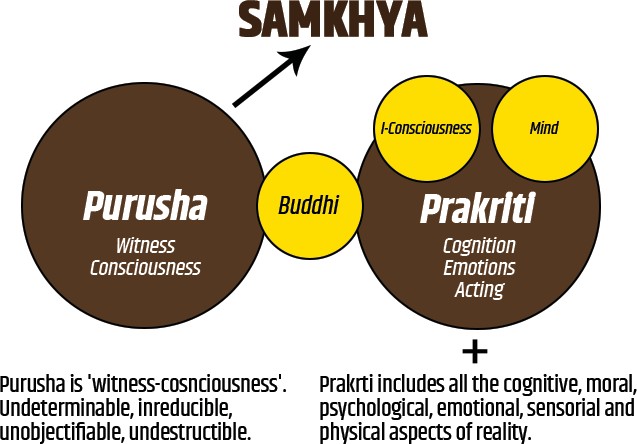
• According to this system, Purusha is mere consciousness, hence it cannot be modified or changed.
• Prakriti on the other hand is constituted of three attributes, thought, movement and the change or transformation of these attributes brings about the change in all objects.
• The Samkhya philosophy tries to establish some relationship between Purusha and Prakriti for explaining the creation of the universe.
• This school does not believe in existence of God. According to this philosophy Prakriti (Nature) created this world and nature is also responsible for evolution. Later the concept of Purusha or soul was introduced as an element of Samkhya philosophy and universe creation was attributed to both Prakriti and Purusha.
• This school believed in dualism or dvaitavada i.e., the soul and the matter are separate entities.
• Samkhya school believes in concept of 3 gunas which are
Sattva (purity), Rajas (power) and Tamas (destruction).

• This school believes in theory of Satkaryavad (there is a cause for every action).

• Samkhya regards ignorance (avidya) as the root cause of suffering and bondage (Samsara). Samkhya states that the way out of this suffering is through knowledge (viveka). Samkhya school states Mokṣa (liberation) results from knowing the difference between prakṛti and puruṣa. To Samkhya, three forms of knowledge are suitable. i.e., Perception (Drista), Inference (Anumana), and Reliable authority (Aptavacana).
This school went through two phases of development:

VAISHESHIKA SCHOOL OF PHILOSOPHY
• Uluka Kanada was its founder and he also known as Kashyapa and Kanabhuk.
• Kanada Sutras is principal text of this school.
• Vaisheshika system is considered as the realistic and objective philosophy of universe.
• The reality according to this philosophy has many bases or categories which are substance, attribute, action, genus, distinct quality and inherence.
• Vaisheshika thinkers believe that all objects of the universe are composed of five elements–earth, water, air, fire and ether (Akash).
• They believe that God is the guiding principle.
• Creation and destruction of universe was a cyclic process and took place in agreement with the wishes of God.
•
Vaisheshika School of philosophy explained the phenomena of the universe by the atomic theory which states universe is atomic in nature and atoms are eternal.
• It recognizes existence of 4 fundamental non-atomic elements viz time, space, soul and mind.
• They also believe that the laws of karma govern this Universe, implying that everything is determined by human deeds.
• This school believes in dualism of matter and soul. Atoms are different from soul.
• A person can attain salvation by realizing this atomic nature and dualism of universe.
• Padartha Dharma Sangraha is commentary on vaisheshika written by Prashastapada.
NYAYA SCHOOL OF PHILOSOPHY

Akshapada Gautama was founder of this school and Nyaya Sutras composed by him is principal text of the school.
Nyaya is considered as a technique of logical thinking. According to Nyaya, valid knowledge is defined as the real knowledge, that is, one knows about the object as it exists.
For example, it is when one knows a snake as a snake or a cup as a cup. This is also known as school of logic and analysis.
This school argues that logical tools like inference, hearing, and analogy could verify truth of preposition or statement.
According to the Nyaya school, there are exactly four
sources of knowledge (pramanas):

• perception (pratyaksha)

• inference (anumana)
• comparison (upamana), and
• sound, or testimony (shabda)
Like the other systems, Nyaya is both philosophical and religious. Its ultimate concern is to bring an end to human suffering, which results from ignorance of reality.
Clear thinking and logical arguments are considered essential to attain salvation.
The Nyaya system—from Gautama through his important early commentator Vatsyayana (c. 450 CE) until Udayanacharya (Udayana; 10th century)—became qualified as the Old Nyaya (Prachina-Nyaya).
In the 11th century when a new school of Nyaya (Navya- Nyaya, or “New Nyaya”) arose in Bengal.
The best-known philosopher of the Navya-Nyaya, and the founder of the modern school of Indian logic, was Gangesha (13th century).
YOGA SCHOOL OF PHILOSOPHY
The origin of yoga is found in the Yogasutra of Patanjali believed to have been written in the second century BC.
Yoga literally means the union of the two principal entities.

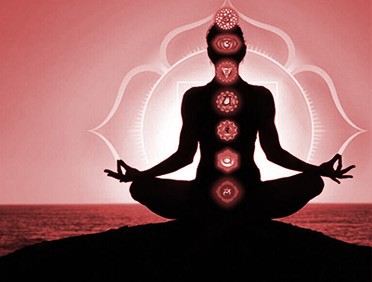
Yogic techniques control the body, mind and sense organs. Thus, this philosophy is also considered a means of achieving freedom or mukti.
According to Yoga philosophy, salvation can attain through physical training (asana) and medication.
This salvation could be attained by practicing self-control (yama), observation of rules (niyama), fixed postures (asana), breath control (pranayama), choosing an object (pratyahara) and fixing the mind (dharna), concentrating on the chosen object (dhyana) and complete dissolution of self, merging the mind and the object (Samadhi).
It recognizes 25 fundamental elements (Tatvas) of Samkhya school but also believes in existence of God.
“Om” is considered as sacred symbol.
Yoga is partial or complete cessation of mental state which results in a new type of wisdom (Prajna) and causes destruction of Avidya.
Raja Bhoja wrote a commentary on Patanjali’s Yoga sutra with ‘Yoga Sutra Vritti’ or ‘Bhoja Vritti’
MIMANSA SCHOOL OF PHILOSOPHY
• Maharshi Jaimini was founder of this school. Jaimini sutras also known as Upadesha sutras is principal text of this school. This school is also known as Purva Mimansa and Karan Mimansa.
• Mimamsa philosophy is basically the analysis of interpretation, application and the use of the text of the Samhita and Brahmana portions of the Veda.
• They claim that the Vedas are the repository of all knowledge and contain the ultimate truth. If one wants to obtain religious merit, paradise, and salvation, one must perform all of the responsibilities given by the Vedas.
• They say that practicing Vedic rituals can lead to salvation, but that understanding the explanation and reasoning behind Vedic rites is also required. It was vital to comprehend this logic if one wished to follow the rituals flawlessly and thereby achieve redemption.
• The merits and demerits of a person were determined by their activities, and a person would experience the bliss of paradise as long as their virtuous acts lasted. They would not, however, be exempt from the cycle of life and death. They will be able to break away from this never-ending cycle after they have found redemption.
• It was associated with Akhyativad (existence of illusion is not accepted).
• By propagating Mimansa philosophy, Brahmanas attempted to maintain their superiority and authority. They wanted to preserve social hierarchy based on Brahmanical values.
• The names associated with this philosophy are Sabar Swami, Bhavdas, Mandana Mishra and Kumarila Bhatta. Mandana Mishra wrote Vidhi Vedhak, Brahmasiddhi and Bhawana vivek.
VEDANTA SCHOOL OF PHILOSOPHY
• Badarayana was the founder of this school.
• His Brahma Sutra is the principal text of this school.
• The literal meaning of Vedanta is end of the vedas.
• It is also known as Uttara Mimamsa or Jnana Mimansa.
• Vedanta implies the philosophy of the Upanishad, the concluding portion of the Vedas. This school adheres to the life ideals outlined in the Upanishads.

• Brahma, according to this philosophy, is the truth of existence, whereas all else is illusory or Maya. In addition, the Atma, or self-consciousness, is analogous to the Brahma.
• This argument equates Atma with Brahma, implying that if a person achieves self-knowledge, he will instantly comprehend Brahma and gain redemption.
• Vedanta philosophy teaches that all these different religions are like so many roads, which lead to same goal.
• The Karma Philosophy was also validated by the Vedanta theory. They believed in Punarjanam or reincarnation as a theory.
• The core message of Vedanta is that every action must be governed by the intellect – the discriminating faculty. The mind makes mistake but the intellect tells us if the action is in our interest or not. Vedanta enables the practitioner to access the realm of spirit through the intellect. Whether one moves into spirituality through Yoga, meditation or devotion, it must ultimately crystallize into inner understanding for attitudinal changes and enlightenment.
Sub-Schools of Vedanta
The school was divided into six sub-schools, each of which interpreted the texts differently and produced its own set of sub-commentaries:
• Advaita (Adi Shankara): It asserts that the individual self (Atman) and Brahman are the same, and that understanding the difference leads to liberation.
• Visishtadvaita (Ramanuja): This school of thought holds that all diversity is subsumed by a unified whole.
• Dvaita (Madhvacharya): It regards Brahman and Atman as distinct entities, with Bhakti serving as the path to eternal salvation.
• Dvaitadvaita (Nimbarka): It states that the highest reality, the controller of all, is Brahman.
•
Shuddhadvaita (Vallabhacharya): It asserts that God and the individual self are indistinguishable.
• Chaitanya Mahaprabhu (Achintya Bheda Abheda): It emphasizes that the individual self (Jivatman) is both distinct and indistinguishable from Brahman.

Shankaracharya
Shankaracharya wrote profound commentaries on the Upanishads, Brahmasutras, and the Bhagavad Gita. His philosophical teachings became known as Advaita Vedanta. The term Advaita translates to "non-dualism," reflecting the belief in a single, unified reality. Shankaracharya taught that the ultimate reality is Brahman, which is both the essence of existence and the highest truth.
According to Vedanta philosophy, Brahman is the only true reality, while the world is considered illusory. Shankaracharya emphasized that there is no distinction between Brahman and the self, asserting that they are one and the same. He believed that Brahman is eternal, unchanging, and the ultimate knowledge—understanding this knowledge is the key to realizing the essence of all things and achieving true existence.
Ramanuja
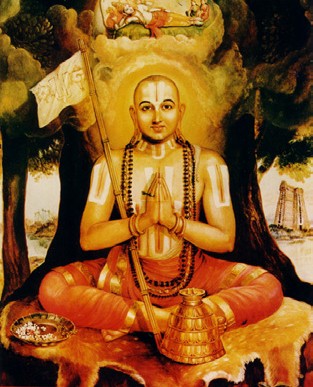
Ramanujacharya lived in the 12th century AD, was another important philosopher of this school. His intervention caused certain changes in the Vedanta school. He believes that Brahma possesses certain qualities. The road to salvation, he believes, is to love the religion and practice devotion.


Heterodox School
Heterodox philosophy in ancient India refers to the philosophical schools and thought systems that were considered non-conventional or outside the mainstream Vedic and orthodox Brahmanical traditions. These heterodox schools of thought often challenged the prevailing religious and philosophical beliefs of their time.
Some of the Notable Heterodox Philosophies in Ancient India are:
Charvaka (Lokayata): Charvaka philosophy, also known as Lokayata, is one of the most well-known heterodox schools in ancient India. It is known for its materialistic and atheistic worldview. Charvakas rejected the authority of the Vedas, denied the existence of an afterlife, and advocated for the pursuit of sensory pleasures as the
highest good.
Ajivika: The Ajivikas were followers of Makkhali Gosala, who founded this heterodox school. They believed in a doctrine of determinism, asserting that all events and actions in the universe were predestined and beyond individual control. The Ajivikas also rejected the concept of karma and rebirth.
Jainism: Although Jainism is now considered one of the major religions of India, it was originally a heterodox school of thought during ancient times. Founded by Lord Mahavira, Jainism emphasizes non-violence (ahimsa), truth, and asceticism. Jains reject the authority of the Vedas and the caste system.
Buddhism: Buddhism, founded by Siddhartha Gautama (Buddha), emerged as a heterodox school of thought that challenged the religious and philosophical ideas of its time. It rejects the authority of the Vedas, the caste system, and the idea of a permanent self (atman). Buddhism offers a path to enlightenment and liberation from suffering.
Atheistic Schools (Nastika Darshanas): In addition to Charvaka, there were other atheistic schools of thought that emerged in ancient India. These schools did not
adhere to theistic beliefs and questioned the existence of a creator god. They include the Ajivikas, the Buddhists, and the Jainas.
Materialist Schools: Some heterodox philosophies in ancient India, including the Charvakas, focused on a materialistic view of the world, denying the existence of the supernatural and emphasizing the importance of empirical observation and sensory experience.
These heterodox schools of thought played a significant role in the intellectual and philosophical history of ancient India. They provided alternative perspectives and challenged the dominant religious and philosophical ideologies of the time, contributing to a rich tapestry of diverse philosophical traditions in the subcontinent. While some of these heterodox philosophies, like Buddhism and Jainism, evolved into major religions, others, such as Charvaka, remained as independent schools of thought.
Conclusion
In our journey through the six classical schools of Indian philosophy—Nyaya, Vaisheshika, Samkhya, Yoga, Mimamsa, and Vedanta—we have witnessed the intricacies of their metaphysical systems, epistemological theories, and ethical principles. Each school, with its unique perspective, has contributed to the philosophical discourse, fostering critical inquiry and dialogue.
From the rationalist approach of Nyaya and Vaisheshika to the dualism of Samkhya, the contemplative practices of Yoga, the ritualistic emphasis of Mimamsa, and the profound inquiry of Vedanta, these philosophical traditions offer a kaleidoscope of ideas and perspectives. They have explored questions of existence, knowledge, morality, and the ultimate reality with rigor and depth.
Ancient Indian philosophy goes beyond intellectual speculation; it is a guide to living a meaningful and ethical life. The emphasis on dharma (duty/righteousness) and moksha (liberation) underscores the practical application of these philosophical ideas in the pursuit of individual and collective well-being.

