A Puppet is a doll or figure representing a person, animal, object or an idea and is used to tell a story. Puppetry is one of the ancient forms of entertainment. Puppetry has long been of interest in India, both for entertainment and educational purposes. In Sanskrit, puppets are termed `Putraka’, `Putrika’ or `Puttalika’, derived from the root Putta equivalent to Putra (son). It is derived from ancient Indian thoughts that puppets have life.

Di fferent Forms of Puppetry in India
Four Basic Kinds of Puppets
String Puppets
Shadow Puppets
Glove Puppets
Rod Puppets
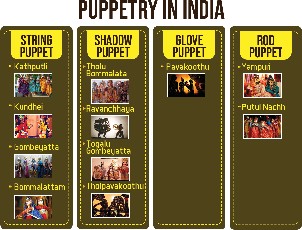
STRING PUPPETS
The string puppet (or marionetter) is a figure with multiple joints and suspended by a string which is controlled. String puppets have a prominent presence in the Indian cultural traditions.
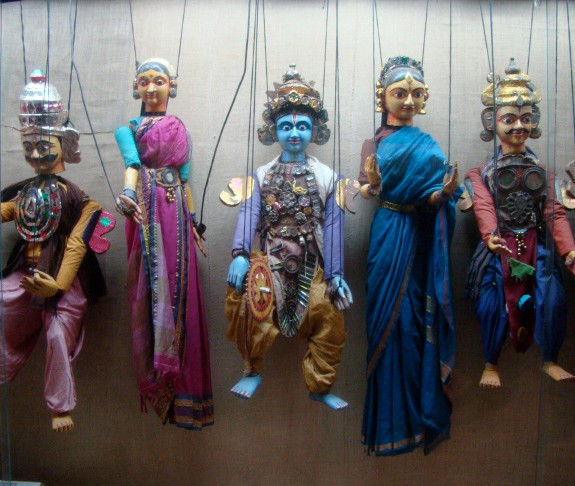
Strin g puppet
Some of the popular examples of string puppetry in India are:
Kathputli (Rajasthan)
The show of Kathputli is accompanied by a dramatic folk music. A unique feature of the puppets is the absence of legs.
Gombeyatta (Karnataka)
It is influenced by Yakshagana Theatres. A unique feature of this puppetry is the use of more than one puppeteer to manipulate the puppets.
Kundhei (Odisha)
The string puppets of Odisha are known as Kundhei. There is a marked influence of Odissi dance in Kundhei puppet shows.
Bommalattam (Tamil Nadu)
Bommalattam combines features of rod and string puppetry. The Bommalattam puppets are the largest and heaviest marionettes found in India.
SHADOW PUPPETS
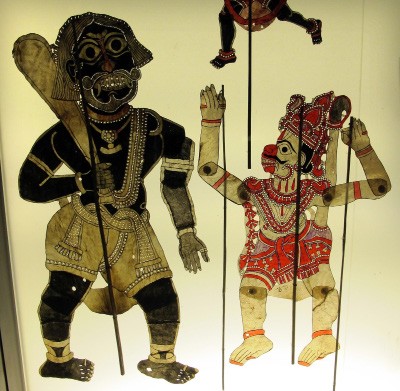
In this form, shadows of puppets are used in black and white in colour. The flat figures, usually made of leather, are lightly pressed on a transparent screen with a strong source of light behind. The screen thus forms the barrier between the audience and the puppet, creating the projection of image causing a dramatic impact.

Shadow puppet
Some of the popular examples of shadow puppetry are-
Togalu Gombeyatta (Karnataka)
These puppets are mostly small in size. The puppets however, differ in size according to their social status, for instance, large size for kings and religious characters and smaller size for common people.
Tholu Bommalata (Andhra Pradesh)
The show is accompanied by a musically classic background and is themed around mythological and devotional tales of the epics and Puranas.
Ravanachhaya (Odisha)
It is the most theatrical shadow puppetry and is a popular form of entertainment in the Odisha region. The puppets are made of deer skin and depict bold and dramatic postures. Use of non- human puppets such as trees and animals is common.
Chamadyacha Bahulya (Maharashtra)
Shadow Puppet Theatre Traditions of Maharashtra. It is practiced by the Thakar community.
Tholpavakoothu (Kerala)
It is a form of shadow puppetry that is practiced in Kerala (Nair Community) and Tamil Nadu. It is performed using leather puppets and is performed in temples or in villages in specially built theatres.
GLOVE PUPPETS
Glove puppets are mostly found in Orissa, Kerala and Tamil Nadu. Puppeteers wear them on the hand and manipulate their heads and arms with their fingers. The puppeteer narrates his story in verse or prose, while the puppets provide, the visual thread.
In Orissa, such plays are based on stories of Radha and Krishna, puppeteer plays on the dholak with one hand and manipulates the puppet with the other. The delivery of the dialogues, the movement of the puppet and the beat of the dholak are well synchronised and create a dramatic atmosphere

Glove puppets
Pavakoothu
In Kerala, the traditional glove puppet play is called Pavakoothu. It came into existence during the 18th century due to the influence of Kathakali. In Pavakoothu, the height of a puppet varies from one foot to two feet. The head and the arms are carved of wood and joined together with thick cloth, cut and stitched into a small bag.
The musical instruments used during the performance are Chenda, Chengiloa, Ilathalam and Shankha the conch. The theme for Glove puppet plays in Kerala is based on the episodes from either the Ramayana or the Mahabharata.
ROD PUPPETS
Rod puppets are an extension of glove-puppets, but often much larger and supported and manipulated by rods from below. This form of puppetry now is found mostly in West Bengal and Orissa.
Rod puppets
Putul Nautch (West Bengal)
In Nadia district of West Bengal, rod-puppets used to be of human size like the Bunraku puppets of Japan. This form is now almost extinct. The Bengal rod-puppets, which survive are about 3 to 4 feet in height and are costumed like the actors of Jatra, a traditional theatre form prevalent in the State. These puppets have mostly three joints. The head, supported by the main rod, is joined at the neck and both hands attached to rods are joined at the shoulders.
Yampuri (Bihar)
These puppets are made of wood. Unlike the traditional Rod puppets of West Bengal and Orissa, these puppets are in one piece and have no joints. As these puppets have no joints, the manipulation is different from other Rod puppets and requires greater dexterity.
Commemorative Postage Stamps
The Department of Posts issued a set of 8 Commemorative Postage Stamps on “Puppets of India” on 13th February 2026 from different regions of India, namely Kathputli (Rajasthan), Yakshagana Sutrada Gombeyatta (Karnataka), Daanger
Putul (West Bengal), Kathi Kundhei (Odisha), Benir Putul (West Bengal), Pavakathakali (Kerala), Ravanachhaya (Odisha) and Tolu Bommalatta (Andhra Pradesh).