INDIAN SPACE RESEARCH PROGRAMME (ISRP)
India’s space exploration began in the early 1960s due to global interest in satellite technology, particularly the American Satellite ‘Syncom-3’ broadcasting the Tokyo Olympics. Dr. Vikram Sarabhai, known as the architect of India’s space program, saw the potential of space technology as a catalyst for India’s development. With the founding of the Indian National Committee for Space Research (INCOSPAR) in 1962, the nation’s space efforts got underway. The Thumba Equatorial Rocket Launching Station (TERLS) in Thiruvananthapuram also began construction that same year. Subsequently, Indian Space Research Organisation (ISRO) was established in August 1969, in place of INCOSPAR. The Government of India constituted the Space Commission and established Department of Space (DOS) in June 1972 and brought ISRO under DOS in September 1972.
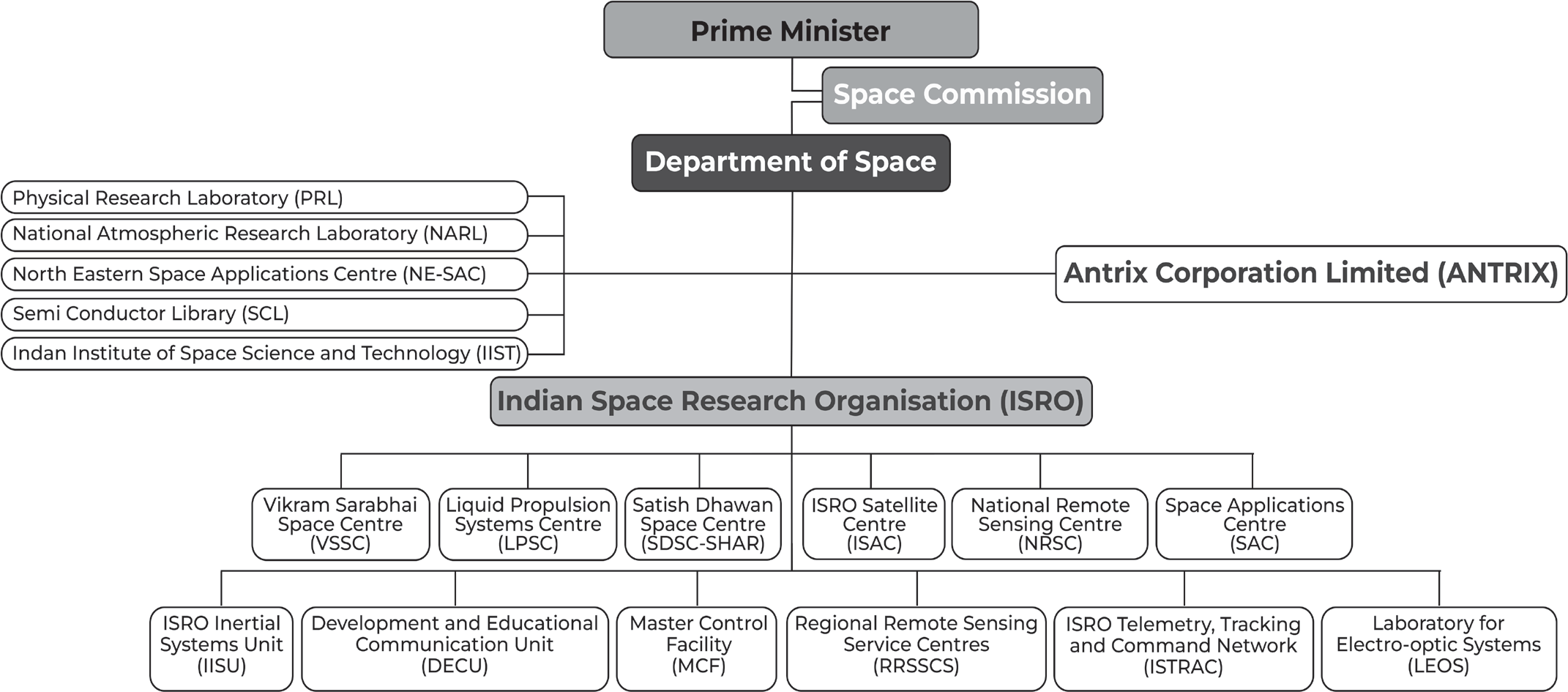
In June 1972, the Indian government formed the Department of Space (DOS), placed ISRO under DOS, and established the Space Commission. The Department of Space (DOS) is primarily in charge of advancing space science, technology, and applications in order to help the country become self- sufficient and grow economically. Towards this, DOS has evolved the following programmes:
Indian National Satellite (INSAT) programme for telecommunications, TV broadcasting, meteorology, developmental education, etc.
Remote Sensing programme for application of satellite imagery for various developmental purposes.
Indigenous capability for design and development of spacecraft and associated technologies for communications, resources survey and space sciences.
Design and development of launch vehicles with indigenous technology for access to space and orbiting INSAT, IRS spacecraft and space science missions.
•
Research and development in space sciences and technologies as well as application programme for national development.
The Space Commission in India formulates policies and oversees the implementation of the Indian space programme, promoting space science and technology for socio-economic benefit. The Department of Space (DOS) implements these programmes through various institutions, including Indian Space Research Organisation (ISRO), Physical Research Laboratory (PRL), National Atmospheric Research Laboratory (NARL), North Eastern-Space Applications Centre (NESAC) and Semi-Conductor Laboratory (SCL).
From its inception, the Indian space program has been built on three foundational pillars:
• The deployment of satellites for communication and remote sensing.
• The development of a space transportation system.
• The implementation of application programs designed to leverage space technology for various national requirements.
In 1967, the first Experimental Satellite Communication Earth Station (ESCES) was operationalized in Ahmedabad, serving as a training center for Indian and international scientists and engineers. ISRO aimed to establish a satellite system that could contribute to the national development by using foreign satellites in the initial stages. The first controlled experiment was the ‘KrishiDarshan’ TV program on agricultural information for farmers, which received good response.
The next step was the Satellite Instructional Television Experiment (SITE), which was hailed as the largest sociological experiment in the world, covering 2400 villages of six states and transmitting development-oriented programs using the American Technology Satellite (ATS-6). The credit of training 50,000 science teachers primary schools in one year goes to SITE.
The Satellite Telecommunication Experiments Project (STEP) was a joint project of ISRO-and Post and Telegraphs Department (P&T) using the Franco-German Symphonie satellite during 1977-79. STEP aimed to provide a system test of using geosynchronous satellites for domestic communications, enhance capabilities and experience in the design, manufacture, installation, operation and maintenance of various ground segment facilities and build up requisite indigenous competence for the proposed operational domestic satellite system, INSAT, for the country.
During this period, the first Indian spacecraft, ‘Aryabhata’, was developed and launched using a Soviet Launcher. The first launch vehicle, SLV-3, with a capability to place 40 kg in Low Earth Orbit (LEO) was developed, which had its first successful flight in 1980. The development of mult- istage rocket systems with appropriate control and guidance systems to orbit a satellite was a major landmark in the space programme.
During the operational phase in the 90s, major space infrastructure was created under two broad classes: communication, broadcasting, and meteorology through a multi-purpose Indian National Satellite system (INSAT) and the Indian Remote Sensing Satellite (IRS) system.
The IRS launched its first satellite in 1988, and the program continued to develop more specialized satellites, such as the Radar Imaging Satellite-1 (RISAT-1, launched in 2012) and the Satellite with Argos and Altika (SARAL, launched in 2013), a joint Indian-French mission that measures ocean wave heights. ISRO then created three more rockets: the Polar Satellite Launch Vehicle (PSLV) for putting satellites into polar orbit, the Geostationary Space Launch Vehicle (GSLV)
for putting satellites into geostationary orbit and a heavy- lift version of the GSLV known as the LVM3. These rockets launched communications and Earth-observation satellites, as well as the Chandrayaan lunar missions (Chandrayaan-1, 2008; Chandrayaan-2, 2019; Chandrayaan-3, 2023) and India’s first Mars mission, the Mars Orbiter Mission (2013). ISRO plans to put astronauts into orbit with the Gaganyaan spacecraft in 2025.
Space Centres and Agencies functioning in India under DOS
• ISRO Centres & Units
• Department of Space and ISRO HQ
• Human Space Flight Centre (HSFC)
• Indian Institute of Remote Sensing (IIRS)
• ISRO Inertial Systems Unit (IISU)
• ISRO Propulsion Complex (IPRC)
• ISRO Telemetry, Tracking and Command Network (ISTRAC)
• Laboratory for Electro-Optics Systems (LEOS)
• Liquid Propulsion Systems Centre (LPSC)
• Master Control Facility (MCF)
• National Remote Sensing Centre (NRSC)
• Satish Dhawan Space Centre (SDSC) SHAR
• Space Applications Centre (SAC)
• U R Rao Satellite Centre (URSC)
• Vikram Sarabhai Space Centre (VSSC)
• IN-SPACe
• CPSEs
• Antrix Corporation Limited
• NewSpace India Limited (NSIL)
• Autonomous bodies
• Indian Institute of Space Science and Technology (IIST)
• National Atmospheric Research Laboratory (NARL)
• North Eastern-Space Applications Centre (NE-SAC)
• Physical Research Laboratory (PRL)

Indian Space Research Organization (ISRO), Bangalore
The Indian Space Research Organisation (ISRO) is the national space agency of India, responsible for space- based operations, exploration, international cooperation, and technology development. It is one of six global space agencies with full launch capabilities, cryogenic engines, extraterrestrial missions and a large fleet of artificial satellites. ISRO is one of the four government space agencies to have soft landing (uncrewed) capabilities. In 1969, ISRO replaced INCOSPAR which was established in 1962 by Jawaharlal Nehru and Dr. Vikram Sarabhai. INCOSPAR grew and became ISRO in 1969 and was incorporated into the Department of Atomic Energy (DAE) in 1972. In 1972, India established the Space Commission and the Department of Space (DoS), establishing ISRO, which institutionalized space research activities in the country. The DoS now manages ISRO and other Indian institutions in astronomy and space technology.
VikramSarabhaiSpaceCentre(VSSC),Thiruvananthapuram
Vikram Sarabhai Space Centre (VSSC) at Thiruvananthapuram is the major centre of ISRO, where the design and development activities of satellite launch vehicles and sounding rockets are carried out and made ready for launch operations. The centre focuses on various technologies such as launch vehicle design, propellants, solid propulsion technology, aerodynamics, avionics, polymers, composites, guidance, control, simulation, computer and information, mechanical engineering, aerospace mechanisms, vehicle integration and testing, space ordnance, chemicals, and materials. The centre ensures systems reliability and quality assurance in all engineering and operations aspects. The Space Physics Laboratory at VSSC conducts research in atmospheric science and related space science activities. The Ammonium Perchlorate Experimental Plant (APEP) in Kerala is part of VSSC. Major programs at VSSC include launch vehicle projects for Polar Satellite Launch Vehicles (PSLV), Geosynchronous Satellite Launch Vehicles (GSLV
Mark II and Mark III), Rohini Sounding Rockets, Space- capsule Recovery Experiments, Reusable Launch Vehicles,
and Air Breathing Propulsion for Advanced Reusable Launch Vehicles.
Satish Dhawan Space Centre (SDSC) SHAR, Sriharikota
Satish Dhawan Space Centre (SDSC) SHAR with two launch pads is the main launch centre of ISRO located at 100 km north of Chennai. SDSC SHAR has the necessary infrastructure for launching satellite into low earth orbit, polar orbit and geostationary transfer orbit. The launch complexes provide complete support for vehicle assembly, fuelling, checkout and launch operations. Apart from these, it has facilities for launching sounding rockets meant for studying the earth’s atmosphere. Achievements include establishment of launch complexes for Sounding rockets, SLV- 3, ASLV and PSLV. Launch complex augmented for GSLV.
Liquid Propulsion Systems Centre (LPSC), Thiruvananthapuram / Karnataka
The LPSC takes care of design development, testing, and implementation liquid propulsion packages. The production and testing of liquid stages and liquid engines for launch vehicles and satellites take place here. LPSC, Bangalore on the other hand is responsible for producing precision transducers.
U R Rao Satellite Centre, Bangalore
It is the lead centre of the Indian Space Research Organisation (ISRO) responsible for design, development, assembly & integration of communication, navigation, remote sensing, scientific and small satellite missions. URSC’s specialized teams have developed over 90 advanced satellites for various applications, including telecommunications, telemedicine, navigation, weather forecasting and disaster warning. They aim to expand space technology benefits to society by creating cost-effective infrastructure.
Space Applications Centre (SAC), Ahmedabad
The Space Applications Centre (SAC) is a major center of the Indian Space Research Organisation (ISRO) that focuses on various disciplines such as payload design, societal applications, capacity building and space sciences. It develops communication, navigation, earth and planetary observation payloads, meteorological payloads, data processing and ground systems. SAC operates Ahmedabad and Delhi Earth Stations and hosts training programs under the UN-affiliated Centre for Space Science & Technology Education in Asia and the Pacific (CSSTEAP).
National Remote Sensing Centre (NRSC), Hyderabad
The National Remote Sensing Centre (NRSC) handles satellite data acquisition, processing, dissemination, aerial remote sensing, and disaster management support. The centre also collaborates with users on remote sensing application projects.
ISRO Telemetry Tracking and Command Network (ISTRAC), Bangalore
ISRO Telemetry Tracking and Command Network (ISTRAC) provides space operation services for launch vehicle, low earth orbiting spacecraft and deep space missions. It also develops RADAR systems for tracking and atmospheric applications and establishes a Ground Segment Network for the Indian Regional Navigation Satellite System. ISRO has established a network of ground stations to provide Telemetry, Tracking, and Command (TTC) support for satellite and launch vehicle missions, with facilities in Bangalore, Lucknow, SHAR, Thiruvananthapuram, Port Blair Island, Brunei, Biak, and Mauritius. The Indian Deep Space Network (IDSN) forms the ground segment for India’s Chandrayaan-1 mission.
Master Control Facility (MCF), Hassan & Bhopal
The Master Control Facility (MCF) in Karnataka and Madhya Pradesh oversees ISRO’s geo-stationary satellites, performing operations like initial orbit raising, in-orbit payload testing, and on-orbit operations. It also handles special operations like eclipse management and station-keeping manoeuvres. MCF collaborates with user agencies to optimize satellite payload utilization and minimize service disruptions.
ISRO Propulsion Complex (IPRC), Mahendragiri
ISRO Propulsion Complex (IPRC), Mahendragiri, is a state- of-the-art facility for ISRO space research. Previously known as LPSC, Mahendragiri, it was elevated as IPRC on February 1, 2014, due to future growth in the nation’s space program and expansion at the site.
ISRO Inertial Systems Unit (IISU), Thiruvananthapuram
ISRO Inertial Systems Unit (IISU) in Thiruvananthapuram designs and develops inertial systems for launch vehicles and spacecraft programs. Major systems include navigation systems, attitude reference systems, rate gyro packages, and accelerometer packages. IISU also designs actuators and mechanisms for spacecraft. It engages in continuous research and development to improve cost-effective, reliable and realisable systems.
Indian Institute of Remote Sensing (IIRS), Dehradun
It aims to build capacity in Remote Sensing and Geo- informatics through postgraduate education and training programs. It supports the Centre for Space Science and Technology Education in Asia and the Pacific (CSSTE-AP) and caters to various user groups.
SPACE BASED PROGRAMME
YUVIKA
• Indian Space Research Organisation is organising a special programme for School Children called “Young Scientist Programme” “YUva VIgyani KAryakram”, YUVIKA, to impart basic knowledge on Space Technology, Space Science and Space Applications to the younger students in emerging trends in space science and technology amongst the youngsters, who are the future building blocks of our nation.
• ISRO has chalked out this programme to “Catch them young”. The programme is also expected to encourage more students to pursue in Science, Technology, Engineering and Mathematics (STEM) based research /career.
• It was a two-week residential programme for the high school students.
• The students were given exposure to space science, technology and applications through classroom lectures, hands-on activities such as model rocketry, sky gazing, robotic coding/experiments, CANSAT experiments, drone demonstrations, DIY kits assembly, facility visits and interaction with eminent scientists etc.
Extracurricular activities like yoga & meditation, sports, cultural activities and local sight tours etc. were also organised as part of the residential programme.
Antrix Corporation
Antrix Corporation Limited (ACL), a government-owned company, was established in 1992 as a marketing arm of ISRO to promote and commercialize space products, technical consultancy services, and transfer of ISRO-developed technologies. The company aims to develop space-related industrial capabilities in India. As the commercial and marketing arm of ISRO, Antrix provides space products and services to international customers worldwide. It offers hardware and software for various applications, including communications, earth observation, and scientific missions. It also provides space-related services such as remote sensing data, transponder lease, launch services, mission support services, and consultancy and training services