Indifference Curve
An indifference curve is a graphical representation used in microeconomics to depict the various combinations of two goods or services that provide equal levels of satisfaction or utility to a consumer. It shows all the possible combinations of goods among which the consumer is indifferent or has no preference.
A curve joining all points representing bundles among which the consumer is indifferent is called an indifference curve. Every point on an indifference curve, such as A, B, C and D, offers the same degree of satisfaction to the customer.
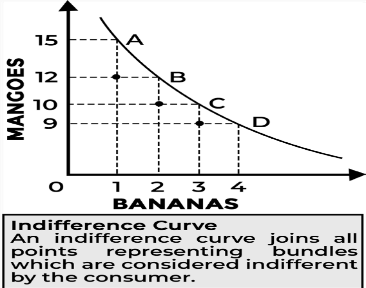
The marginal rate of substitution (MRS) is the quantity of mangoes a consumer must give up in order to obtain an extra banana while maintaining her total utility level.
Put otherwise, MRS represents the rate at which a customer will switch from mangoes to bananas while maintaining the same level of overall utility.
Features of Indifference Curve
The indifference curve slopes downwards from left to right.
A higher indifference curve gives a greater level of utility.
Two indifference curves never intersect each other.
Engel curve
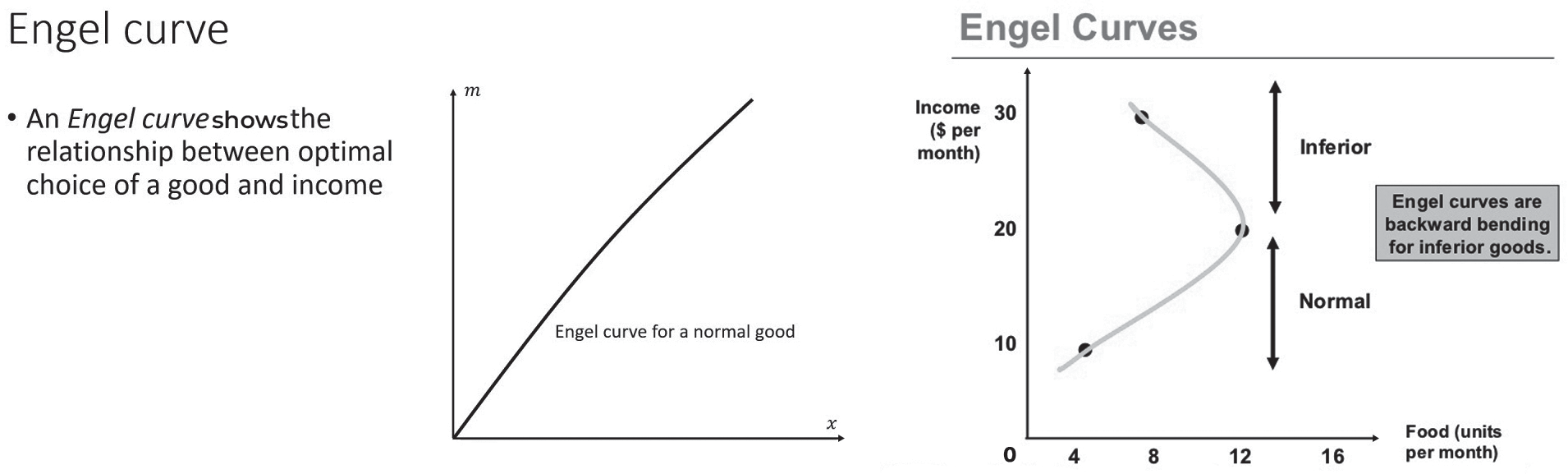
The Engel curve illustrates the relationship between household income and expenditure on a certain good. Along with other consumer attributes, demographic factors like age, gender and educational attainment can affect the shape of an Engel curve.
Additionally, the Engel curve varies according to the kind of items. With income level as the x-axis and expenditures as the y-axis, the Engel curves show upward slopes for normal goods, which have a positive income elasticity of demand. Inferior goods, with negative income elasticity, assume negative slopes for their Engel curves. In the case of food, the Engel curve is concave downward with a positive but decreasing slope.
Kuznets curve
The Kuznets curve is an economic concept that explains the relationship between economic development and income inequality. It proposes that when a nation moves from an agrarian to an industrial economy in its early stages of growth, income disparity rises. Income disparity reduces while economic growth continues. A common representation of the Kuznets Curve is an inverted U, where income inequality rises in the early phases of development and then falls after a certain degree of economic success is attained. The question of whether this pattern is always true remains unresolved, as some scholars have proposed that the relationship between economic progress and income disparity may be influenced by other variables, such as governmental regulations.
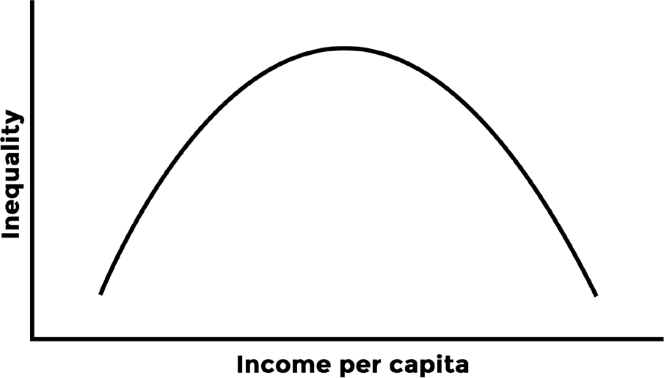
The Kuznets curve hypothesis suggests that economic development is linked to a specific pattern of income inequality over time. It implies that when a nation experiences economic growth, income disparity first rises before peaking and declining as the nation grows wealthier.