Indo-Greeks
The Indian word for coin Karsa is of Persian origin. The coins might have been inspired by the Persian coins.
• The presence of coins from this period indicates active trade connections between India and Persia.
• Mauryan art and architecture exhibit clear Persian influences, with the Ashokan Pillars resembling columns from the Achaemenid Empire.
• The bell-shaped capitals of the columns, such as the lion capital of the Sarnath pillar and the bell capital of the Rampurva pillar, share similarities with designs found in Achaemenid columns.
• Additionally, the pillared remains of the palace in Pataliputra bear a striking resemblance to the pillared halls of the Achaemenid capital. Despite these influences, Indian craftsmen infused their work with distinct local characteristics, blending Persian designs with Indian styles.

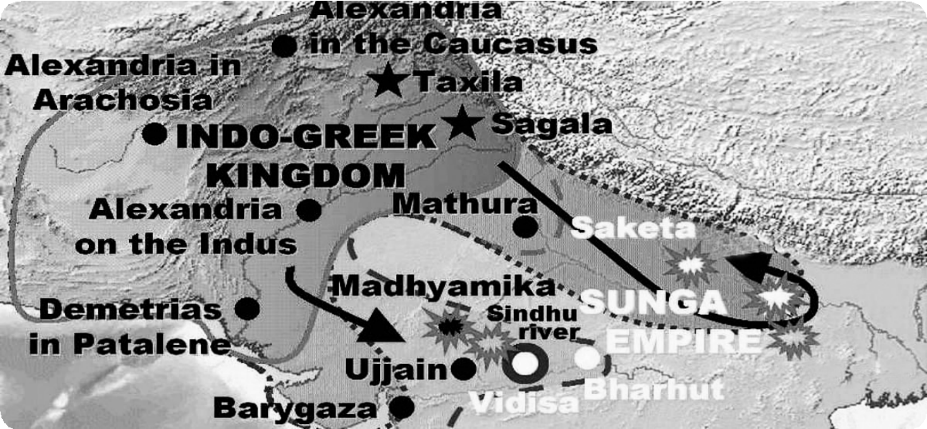
• After Alexander’s death in 323 BCE, Greek settlers moved to the north-western border of India near Bactria (now northern Afghanistan, south of the Oxus River, and northwest of the Hindu Kush mountains).
Beginning of Bactrian Rule
• These Bactrian Greeks descended from Hellenistic ancestry and were originally subordinate rulers of the Seleucid Empire.
• Around the 3rd century BCE, Diodotus I rebelled against the Seleucid king and founded an independent Bactrian Greek kingdom.
• By around 145 BCE, due to pressure from Scythian tribes, the Bactrian Greeks lost Bactria but continued to rule part of north-western India between the 2nd century BCE and the early 1st century BCE, known as the Indo-
Greeks.
• Since the successors of Ashoka were too weak to hold ground, a series of invasions on the north-western border of India started.

• Facing Scythian threats at the beginning of the 2nd century BCE, the Indo-Greeks were the first to invade India and expanded as far as Ayodhya and Pataliputra and occupied a large part of north-western India, much larger than that conquered by Alexander.
Significance of Coins
• They were the first to mint gold coins, and their history is primarily documented through coins, including silver, copper, and nickel.
• Out of 42 Indo-Greek kings, 34 are only known through their coins, suggesting concurrent rule, possibly by two Greek dynasties in north-western India.
Rulers of the Indo-Greek kingdom:
Antiochus II
• Governor of Bactria.
• Defeated king Subhagsena of Kabul.
Demetrius (King of Bactria):
• He invaded India around 190 BCE and likely clashed with Pushyamitra Shunga.
• He successfully captured a significant portion of the Mauryan Empire in north-western India, expanding Bactrian rule south of the Hindu Kush.
Menander /Milinda/Minedra (165 BCE – 145 BCE):
• His kingdom's capital was Sakala, modern-day Sialkot in Punjab.
• His empire spanned parts of both Bactria and northwestern India, including southern Afghanistan and Gandhara, located west of the River Indus.
• He invaded the Ganga-Yamuna Doab but was unable to hold it for long.
• He embraced Buddhism after learning from a Buddhist
monk named Nagasena, also known as Nagarjuna.
• He is likely the same King Minedra mentioned in a fragmented Kharosthi inscription found on a casket at Bajaur (now in Pakistan's North-West Frontier Province), which commemorates the enshrinement of Buddha's relics, possibly in a stupa, during his reign.
• His coins feature the Dharmachakra symbol.
Hermaius:
• He was the last ruler of this dynasty, defeated by the
Parthians at the end of the 2nd century BCE.
• Their north-western Gandhara region was also lost to Parthians, Shakasand, and Kshatrapas.
Impact of Indo-Greek Rule on Indian Subcontinent:
• First rulers to issue gold coins in India. Also issued silver, copper, and nickel coins.
• IndoGreek coins indicate that Shaiva and Bhagvata sects were prominent in their kingdom.
•
The contact between Greek and Central Asian cultures gave rise to a fusion of Hellenistic art and literature with Indian art, particularly seen in Gandhara art in northwestern India. E.g. Besnagar Pillar inscription of Heliodorus.
• Hellenistic Greeks are renowned for their grand structures and intricate artifacts. Excavations at Ai- Khanoum, Antioch, and Sirkap in Taxila display their impressive urban planning skills.
• The Indo-Greeks introduced the practice of military governorship, with governors known as strategos or satraps.