Introduction
• India witnessed the early development of cultures and civilizations.
• Since the Old Stone Age, various groups migrated multiple times across the region, adapting culturally to different eco-zones.
•
Each group developed its own unique culture, shaped by their experiences in each new environment, leading to a diversity of beliefs and systems.
• Transitioning from foraging and nomadic pastoralism, the settlers of the Indus region eventually reached a more advanced way of life during the Bronze Age.


Sources
Archaeological sources serve as the foundation for understanding this extensive period in Indian history.
• These sources include archaeological sites, geological sediments, animal bones and fossils, stone tools, bone tools, rock paintings, and various artifacts.
• There is no written record from this era, although the Harappans had a script that remains undeciphered.
• Faunal (animal) and floral (plant) evidence are crucial for understanding how Stone Age people interacted with their environment.
• Floral evidence, such as charred seeds, pollen, and phytoliths (plant stones), provides insights into the farming practices of Stone Age people.
• Human genetics also play a key role in tracing prehistoric migrations, with mitochondrial DNA (mt-DNA) studies offering valuable information.
Some Important Terms to Be Understood
• Sites: Places from where historical evidence can be collected.
• Factory Sites: These are the places where stone tools were made.
• Habitation Sites: Places where people started residing.
• Acheulian Industry: A type of industry based on producing stone tools which was present during Palaeolithic times.
Process of Making Stone tools:
Majorly two techniques were popular.
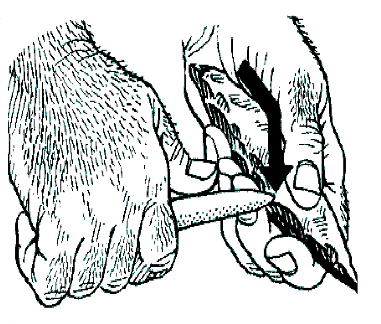
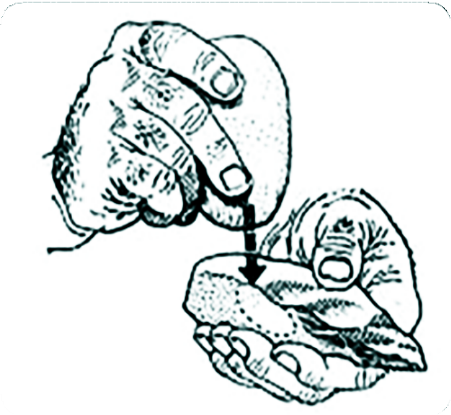
Stone on Stone Technique: Stones were used to cut other stones/rocks to make tools.
Pressure Flaking: Pressure techniques were used to remove outer unwanted material around the stones and thus making the desired tool.
• Based on research, two independent cultural traditions of hand axe (Acheulian) and pebble-flake (Sohanian) industries were confirmed in India.
• Acheulian industry mainly had hand axes and cleavers. The Sohan industry is considered to have used only chopper and chopping tools.
• The Sohan industry gets its name from the Sohan river valley of Pakistan. These two cultural traditions are not considered distinct any longer.
• Recent studies argue that there was no independent Sohan tradition as Acheulian tools are found in the Sohan industry as well.



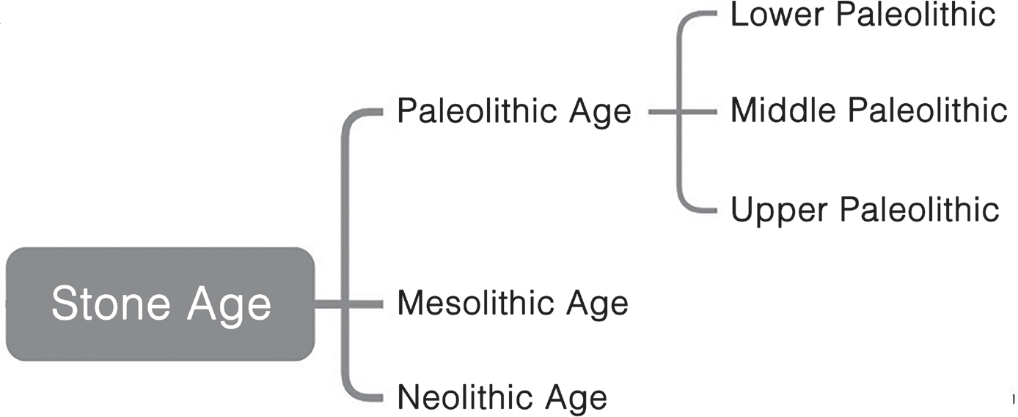
Various periods under Lithic or Stone Age
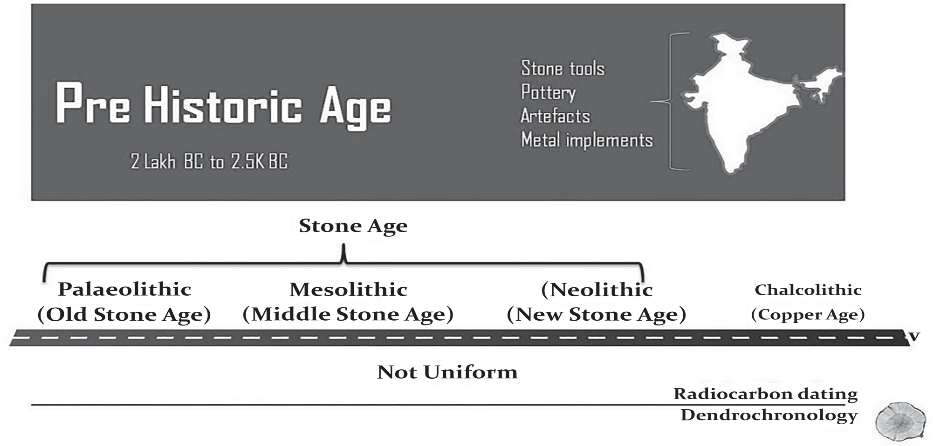
On the basis of the type and technology of stone tools, and subsistence base, the Indian Stone Age is classified primarily into three types:
• Old stone Age or Palaeolithic Age (5,00,000 10,000 BCE)
• Late Stone Age or Mesolithic Age (10,000 6000 BCE)
• New Stone Age or Neolithic Age (6,000 1000 BCE)